Hospital Registration Cancellation Upheld Where Unqualified Persons Performed Medical Functions
Court / Authority
Madhya Pradesh High Court
Update / Judgement Date
26 Nov 2026
Case No.
Writ Petition No. 5574 of 2015
Source
WCP News Bulletin
Author
Dipanshi Bansal — WCP Legal Desk
Reading Time
6 min read
View Count
Civil LawOther Legal Matters
Madhya Pradesh High Court · WCP News Bulletin
The High Court declined to interfere with cancellation of a hospital’s registration after an enquiry found that persons without the requisite medical qualifications had performed functions recorded as medical duties, holding that the statutory authorities had acted within jurisdiction and had afforded a meaningful opportunity of hearing. The Court also held that writ review concerns legality of the decision-making process rather than a fresh factual enquiry. (Paras 43–54)
Key Proposition: A hospital cannot avoid regulatory consequences merely by pointing to the presence of qualified doctors where the record supports deployment of unqualified persons in functions requiring professional qualifications and the statutory decision-making process is otherwise lawful.
Madhya Pradesh Nursing Homes and Medical Establishments Act, 1973 – hospital registration – unqualified personnel – whether regulatory authorities could act on contemporaneous medical records? – Held, yes, subject to statutory procedure and relevant material. (Paras 43–54)
Article 226 – judicial review – enquiry report – whether High Court should substitute its own factual enquiry? – Held, no, absent jurisdictional or material procedural illegality. (Paras 45–52)
Natural justice – show-cause notice – meaningful opportunity – whether mere receipt of a reply is sufficient? – Held, opportunity must be real and effective, but the record here did not establish a legally sustainable violation. (Paras 46–50)
Reasoned orders – appellate authority – whether absence of elaborate discussion invalidates the order? – Held, no, if reasons are discernible and material grounds have been considered. (Paras 49–50)
Background / Synopsis :
The petitioner hospital challenged orders dated 24 June 2015 and 14 August 2015 cancelling its registration, along with a consequential communication dated 9 September 2015.
The proceedings followed an enquiry into treatment of a child at the hospital, including allegations that persons lacking the requisite medical qualifications were functioning as duty doctors and making treatment-related entries.
The petitioner disputed the enquiry, asserted that qualified doctors supervised treatment, and challenged the procedure, natural justice, jurisdiction and appellate reasoning.
Full Judgement / Attachment
Full Judgement
The Court examined the statutory record, hospital records, enquiry report, show-cause proceedings and the appellate order before deciding whether Article 226 intervention was warranted.
Issues For Consideration :
Whether the cancellation of the hospital’s registration suffered from jurisdictional or procedural illegality under the governing 1973 Act.
Whether the enquiry was legally defective because all treating doctors were not examined and because a subsequent report existed.
Whether the petitioner received a meaningful opportunity of hearing and whether the appellate order was adequately reasoned.
Whether the High Court should direct a fresh independent enquiry.
Submissions Of Parties :
Petitioner / Hospital:
The hospital argued that the concerned persons were only assisting qualified doctors and that medical treatment remained under qualified supervision.
It challenged the enquiry as incomplete and disputed reliance on selected medical-record entries.
It alleged violation of natural justice, including non-supply of the enquiry report with the show-cause notice and failure to consider requests concerning an independent enquiry.
It relied on the requirement of reasoned orders and cited Kranti Associates and other authorities.
State / Respondents:
The State relied on the hospital’s own contemporaneous records and the enquiry report to contend that unqualified persons had performed functions reserved for qualified medical personnel.
It argued that the hospital received a show-cause notice, submitted a reply, and had sufficient opportunity to defend itself.
It maintained that the statutory authorities acted within their powers and that the appellate order disclosed adequate consideration.
Court's Observations & Analysis :
Re: Statutory regulation and unqualified personnel
The Court held that the relevant question was the actual nature of functions performed, not merely the designations given to the employees or the presence of qualified doctors.
The hospital had a statutory responsibility to ensure that medical functions were performed by duly qualified persons and prescribed standards were maintained.
The contemporaneous records and qualifications of the concerned personnel were relevant material for the competent authority.
Held: The petitioner did not establish that the statutory action was based on irrelevant material or suffered from jurisdictional error. (Paras 43–54)
Re: Judicial review and enquiry
Article 226 review is concerned with the legality of the decision-making process and does not ordinarily permit the Court to substitute its own factual enquiry.
A fresh enquiry cannot be ordered merely because the affected party disputes the findings; a material legal infirmity must be shown
Held: No sufficient ground existed to replace the statutory enquiry with a fresh enquiry. (Paras 45–52)
Re: Natural justice and reasons
The Court stressed that natural justice requires a real and effective opportunity, not a merely formal notice.
The petitioner had participated in the enquiry and responded to the show-cause notice; the record did not demonstrate a legally sufficient denial of hearing.
An appellate authority must disclose consideration of material grounds, but an order need not separately discuss every submission if its reasoning is discernible.
Held: The appellate order was not vitiated merely because the petitioner expected more elaborate reasoning. (Paras 46–50)
Notable Observations:
“The requirement of natural justice is not an empty formality.” (Para 47)
“The power of this Court under Article 226 of the Constitution is intended to ensure legality, fairness and compliance with statutory requirements and is not intended to substitute the Court's own enquiry.” (Para 52)
Decision & Directions :
The writ petition was dismissed.
The cancellation orders and consequential action were not interfered with.
The earlier interim protection, if any, stood vacated.
There was no order as to costs; pending interlocutory applications were disposed of.
Legal Provisions Discussed & Precedents Cited :
Madhya Pradesh Nursing Homes and Medical Establishments Act, 1973 – statutory regulation and registration of hospitals.
Constitution of India, Article 226 – judicial review of statutory decision-making.
Principles of natural justice – meaningful opportunity of hearing.
Reasoned decision-making – requirement that quasi-judicial authorities disclose application of mind.
Kranti Associates Pvt. Ltd. v. Masood Ahmed Khan & Others, (2010) – Relied on for the requirement of reasons in judicial, quasi-judicial and administrative decisions.
Kishan Patel and Others v. State of Madhya Pradesh – Considered on statutory requirements concerning reasons; distinguished on statutory context.
Ameena Begum v. State of Telangana and Others – Considered on reasoned decision-making; distinguished on statutory context.
Case Details :
Case / Party Name: Mescot Hospital and Research Centre Pvt. Ltd. v. The State of Madhya Pradesh & Others
Case Number(s): Writ Petition No. 5574 of 2015; CNR No. MPHC030187672015
Counsel Appearances: Shri N.K. Gupta, Senior Advocate with Shri Ankur Maheshwari and Shri Yashasvi Pratap Singh Rathore for the petitioner; Smt. Smriti Sharma, Government Advocate for the State; Shri Vivek Kumar Mishra and Mukesh Sharma for Respondent No. 5, who was also present in person.
Disclaimer: This summary is an editorial aid and does not form part of the judgment. Refer to the original judgment before citing.
RG Medical College sought permission for 50 MBBS seats after disapproval and rejection of its appeals. The Court found deficiencies in infrastructure, faculty and clinical…
The High Court applied its earlier approach to a frozen current account where a disputed amount of Rs.11,37,017.20 was involved. It directed that the account be unfrozen and…
Acting on a suo motu reference, the High Court permitted termination of a 29-week pregnancy of a 14-year-old rape survivor after considering her wishes, her parents’ consent, the…
The High Court quashed the termination of a long-serving Panchayat employee after finding serious procedural defects in the disciplinary process, including the absence of a…
In a common bail order arising from one prosecution, the Madras High Court held that separate recoveries of 10 kg of ganja from each accused could not, at the bail stage, be…
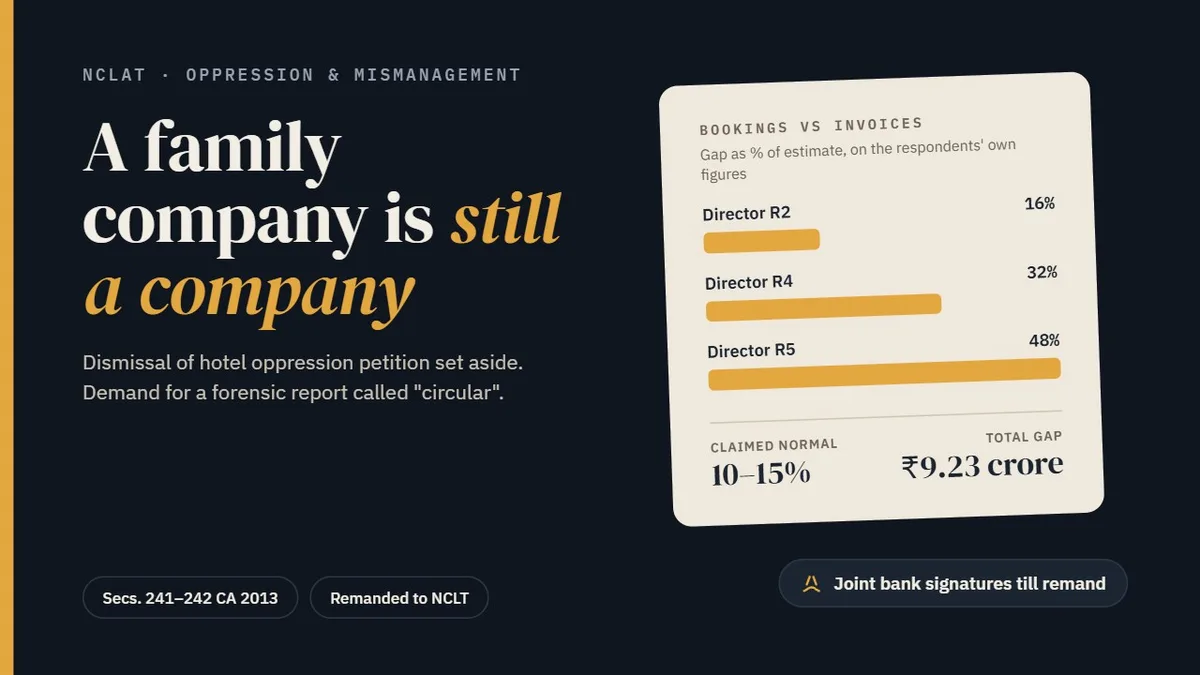
A promoter-director who had run the finances of a family-owned hotel company in Rohini, Delhi, and his wife together holding 14.92% directly alleged that after he questioned a Rs.…
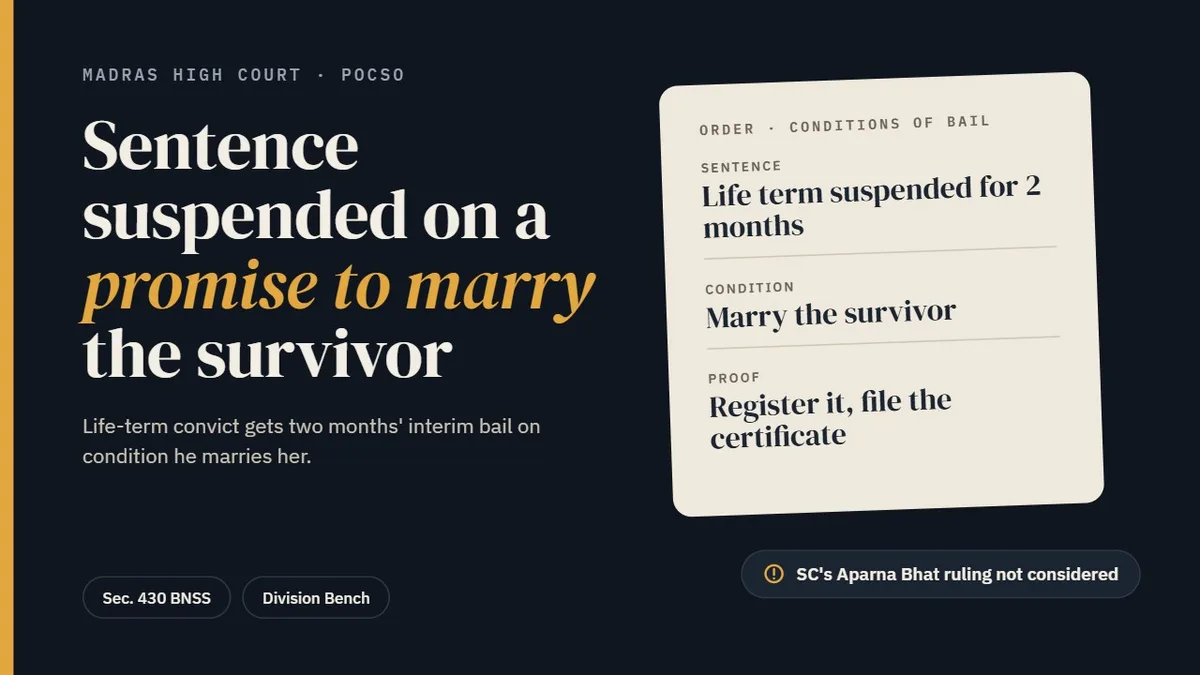
The petitioner, the maternal uncle of the survivor, was convicted by the Principal POCSO Court, Salem on 26.04.2023 under Sections 5 k and 5 n read with Section 6 of the POCSO Act…
The petitioner sought interim custody under Section 497 BNSS of his Swift car, seized by DCB Police Station, Surat in a case under the Gujarat Prohibition Act, 1949; the State…
The Securities and Exchange Board of India SEBI has kept the list of 'Significant Indices' unchanged following its half-yearly review for the period from 01 January 2026 to 30…
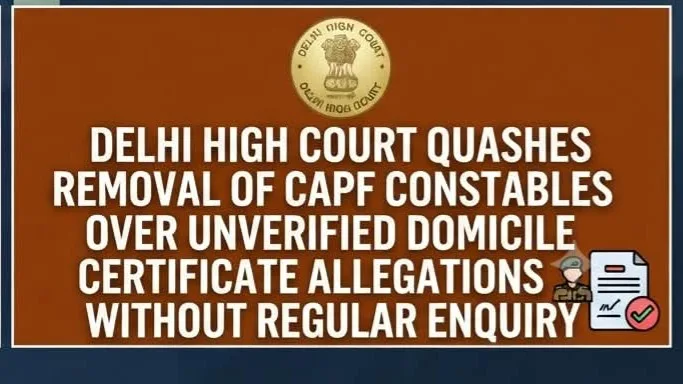
Six former Constables GD in the Central Industrial Security Force CISF and Sashastra Seema Bal SSB challenged their removal from service and the dismissal of their departmental…