
RG Medical College sought permission for 50 MBBS seats after disapproval and rejection of its appeals. The Court found deficiencies in infrastructure, faculty and clinical…
Other Legal Matters
Court / Authority
Gujarat High Court
Update / Judgement Date
23 Nov 2026
Date of Publication
25 Nov 2026
Source
WCP News Bulletin
Author
Arshee Saifi — WCP Legal Desk
Reading Time
7 min read
View Count
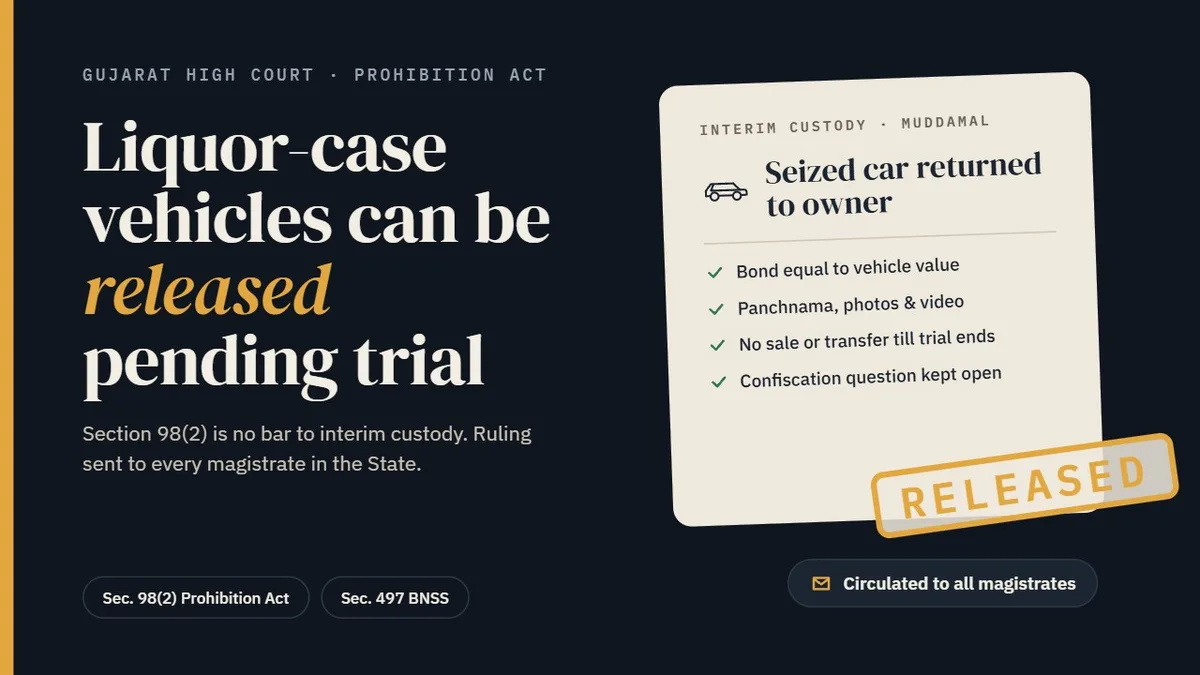
Key Proposition: Section 98(2) of the Gujarat Prohibition Act, 1949, especially after its 2024 amendment, is not an absolute bar to interim custody of a vehicle seized in a liquor case; the Magistrate must decide an application under Section 497 BNSS on its merits and may release the vehicle on safeguards, since interim custody and eventual confiscation operate in different fields.
Background / Synopsis :
Issues For Consideration :
Submissions Of Parties :
He is the lawful owner; prolonged retention exposes the vehicle to deterioration and loss of value; he will furnish bond and security (Para 2).
The vehicle was used to transport liquor above the permissible limit and is liable to confiscation; Section 98(2) bars release pending trial (Para 3).
Court's Observations & Analysis :
The provision aims to preserve seized property and avoid needless retention; its statement, photograph and videography mechanism shows that evidentiary identity does not require continued physical detention (Paras 6–7.1).
The Supreme Court has held Section 98(2) is not an absolute embargo; Sections 98 and 132 of the Act and Section 451 CrPC operate in different fields (Khengarbhai) (Paras 8–9).
Courts must not take a narrow view of their powers; seized property should not be kept longer than necessary (Basavva Kom Dyamangouda Patil; Sunderbhai Ambalal Desai; General Insurance Council) (Paras 10–12.1).
Uday Singh (Forest Act) and Multani Hanifbhai (Animal Preservation Act) are distinguishable regimes; the Prohibition Act has its own confiscation procedure with notice and hearing (Paras 12.2–12.3).
The 2024 amendment removed the bar on release on bond or surety; Pareshkumar (2017) must be read in that light (Paras 12.4–13).
The State's objection rests on Section 98(2) alone, which by itself is not a ground for rejection; the vehicle's use in an alleged offence does not make its detention throughout trial indispensable (Para 14).
Deterioration, depreciation and loss of use can be avoided while evidence is preserved by panchnama, photography and videography (Paras 15–16).
Interim custody is not acquittal and does not extinguish the power of confiscation (Para 17).
Held: The Magistrate is competent, and required, to decide such applications on merits with safeguards; continued detention of this vehicle is not warranted. (Paras 18–20)
Notable Observations:
"…grant of interim custody would not amount to acquittal, discharge or any determination concerning the allegations levelled against the accused nor would it extinguish the power of confiscation available under the Gujarat Prohibition Act." (Para 17)
"A motor vehicle is a valuable movable asset. Its prolonged detention in an open police compound exposes it to natural deterioration, depreciation, damage and loss of utility." (Para 15)
Decision & Directions :
Petition allowed; Rule made absolute. (Paras 21, 24)
1. Personal bond with solvent surety equal to the vehicle's price as stated in the FIR. (Para 21.2)
2. Undertaking to produce the vehicle before the IO or court when directed. (Para 21.3)
3. No sale, transfer, mortgage or third-party interest without the court's permission. (Para 21.4)
4. IO to prepare a detailed panchnama (make, model, registration, chassis and engine numbers, condition) with photographs and videography from all sides, in the presence of the petitioner and two independent witnesses, to be placed on the trial-court record. (Paras 21.5–21.6)
5. Undertaking not to use the vehicle for any offence under the Prohibition Act. (Para 21.7)
6. If the vehicle is ultimately confiscated, the security may be proceeded against or the vehicle auctioned as permissible in law. (Para 21.8)
7. On compliance, the IO to hand over the vehicle expeditiously. (Para 21.10)
Copy to the RTO to record the restraint on transfer until final disposal, subject to trial-court permission. (Para 23)
Registry to circulate the judgment to all judicial officers of the District Judiciary in Gujarat. (Para 25)
Record notes: Para 7 splices a sentence of the Court's own commentary into the middle of the quoted text of Section 497(3) BNSS; condition 21.2 asks for security 'to the satisfaction of this Court' though compliance will ordinarily be before the trial court or IO; 'Copy of this order be send' (Para 23).
Separate Opinions: None.
Legal Provisions Discussed & Precedents Cited :
Case Details :
Disclaimer: This summary is an editorial aid and does not form part of the judgment. Refer to the original judgment before citing.
Full Judgement / Attachment
Full Judgement
© 2026 White Collar Professional Technologies Pvt. Ltd. All rights reserved. CIN: U74999MH2024PTC000001
RG Medical College sought permission for 50 MBBS seats after disapproval and rejection of its appeals. The Court found deficiencies in infrastructure, faculty and clinical…

The High Court applied its earlier approach to a frozen current account where a disputed amount of Rs.11,37,017.20 was involved. It directed that the account be unfrozen and…

Acting on a suo motu reference, the High Court permitted termination of a 29-week pregnancy of a 14-year-old rape survivor after considering her wishes, her parents’ consent, the…

The High Court quashed the termination of a long-serving Panchayat employee after finding serious procedural defects in the disciplinary process, including the absence of a…

The High Court declined to interfere with cancellation of a hospital’s registration after an enquiry found that persons without the requisite medical qualifications had performed…
In a common bail order arising from one prosecution, the Madras High Court held that separate recoveries of 10 kg of ganja from each accused could not, at the bail stage, be…
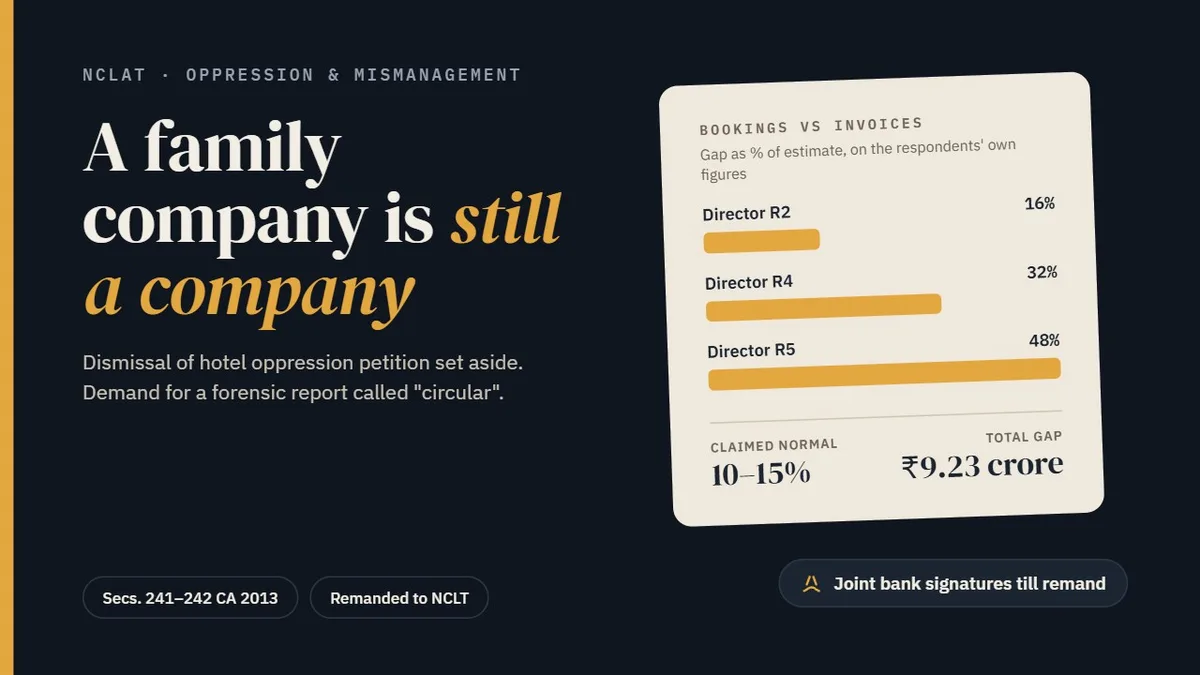
A promoter-director who had run the finances of a family-owned hotel company in Rohini, Delhi, and his wife together holding 14.92% directly alleged that after he questioned a Rs.…
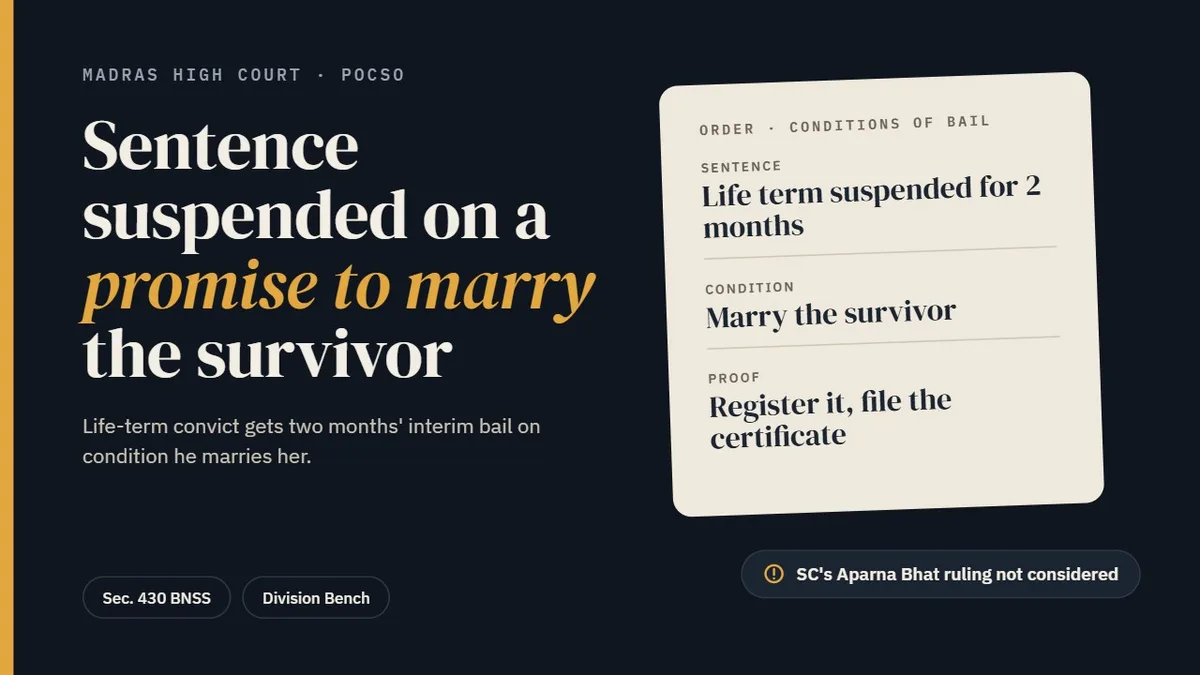
The petitioner, the maternal uncle of the survivor, was convicted by the Principal POCSO Court, Salem on 26.04.2023 under Sections 5 k and 5 n read with Section 6 of the POCSO Act…
The Securities and Exchange Board of India SEBI has kept the list of 'Significant Indices' unchanged following its half-yearly review for the period from 01 January 2026 to 30…
Six former Constables GD in the Central Industrial Security Force CISF and Sashastra Seema Bal SSB challenged their removal from service and the dismissal of their departmental…