
An 85-year-old senior citizen sought eviction of his son and daughter-in-law from his self-acquired home under the Maintenance and Welfare of Parents and Senior Citizens Act,…
Family Law
Court / Authority
Income Tax Tribunal
Update / Judgement Date
19 Aug 2026
Source
WCP News Bulletin
Author
Manas Yadav — WCP Legal Desk
Reading Time
2 min read
View Count
5
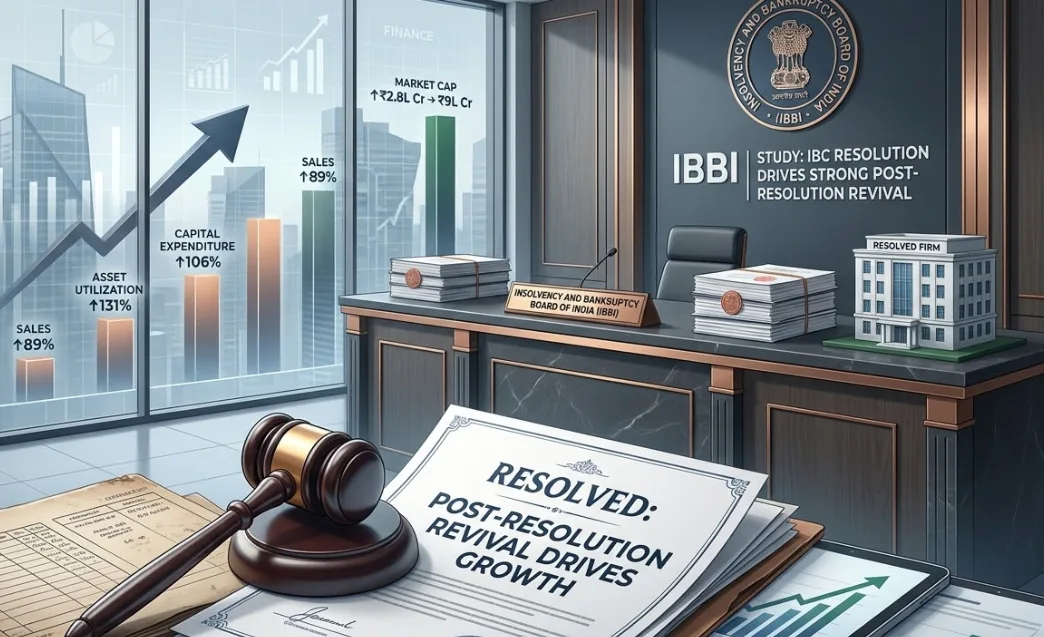
The Insolvency and Bankruptcy Board of India (IBBI) has released a research study conducted by the Indian Institute of Management Ahmedabad assessing the effectiveness of the resolution process under the Insolvency and Bankruptcy Code, 2016 (IBC). The study evaluates post-resolution performance of 1,194 firms and extends prior analysis up to 2025. The study finds a significant improvement in operational and financial indicators of firms undergoing resolution. Average sales of resolved firms increased by 89% within five years of resolution, indicating strong business recovery. Asset utilisation also improved substantially, with the asset turnover ratio rising by approximately 131% over the same period.
Capital expenditure witnessed a notable increase of about 106% post-resolution, reflecting renewed investment activity and improved economic viability. The average asset base of these firms grew from ₹228.33 crore in the year of resolution to ₹254.60 crore after five years, marking an increase of approximately 11.5%. Employment-related indicators also showed upward movement. Average employee expenses rose by nearly 71.91%, while employee strength relative to total assets increased by around 200%, suggesting expansion in workforce intensity following resolution.
Market-linked indicators recorded a sharp recovery. The aggregate market capitalisation of resolved firms increased from approximately ₹2.8 lakh crore to ₹9 lakh crore over five years, reflecting improved investor confidence and valuation recovery. Liquidity levels strengthened significantly, with an increase of around 106% in the five-year post-resolution period, indicating enhanced financial stability and short-term solvency.
Legal Analysis
The study underscores the effectiveness of the resolution framework under the IBC in restoring the financial and operational health of distressed firms. The empirical findings demonstrate that resolution under the Code is associated with sustained improvements across multiple performance indicators, including revenue generation, asset efficiency, investment activity, and financial resilience. The observed trends indicate that the resolution mechanism facilitates not only immediate debt restructuring but also long-term revival of business operations. The consistent improvement in liquidity and capital expenditure highlights the ability of resolved firms to regain access to financial resources and undertake growth-oriented investments.
Further, the increase in market capitalisation and investor confidence suggests that successful resolution outcomes contribute to broader market stability and credibility of the insolvency framework. The expansion in employment metrics reflects the potential of the resolution process to support economic activity beyond financial restructuring.
Full Judgement / Attachment
Full Judgement
© 2026 White Collar Professional Technologies Pvt. Ltd. All rights reserved. CIN: U74999MH2024PTC000001
An 85-year-old senior citizen sought eviction of his son and daughter-in-law from his self-acquired home under the Maintenance and Welfare of Parents and Senior Citizens Act,…

A batch of writ appeals was brought by educators engaged on a contractual/guest-faculty basis in Madhya Pradesh Government Colleges, who sought regularisation, pay parity and…

The Madhya Pradesh High Court directed that the petitioner’s bank account be unfrozen while preserving the disputed sum of ₹23,425.21 in a fixed deposit. Following earlier…

The Karnataka High Court quashed a private complaint, the Magistrate’s referral order and the resulting FIR alleging medical negligence against an eye hospital and its doctors.…

The Karnataka High Court allowed an appeal and granted anticipatory bail in a case invoking the SC/ST Prevention of Atrocities Act. The Court took note of the 13-day delay in…

The Karnataka High Court quashed criminal proceedings against two former Karnataka State Open University functionaries after holding that the Magistrate had exceeded jurisdiction…

The Orissa High Court held that a registering authority cannot refuse registration of an arbitral award in its entirety merely because one of the properties covered by the award…

The Bombay High Court granted bail to an accused charged in a dacoity case involving the MCOC Act, taking into account his limited alleged role as a lookout, the absence of…

The petitioner, a retired employee of the Indian Institute of Public Administration IIPA , sought continuation of Central Government Health Scheme CGHS facilities that he had…
Following an inter-corporate deposit of Rs. 1,00,00,000/- made by the complainant company to M/s. Tantia Constructions Limited, a cheque of Rs. 1,00,00,000/- issued towards…