
The Division Bench dismissed the connected writ appeals, while making a limited modification to the Single Judge’s findings concerning the Bar Council of Kerala. In light of…
Civil Law
Court / Authority
Delhi High Court
Update / Judgement Date
17 Nov 2026
Date of Publication
18 Nov 2026
Case No.
W.P.(CRL) 3053/2017
Source
WCP News Bulletin
Author
Soumya Gupta — WCP Legal Desk
Reading Time
6 min read
View Count
2
Background / Synopsis:
• The petitioner, Jitendra @ Jitu Nainsingh Gehlot, along with a co-accused, was convicted for the brutal murders of five innocent women (including a pregnant woman) and two children (aged 1.5 and 2.5 years) during a dacoity committed on August 26, 1994, in Pune, Maharashtra. (Paras 3, 6)
• The Trial Court sentenced the petitioner to death on February 23, 1998, which was confirmed by the Bombay High Court on July 22, 1999, and upheld by the Supreme Court on September 5, 2000, with review petitions dismissed on November 24, 2000. (Paras 6, 8, 9, 10)
• A mercy petition was submitted on June 27, 2001, and a subsequent mercy petition was submitted on November 2, 2004. Due to administrative delays, shifting requirements between state and central authorities, and file destruction during a 2012 ministry fire, the mercy petition remained pending for over 15 years. (Paras 11, 12, 16, 27)
• The Attorney General of India opined on February 11, 2016, that the huge unexplained delay warranted commutation to life imprisonment under the ratio of Shatrughan Chauhan. However, the Home Minister recommended rejection. (Paras 24, 25)
• On September 18, 2016, the President of India partially allowed the mercy petition, commuting the death sentence to life imprisonment with the express condition that the petitioner shall remain in prison for the remainder of his natural life without further remission by any authority. (Paras 2, 27)
• The petitioner filed W.P. (Crl.) 3053/2017 before the Delhi High Court challenging the conditional nature of the commutation order and seeking unconditional commutation on grounds of inordinate delay and solitary confinement. (Paras 1, 2, 28, 33)
Issues For Consideration:
• Whether this Court possesses territorial jurisdiction under Article 226 to entertain a challenge against an order passed by the President of India under Article 72 of the Constitution.
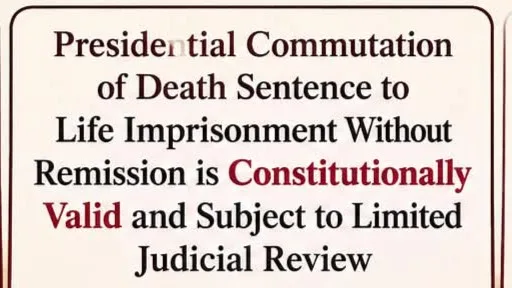
• Whether the President of India has the constitutional authority under Article 72 to commute a death sentence to life imprisonment subject to the condition that the convict shall remain in prison for the remainder of natural life without any possibility of remission.
Full Judgement / Attachment
Full Judgement
• Whether an inordinate and unexplained delay of over 15 years in deciding the mercy petition entitles the petitioner to unconditional commutation of sentence under Article 21, notwithstanding the President's conditional commutation order.
Submissions Of Parties:
Petitioner:
• The President of India lacks the power to impose a condition barring remission, as it overrides statutory and constitutional provisions governing remission and leaves the convict to face a slow death without hope of rehabilitation. (Paras 36, 37)
• The inexplicable delay of over 15 years in disposing of the mercy petition, coupled with 18 years of solitary single-cell confinement, constitutes severe torture and a violation of Article 21, entitling the petitioner to unconditional commutation. (Paras 32, 33)
• The President's decision ignored the Attorney General's explicit recommendation for unconditional commutation based on the binding precedent in Shatrughan Chauhan. (Paras 25, 35)
Respondents (Union of India):
• The power of the President under Article 72 is an absolute constitutional power, sui generis, and is uninfluenced by judicial sentencing or statutory restrictions. (Paras 39, 41)
• A convict who benefits from an order of commutation reducing death to life imprisonment cannot accept the favorable part while challenging the attached condition restricting remission. (Para 41)
• Judicial review of presidential clemency is extremely limited and restricted to cases of mala fides, irrelevance, or complete non-application of mind—none of which apply here since the President consciously considered the delay and conflicting opinions. (Paras 40, 61)
Court's Observations & Analysis:
Re: Issue (i): Territorial Jurisdiction
• The Delhi High Court possesses territorial jurisdiction because the impugned order emanates from the decision of the President of India under Article 72, whose office is located in Delhi, giving rise to a substantial cause of action within Delhi. (Para 45)
• Held: Territorial jurisdiction is established and the respondents' preliminary objection is rejected. (Para 45)
Re: Issue (ii) & (iii): Scope of Article 72, Conditional Commutation, and Supervening Delay
• The power under Article 72 is a constitutional responsibility of the highest order, subject to limited judicial review examining the manner of exercise rather than substituting judicial opinion. (Paras 48, 50, 63)
• While inordinate delay in deciding a mercy petition causes mental agony and violates Article 21, the record demonstrates that the President specifically addressed the delay and sought the Attorney General's opinion. (Paras 47, 61)
• As affirmed by the Constitution Bench in Union of India v. V. Sriharan and reiterated in Ramasrey v. State of U.P., the President or the Court can impose a special category of sentence for the remainder of natural life without remission in exceptionally grave cases where ordinary remission would be grossly inadequate. (Paras 59, 61)
• The petitioner cannot selectively accept the commutation of his death sentence while striking down the lawful condition attached thereto. (Para 41)
• Held: The petition lacks merit and is dismissed; the President's conditional commutation order is valid. (Paras 61, 64)
Notable Observations:
"A convict, who has already been benefitted from an order of commutation reducing his sentence from Death Sentence to Life Imprisonment, cannot question the condition attached to such commutation. Such condition has been imposed by the Hon'ble President in the exercise of his sui generis powers. The order reducing the sentence has to be accepted as a whole." (Para 41)
"Once we find that the Hon'ble President of India had all the relevant inputs and took into consideration all the relevant factors before passing the Impugned Order, this Court cannot substitute the opinion of the Hon'ble President of India only on the ground that it itself may have decided the Mercy Petition in a different manner." (Para 63)
Decision & Directions:
• The Writ Petition (W.P. (Crl.) 3053/2017) is dismissed. (Para 64)
• Criminal Miscellaneous Application (CRL.M.A. 17911/2017) is disposed of as infructuous. (Para 64)
• The official records relating to the petitioner's mercy petition retained by the Court shall be returned forthwith to Mr. Sunil Kumar Singh, Under Secretary (Judicial), MHA. (Para 65)
• There shall be no order as to costs. (Para 66)
© 2026 White Collar Professional Technologies Pvt. Ltd. All rights reserved. CIN: U74999MH2024PTC000001
The Division Bench dismissed the connected writ appeals, while making a limited modification to the Single Judge’s findings concerning the Bar Council of Kerala. In light of…

The High Court held that the trial court was not justified in directing the parties to undergo fresh DNA testing when the existing expert report had not been rejected for legally…

The High Court held that a subsequently communicated minimum 20% local-content requirement, including an indigenously developed EMS software condition, could not be…

The Division Bench held that the petitioner had been deprived of a reasonable opportunity to present its case before the Commissioner of Sales Tax. An adjournment request must be…

The High Court exercised its inherent jurisdiction to quash a POCSO FIR and the pending trial after obtaining independent reports verifying the parties’ marriage, family…

The Division Bench held that the writ court had exceeded the proper scope of the dispute between the supplier and KSBCL by deciding, in effect, the Revenue’s separate tax…

The High Court considered the petitioners’ request for regular bail in an Enforcement Directorate prosecution alleging money laundering under the Prevention of Money Laundering…

The High Court upheld the appellant’s conviction under Section 18 c of the NDPS Act for possession of opium but reduced the sentence of seven years’ rigorous imprisonment to the…

The High Court dismissed the State’s appeal against acquittal, holding that the trial court’s view was a reasonably possible view on the evidence and that material inconsistencies…
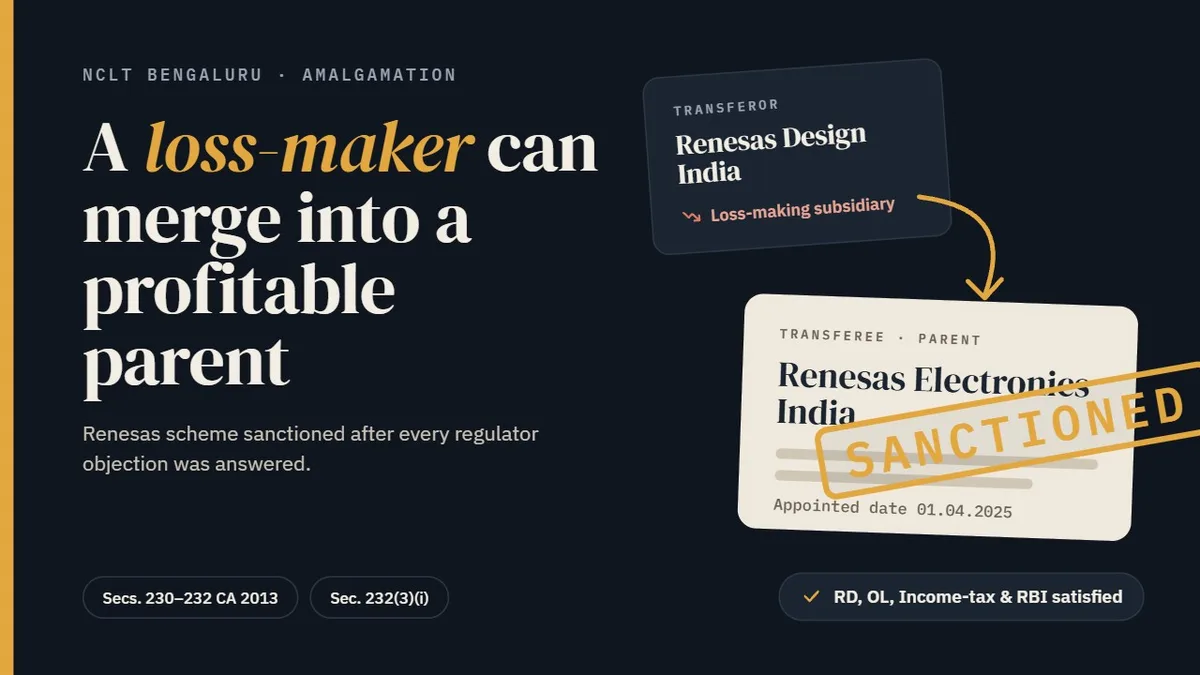
Renesas Design India Pvt. Ltd., a loss-making wholly owned subsidiary engaged in semiconductor design, and its parent Renesas Electronics India Pvt. Ltd. sought sanction of a…