
The Division Bench dismissed the connected writ appeals, while making a limited modification to the Single Judge’s findings concerning the Bar Council of Kerala. In light of…
Civil LawOther Legal Matters
21/11/20265 min read
Update / Judgement Date
11 Nov 2025
Source
WCP News Bulletin
Author
Sakshi Bhardwaj — WCP Legal Desk
Reading Time
4 min read
View Count
1
The Supreme Court held that a counter claim cannot be maintained against a co-defendant in a civil suit, reaffirming the settled position under Order VIII Rule 6A of the Code of Civil Procedure, 1908 (CPC). The Court allowed the appeal filed by the plaintiff, setting aside concurrent orders of the Trial Court and the High Court that had permitted defendants No. 2 and 3—impleaded later—to raise a counter claim against the original defendant. The Court observed that the counter claim was barred by limitation, lacked a valid cause of action, and was impermissible in law since it was directed not against the plaintiff but a co-defendant.
• The appellant–plaintiff filed a suit for specific performance against Defendant No. 1 concerning 0.93 acres of land based on an oral agreement dated 2 December 2002.
• The plaintiff claimed that the entire consideration was paid on 3 December 2002 and possession delivered.
• Defendant No. 1 contended that two other persons (later Defendants No. 2 and 3) were already in possession of a part of the property, having entered into a separate agreement to purchase 50 decimals on 1 December 2002 for ₹2,95,000.
• The Trial Court allowed Defendants No. 2 and 3 to be impleaded and admitted their counter claim against Defendant No. 1 for transfer of the entire land.
• The High Court, invoking Article 227, refused to interfere, citing avoidance of multiplicity of litigation.
• Aggrieved, the plaintiff approached the Supreme Court.
• Counter Claim Against Co-Defendant Impermissible:
Referring to Rohit Singh v. State of Bihar [(2006) 12 SCC 734] and Rajul Mano Shah v. Kiranbhai Patel [(2025) 10 SCR 152], the Court reiterated that a counter claim under Order VIII Rule 6A CPC must be directed only against the plaintiff, not against another defendant.
• Lack of Concrete Cause of Action:
Defendants No. 2 and 3 failed to prove readiness and willingness to pay the remaining consideration. Their claim was vague and inconsistent—admitting that 43 decimals had already been sold to the plaintiff’s father while alleging fraud in the measurement (43 changed to 93 decimals).
• Limitation Bar:
Even if their claim were valid, the alleged agreement dated 2 December 2002 meant the limitation for specific performance had expired long before their impleadment in 2006. Hence, any counter claim was time-barred.
• No Liberty for Separate Suit:
Decision:Legal Provisions Discussed:Judgments Relied Upon:Since limitation had already expired, the Court refused to grant liberty to Defendants No. 2 and 3 to institute a fresh suit.
• Non-joinder Issue Cured:
Their impleadment cured the defect of non-joinder, allowing the trial to proceed. However, their counter claim was untenable in law and fact.
• The Supreme Court allowed the appeal, set aside the orders of the Trial Court and High Court permitting the counter claim.
• It held that Defendants No. 2 and 3 could not raise a counter claim against a co-defendant and that their claim was barred by limitation.
• The matter was remitted to the Trial Court to proceed with the main suit, leaving open all other issues except the rejected counter claim.
• Order VIII Rule 6A, Code of Civil Procedure, 1908 – Scope and limits of counter claims.
• Article 227, Constitution of India – Power of High Courts to supervise subordinate courts.
• Limitation Act, 1963 – Limitation period for suits seeking specific performance.
• Rohit Singh & Ors. v. State of Bihar, (2006) 12 SCC 734 – Counter claim cannot be against co-defendant.
• Rajul Mano Shah @ Rajeshwari Rasiklal Sheth v. Kiranbhai Shakrabhai Patel & Anr., (2025) 10 SCR 152 – Specific performance claim independent of partition claim; counter claim must relate to plaintiff.
Citation: 2025 INSC 1310
Case: Sanjay Tiwari v. Yugal Kishore Prasad Sao & Ors.
Court: Supreme Court of India
Coram: Justice K. Vinod Chandran & Justice N. V. Anjaria
Date of Decision: 12 November 2025
Civil Appeal No.: [@ Special Leave Petition (C) No.11050 of 2025]
© 2026 White Collar Professional Technologies Pvt. Ltd. All rights reserved. CIN: U74999MH2024PTC000001
The Division Bench dismissed the connected writ appeals, while making a limited modification to the Single Judge’s findings concerning the Bar Council of Kerala. In light of…

The High Court held that the trial court was not justified in directing the parties to undergo fresh DNA testing when the existing expert report had not been rejected for legally…

The High Court held that a subsequently communicated minimum 20% local-content requirement, including an indigenously developed EMS software condition, could not be…
The Division Bench held that the petitioner had been deprived of a reasonable opportunity to present its case before the Commissioner of Sales Tax. An adjournment request must be…

The High Court exercised its inherent jurisdiction to quash a POCSO FIR and the pending trial after obtaining independent reports verifying the parties’ marriage, family…

The Division Bench held that the writ court had exceeded the proper scope of the dispute between the supplier and KSBCL by deciding, in effect, the Revenue’s separate tax…

The High Court considered the petitioners’ request for regular bail in an Enforcement Directorate prosecution alleging money laundering under the Prevention of Money Laundering…

The High Court upheld the appellant’s conviction under Section 18 c of the NDPS Act for possession of opium but reduced the sentence of seven years’ rigorous imprisonment to the…

The High Court dismissed the State’s appeal against acquittal, holding that the trial court’s view was a reasonably possible view on the evidence and that material inconsistencies…
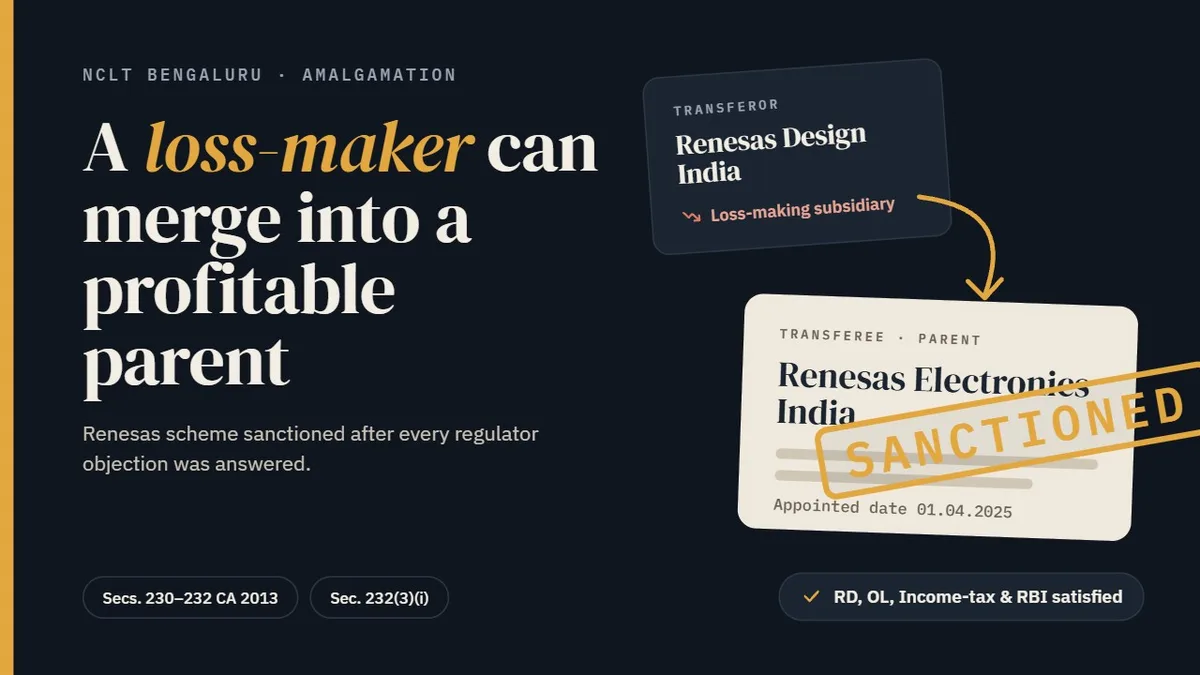
Renesas Design India Pvt. Ltd., a loss-making wholly owned subsidiary engaged in semiconductor design, and its parent Renesas Electronics India Pvt. Ltd. sought sanction of a…