The Madhya Pradesh High Court held that where a party obtains a certified copy of an arbitral award, limitation for an application under Section 34 of the Arbitration and…
Other Legal Matters
Court / Authority
Delhi High Court
Update / Judgement Date
16 Oct 2026
Date of Publication
27 Oct 2026
Case No.
257/2016
Source
WCP News Bulletin
Author
Arshee Saifi — WCP Legal Desk
Reading Time
10 min read
View Count
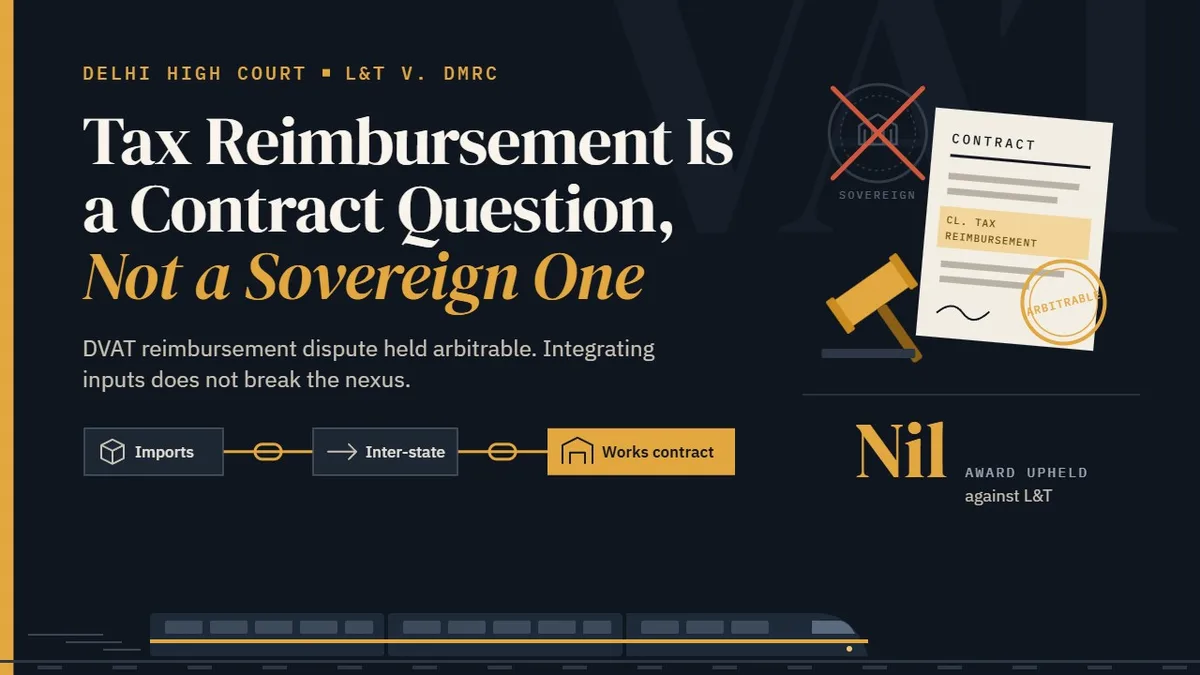
Key Proposition: A dispute about whether a party is contractually entitled to reimbursement of tax 'if applicable' is arbitrable, even though the tribunal must decide whether the tax applied; and in a works contract, goods procured from approved suppliers to the employer's specifications and consigned for its project are sold in the course of import or inter-State trade, whether or not the contractor integrates them into a different contract item.
Background / Synopsis :
DMRC awarded a contract dated 15 January 2008 to a consortium of L&T and M/s Furrer + Frey AG for design, supply, installation, testing and commissioning of a 25kV Rigid Overhead Contact System with switching stations and cabling for the underground Central Secretariat–Green Park–Saket and Central Secretariat–Jangpura sections of Delhi MRTS Phase-II, valued at about Rs. 43.37 crores plus USD 2,024,988 and CHF 54,94,930 (Paras 2–3).
Clause 24(c)(ii) of the Special Conditions of Contract provided that DVAT/UP Trade Tax 'if applicable' paid on indigenous equipment would be reimbursed on the basis of actuals on proof of payment (Para 5).
L&T bought HV panels from M/s Areva (India), Allahabad, which imported them from Germany (customs duty reimbursed by DMRC), and LV panels from M/s Areva (India), Kolkata, issuing Form C for 2% CST (Para 8).
L&T integrated these into sectioning and sub-sectioning posts and other BOQ items, treated them as local sales in Delhi and paid Rs. 4,45,73,743 as DVAT (Para 9).
DMRC reimbursed DVAT on one invoice (Rs. 1,88,28,688 claimed; Rs. 1,29,29,200 net paid on 15 January 2010) and then recovered Rs. 1,38,22,788 from a running bill on 3 March 2011, saying DVAT did not apply (Paras 10, 54).
A Notice of Dispute was issued on 21 October 2011; a three-member tribunal constituted on 1 June 2012 passed a nil award on 31 March 2014. DMRC made no counter-claim (Paras 6, 12).
Issues For Consideration :
Submissions Of Parties :
Clause 24(c)(ii) read with Clause 11.1.1 of the GCC requires only actual payment and proof; 'if applicable' identifies the transactions, and Clause 35 of the GCC gives DMRC a refund route with the tax department if it thinks tax was not payable (Para 15).
Whether DVAT is leviable is a sovereign question for DVAT authorities; Section 83 of the DVAT Act bars civil suits and so, by implication, arbitration; a self-assessment under Sections 26 and 31 is deemed an assessment by the Commissioner, which the award effectively overturns (Paras 16–17).
The import and purchases were independent transactions not directly linked to the BOQ items; Areva imported on its own account, with no privity between DMRC and the foreign seller (Binani Bros.; K.G. Khosla; Indian Explosives) (Paras 18–20).
DMRC's reimbursement and its deduction of TDS under Section 36A of the DVAT Act acknowledged a local sale, so DMRC is estopped (Para 21).
ABB Ltd. is distinguishable: there the contractor imported directly and supplied goods as they were, without integration or value addition (Paras 22, 30).
L&T itself invoked arbitration and filed no Section 16 application, so it cannot now object to jurisdiction (Narayan Prasad Lohia; S.N. Malhotra) (Para 23).
Section 34 is not an appeal; the tribunal's interpretation must stand if plausible (Saw Pipes; Toepfer) (Para 24).
DVAT is reimbursable only if legally applicable; the goods were custom-made for DMRC and consigned in its name, so import and inter-State movement were linked to the contract and exempt under Section 7 (ABB Ltd.) (Paras 25–26).
The technical findings of an engineering tribunal on the BOQ items should not be disturbed; L&T invoiced DVAT on panels, not on the posts (Paras 26–27, 53).
Court's Observations & Analysis :
Re: Issue (i): Arbitrability of the DVAT question
Adopting the Allahabad High Court's two-head test in Vriddhi Infratech: disputes resolvable within the contract (inter se tax liability, reimbursement, indemnity, interpretation of tax clauses) are arbitrable; disputes needing statutory determination (whether a transaction is taxable in a way that binds the State, classification, rate, exemptions, disputes with the tax authority) are not (Paras 47–48).
The dispute here arises under Clause 24(c)(ii), which provides for reimbursement 'if applicable'; the question whether DVAT applied is the anterior step to a contractual reimbursement claim (Para 49).
Held: The dispute falls under 'Head A' and is arbitrable. (Para 49)
Re: Issues (ii) and (iii): Whether DVAT applied – import and inter-State nexus
Under Article 366(29A)(b), the transfer of property in goods in a works contract is a deemed sale; following Aristo Printers and L&T v. State of Karnataka, the taxable event is when goods are incorporated into the works (Paras 35–36, 42–43).
Section 7 of the DVAT Act exempts sales in the course of inter-State trade or import, determined under Sections 3 and 5 of the CST Act (Paras 39–41).
ABB Ltd. (affirmed in CVAT v. ABB Ltd.) asks whether the movement of goods was integrally connected with the contract; passing of title, privity with the end user and the source of consideration are not decisive. It listed eight indicators, including DMRC specifications, approved suppliers, pre-inspection, custom-made goods, duty exemption certificates and packages marked for DMRC (Paras 44–46).
Here at least conditions (1), (2), (3), (4), (5), (7) and (8) were met; the purchase order and the excise and customs invoices named DMRC as consignee, and DMRC approved Areva and issued the customs exemption certificate (Paras 58, 61, 63).
Held: There is a direct link between the inter-State procurement and import of the goods and the contract; the Section 7 exemption applies. (Para 64)
Re: L&T's attempt to distinguish ABB Ltd.
That L&T bought from an importer rather than importing directly is of no avail; the inquiry is whether the movement was occasioned by or incidental to the contract with DMRC (Para 67).
ABB Ltd. itself concerned a works contract for installing and commissioning electrical systems for DMRC; what matters is the contractual nexus with the movement of goods, not the form in which they were incorporated, and incorporation does not sever that nexus (Paras 68–69).
Held: ABB Ltd. squarely covers the case. (Paras 60, 66–69)
Re: Issue (iv): Scope of interference under Section 34
The tribunal considered the material and treated DMRC's reimbursement and later recovery as a corrected mistake, not an admission (Paras 58–59).
The Court cannot re-appreciate evidence or substitute an equally plausible view; even a mere incorrect application of law does not justify interference (Paras 62, 71–72).
Held: The award reflects due application of mind, is a plausible view and suffers from no patent illegality going to the root of the matter. (Paras 71–72)
Notable Observations:
"The incorporation, according to this Court, does not severe this nexus." (Para 69)
"Even mere incorrect application of law is not a ground sufficient enough to warrant interference." (Para 71)
Decision & Directions :
Legal Provisions Discussed & Precedents Cited :
Arbitration and Conciliation Act, 1996 – Section 34 (setting aside on patent illegality / public policy); Section 16 (jurisdictional objection not raised).
Constitution of India – Article 366(29A)(b) (deemed sale in works contracts, pre-2021 text); Article 286(1)(b).
Delhi Value Added Tax Act, 2004 – Section 2(zo) (works contract); Section 7 (sales in course of inter-State trade or import not taxable); Sections 26, 31 (self-assessment); Section 36A (TDS on works contracts); Section 83 (bar on civil suits).
Central Sales Tax Act, 1956 – Section 2(ja) (works contract); Section 3 (inter-State sale); Section 5(2) (sale in course of import).
Contract dated 15 January 2008 – Clause 24(c)(ii) SCC (DVAT reimbursement 'if applicable'); Clauses 11.1.1 and 35 GCC.
Doctrines applied: arbitrability of tax disputes (Head A / Head B); 'conceivable link' test for inter-State sales; limited Section 34 review.
Case Details :
Disclaimer: This summary is an editorial aid and does not form part of the judgment. Refer to the original judgment before citing.
Full Judgement / Attachment
Full Judgement
The Madhya Pradesh High Court held that where a party obtains a certified copy of an arbitral award, limitation for an application under Section 34 of the Arbitration and…
The Madhya Pradesh High Court held that an unregistered document recording a purported sale of the shop did not transfer title and did not terminate the tenancy where termination…
The Madhya Pradesh High Court set aside Bharat Bairagi’s conviction under Section 7 of the Prevention of Corruption Act, 1988, holding that the prosecution failed to prove a clear…
Case Header Case / Party Name: Moiz Dawoodbhai Palitanawala & Ors. v. The Municipal Corporation of Greater Mumbai & Ors. Court Name: High Court of Judicature at Bombay – Ordinary…

A large batch of writ petitions concerned the engagement and proposed disengagement of Gram Rozgar Sevaks and supporting staff under the MGNREGA Scheme in the erstwhile State of…

The Division Bench of the High Court of Jammu & Kashmir and Ladakh reversed a Single Judge decision that had struck down Rule 129 of the Border Security Force Rules, 1969. The…
The Division Bench considered an appeal and writ petition arising from consumer complaints involving claims above Rs. 50 lakh. The J&K State Consumer Disputes Redressal Commission…

The Bombay High Court held that where MahaRERA had dismissed a complaint only on the preliminary issue of maintainability, the Maharashtra Real Estate Appellate Tribunal could…

The Bombay High Court dealt with five connected Criminal Writ Petitions challenging orders issuing bailable or non-bailable warrants against the petitioners. The petitioners,…

The Bombay High Court considered cross-appeals against an Appellate Tribunal order continuing provisional attachment of two properties to the extent of Rs. 25 crore in proceedings…