TET Made Mandatory for Recruitment of Teachers in Aided Schools
Court / Authority
Andhra Pradesh High Court
Update / Judgement Date
23 Nov 2026
Date of Publication
25 Nov 2026
Case No.
W.P. Nos. 25107 and 25370 of 2025
Source
WCP News Bulletin
Author
Dipanshi Bansal — WCP Legal Desk
Reading Time
8 min read
View Count
Other Legal Matters
Andhra Pradesh High Court · WCP News Bulletin
The Andhra Pradesh High Court disposed of two writ petitions filed by aided schools challenging the insistence that applicants for vacant aided teaching posts possess the Teacher Eligibility Test (TET) qualification. The schools relied on G.O.Ms.No.1 dated 1 January 1994 and contended that TET was not required for recruitment in private aided schools. Following the Supreme Court’s decision in Anjuman Ishaat-E-Taleem Trust v. State of Maharashtra and Others, the High Court held that aided schools could not claim exemption from TET for recruitment. It further directed teachers already recruited without TET who had more than five years of service remaining to obtain the qualification within two years from receipt of the order.
Key Proposition: Aided schools cannot claim exemption from the mandatory TET eligibility requirement for teacher recruitment; teachers already appointed without TET who have more than five years of service remaining must qualify within two years from receipt of the order.
TET – recruitment in aided schools – exemption – Held, TET is mandatory for appointment as a teacher. (Paras 5–9)
G.O.Ms.No.1 dated 1 January 1994 – aided-school recruitment – Held, it does not sustain an exemption contrary to the Supreme Court ruling. (Paras 3–9)
In-service teachers – more than five years of service remaining – Held, TET must be obtained within two years from receipt of the order. (Para 9)
Articles 14 and 21A – constitutional challenge – petitions disposed of following the Supreme Court decision. (Paras 1–10)
Background / Synopsis :
The common order disposed of W.P. Nos. 25107 and 25370 of 2025, filed by aided educational institutions in Andhra Pradesh.
W.P. No. 25107 of 2025 was filed by SMSO Aided Elementary School, Uyyalapalli, SPSR Nellore District, represented by Correspondent V. Geetha Ramani.
W.P. No. 25370 of 2025 was filed by SBVD Sabha High School, Pullampeta, and Sree Veera Brahmendra Mission Aided Upper Primary School, Mydukur, represented by their respective correspondents.
The schools stated that recruitment of teachers in aided schools was governed by G.O.Ms.No.1, Education (P.S.2) Department, dated 1 January 1994.
Permissions to fill aided vacancies were issued through memos dated 4 October 2023 and 20 November 2024. Those memos required applicants to qualify in TET-cum-TRT.
Full Judgement / Attachment
Full Judgement
The schools challenged the TET requirement and sought permission to fill vacancies under the 1994 Government Order without insisting upon TET qualification.
Interim orders had earlier permitted recruitment without TET; the State respondents sought vacation of those orders.
The High Court considered the Supreme Court decision in Anjuman Ishaat-E-Taleem Trust v. State of Maharashtra and Others, reported as (2026) 7 SCC 690.
Issues For Consideration :
Whether aided schools could claim exemption from TET while recruiting teachers by relying on G.O.Ms.No.1 dated 1 January 1994.
Whether directions requiring applicants for aided teaching posts to possess TET qualification were contrary to the Andhra Pradesh Education Act, 1982 and the Right to Education Act, 2009.
What TET requirement applied to teachers already recruited without the qualification, particularly those with more than five years of service remaining.
Submissions Of Parties :
Petitioner Schools:
The schools contended that recruitment in aided schools was governed by G.O.Ms.No.1 dated 1 January 1994 and that TET was not required for appointments in private management schools.
They argued that TET applied to Government, Mandal Praja Parishad and Municipal Schools, but not to aided schools.
They relied on earlier High Court batch matters said to have held that TET was mandatory for Government Schools but not aided schools.
They challenged instructions requiring their Staff Selection Committees to consider only TET-qualified applicants and sought permission to fill vacancies under the 1994 Government Order.
State / Education Authorities:
The official permissions to fill aided vacancies required applicants to qualify in TET-cum-TRT.
The respondents sought vacation of interim orders that had permitted recruitment without insisting upon TET.
The order records the appearance of the Assistant Government Pleader and the Court’s consideration of the Supreme Court ruling; it does not set out a separate detailed counter-affidavit.
Court's Observations & Analysis :
Re: Applicability of TET to recruitment in aided schools
The schools relied on G.O.Ms.No.1 dated 1 January 1994 as the governing recruitment framework, while the vacancy-permission memos expressly required TET-cum-TRT.
The Court noted the schools’ contention that TET applied to Government and local-authority schools but not private aided schools.
The Supreme Court in Anjuman Ishaat-E-Taleem Trust v. State of Maharashtra and Others, (2026) 7 SCC 690, held TET to be mandatory for teacher appointment to maintain national standards and benchmarks and improve teaching quality.
The High Court treated the question of exemption for aided schools as covered by the Supreme Court ruling and followed it.
Held: Aided schools could not claim exemption from TET for recruitment of teachers. (Paras 3–5, 8–9)
Re: Position of teachers already appointed without TET
The Supreme Court clarified that in-service teachers with less than five years of service remaining could continue until superannuation without TET, but would not be considered for further promotion unless qualified.
Teachers with more than five years of service remaining were required to qualify TET within two years to continue in service, in addition to other applicable requirements.
The High Court applied the two-year requirement to teachers already recruited by aided schools who had more than five years of service remaining.
Held: Teachers recruited without TET and having more than five years of service remaining must qualify within two years from receipt of the order. (Paras 6–9)
Re: Effect of G.O.Ms.No.1 and earlier interim orders
The schools relied on the 1994 Government Order and earlier interim orders to support recruitment without TET.
The Court held that the issue was covered by the Supreme Court judgment mandating TET for teacher recruitment and clarifying the position of in-service teachers.
The writ petitions were therefore disposed of by applying the Supreme Court ruling rather than granting the exemption sought.
Held: The schools could not claim an exemption contrary to the Supreme Court’s decision. (Paras 8–10)
Notable Observations: The Court treated Anjuman Ishaat-E-Taleem Trust as directly covering the controversy and did not independently undertake an extended interpretation of G.O.Ms.No.1 or separately analyse the constitutional grounds pleaded.
Decision & Directions :
The Court held that the petitioner schools could not claim exemption from recruiting teachers who possess TET qualification.
Teachers already recruited without TET and having more than five years of service remaining were required to qualify TET within two years from receipt of the order.
The writ petitions were disposed of in terms of the above observations, following Anjuman Ishaat-E-Taleem Trust v. State of Maharashtra and Others.
There was no order as to costs. Pending miscellaneous petitions, if any, stood closed.
Legal Provisions Discussed & Precedents Cited :
G.O.Ms.No.1, Education (P.S.2) Department, dated 1 January 1994 – relied upon by the schools as the governing procedure for recruitment to aided teaching posts.
Andhra Pradesh Education Act, 1982 – invoked by the schools in challenging the TET requirement.
Right of Children to Free and Compulsory Education Act, 2009 – referred to in the pleadings as part of the statutory framework governing teacher eligibility.
Constitution of India, Article 14 – pleaded as a ground of challenge.
Constitution of India, Article 21A – pleaded in relation to the right to education.
Code of Civil Procedure, 1908, Section 151 – invoked in interlocutory applications seeking permission to fill vacancies without TET and vacation of earlier interim orders.
Anjuman Ishaat-E-Taleem Trust v. State of Maharashtra and Others, (2026) 7 SCC 690 – Supreme Court decision holding TET mandatory for teacher appointment and clarifying the position of in-service teachers: those with less than five years remaining may continue until superannuation without TET but are ineligible for further promotion unless qualified; those with more than five years remaining must qualify within two years.
No other judicial precedent is identified or discussed in the common order. Earlier batch matters referred to by the schools are not individually named.
Case Details :
Case / Party Name: SMSO Aided Elementary School and Others; SBVD Sabha High School and Another; and Sree Veera Brahmendra Mission Aided Upper Primary School v. State of Andhra Pradesh and Others
Case Number(s): W.P. Nos. 25107 and 25370 of 2025; interlocutory applications as referred to in the common order
Coram / Judges: Harinath N., J. – Single Judge
Counsel Appearances: For petitioner schools: K.P.S. Sailesh Reddy. For respondents: Government Pleader for School Education.
Disclaimer: This summary is an editorial aid and does not form part of the judgment. Refer to the original judgment before citing.
The Andhra Pradesh High Court disposed of a writ petition filed by eleven prospective candidates seeking police protection to submit nomination papers for the Phase-III Gram…
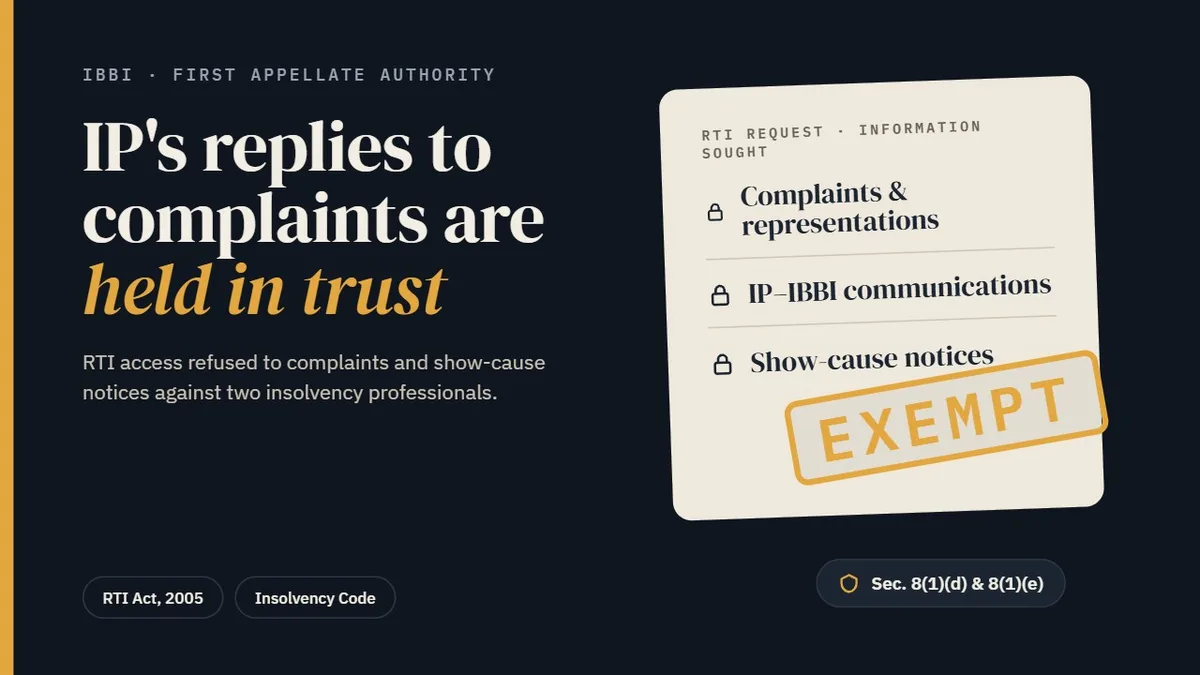
The appellant sought, under the RTI Act, records of complaints and representations received by IBBI, communications between IBBI and the insolvency professionals, and copies of…
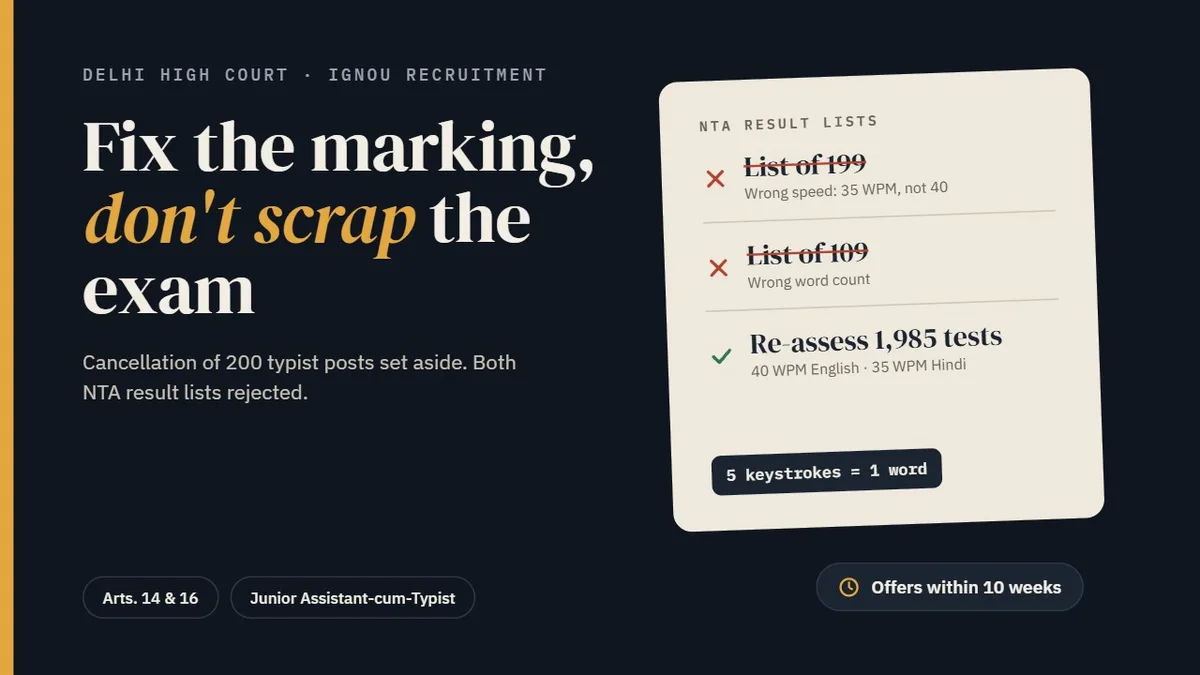
IGNOU entrusted recruitment to 200 Junior Assistant-cum-Typist posts to NTA; after a computer-based test 25,094 candidates and a typing test 1,985 candidates , NTA declared 199…
The Delhi High Court considered whether the 2021 amendment inserting Section 86 4 into the Juvenile Justice Care and Protection of Children Act, 2015 applied to trials already…
Sixteen students of Sree Sankaracharya University of Sanskrit, Kalady challenged their suspension and subsequent disciplinary punishments arising out of a campus protest during a…
The Kerala High Court held that the custody requirement in Section 306 4 b of the Code of Criminal Procedure, 1973 CrPC applies to a pardon tendered by a Magistrate under Section…
National Testing Agency had applied an incorrect typing-speed threshold and the assessment required correction, the identified discrepancies did not establish that the…
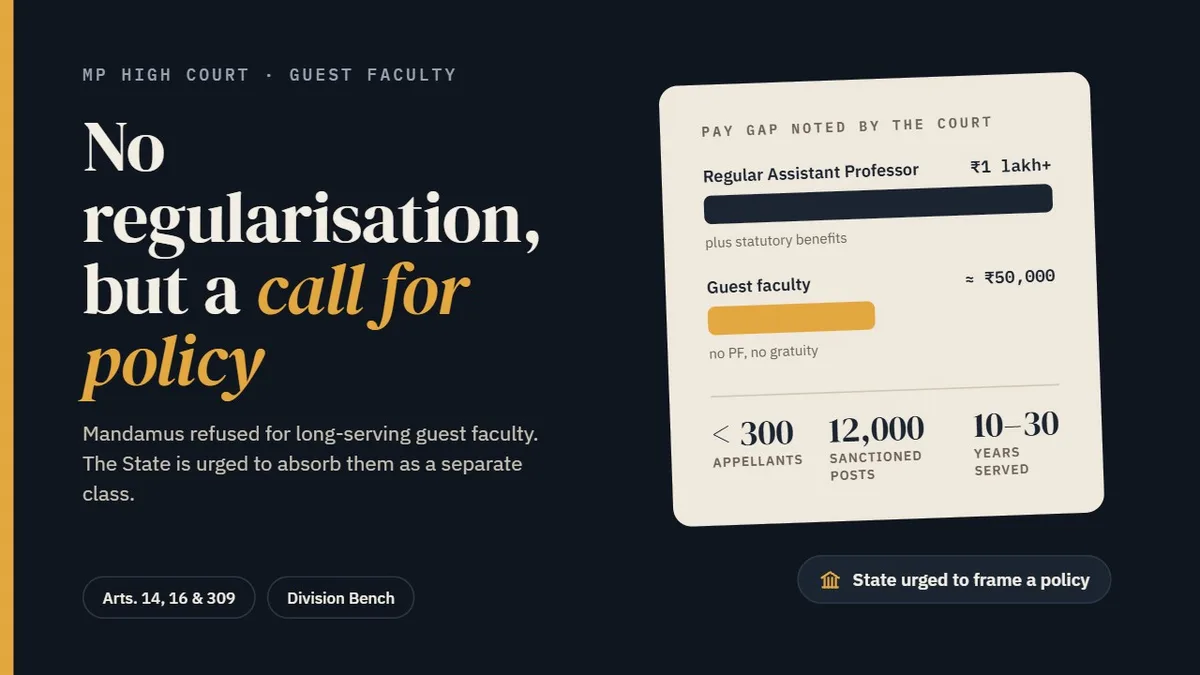
A batch of writ appeals was filed by guest faculty – Assistant Professors, Sports Officers and Librarians engaged after advertisement and selection and serving 10 to 30 years in…
Directorate of Enforcement, Mumbai Zonal Office-I | Draft Press Release | 23 November 2026 The Directorate of Enforcement's draft press release states that its Mumbai Zonal…
The Directorate of Enforcement's draft press release states that its Guwahati Zonal Office-I has provisionally attached movable and immovable properties valued at ₹70.09 lakh in a…