Trade Mark Registered to a Dead Woman: Bombay High Court Rejects Mafatlal Grandson's Time-Barred Plea but Opens Suo Motu Rectification and Orders Registry Audit
Trade Mark Registered to a Dead Woman: Bombay High Court Rejects Mafatlal Grandson's Time-Barred Plea but Opens Suo Motu Rectification and Orders Registry Audit
Court / Authority
Bombay High Court
Update / Judgement Date
20 Nov 2026
Source
WCP News Bulletin
Author
Arshee Saifi — WCP Legal Desk
Reading Time
10 min read
View Count
Intellectual Property Rights
Bombay High Court · WCP News Bulletin
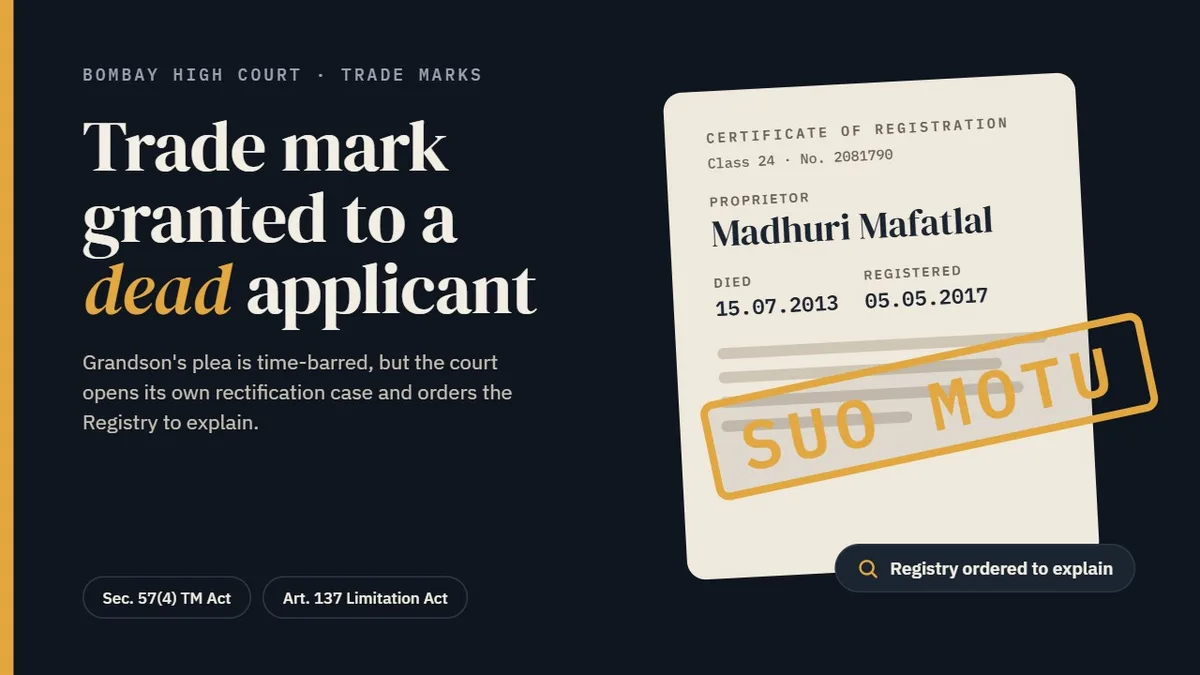
Varun Mafatlal, grandson of Madhuri Mafatlal, sought rectification under Section 57 of the Trade Marks Act, 1999 of entries recording his aunt Malavika Taktawala (July 2018) and then Shree Vallabh Chandak (September 2018) as proprietors of the 'SUNGRACE MAFATLAL' device marks in Classes 24 and 25, which Madhuri had applied for in 2011 and which were registered in her name in 2017 although she had died in 2013 (Paras 1–2, 4). The Court held that Varun is a 'person aggrieved', the expression being liberally construed (Paras 11–14, 59A), but that his petition is time-barred: under Section 2(a)(ii) of the Limitation Act he claims through his father Atulya, the three-year period under Article 137 ran from the public entries of July and September 2018 and expired in 2021 during Atulya's lifetime, Sections 9 and 16 do not help, and Section 17 does not postpone limitation because Atulya, amid family litigation and with the marks advertised in 2016–17 and on renewal in 2020, could with reasonable diligence have discovered the entries (Paras 15–38, 59B–C). The condonation application was rejected (Para 59C). Nevertheless, finding that the Registrar granted registration to a person known to be dead without the substitution that Rule 61 of the 2002 Rules and Rule 55 of the 2017 Rules require – a power coupled with a duty – and then processed transfers in quick succession without any reasoned order, the Court initiated suo motu rectification under Section 57(4) to consider cancelling even Madhuri's registration (Paras 41–58, 59D–E, 60). Show-cause notices were issued to Chandak, Malavika and Madhuri's executors, including on an interim stay of the effect of registration, and the Controller General was directed to have a senior officer explain the Registry's conduct and practice with ten years' statistics (Paras 60–67).
Key Proposition: An heir seeking rectification of the Register inherits the limitation already run against the predecessor through whom he claims and cannot restart the three-year period under Article 137 on his own later discovery; but where the Registrar has granted registration to an applicant known to be dead without substituting the successor under Rule 55 of the 2017 Rules (Rule 61 of the 2002 Rules), the High Court may act suo motu under Section 57(4) to protect the integrity of the Register.
Background / Synopsis :
Madhuri Mafatlal applied to register the marks on 07.01.2011 (Class 24) and 19.07.2011 (Class 25); she died on 15.07.2013, leaving an unprobated will dated 06.02.2012 (Para 2A–C).
Her son Ajay died on 22.08.2015, leaving an unprobated will dated 05.08.2013; her son Atulya (Varun's father) died in September 2022 (Para 2C–D).
On 11.12.2015 Malavika filed two Form TM-16 applications to be recorded as successor, producing Madhuri's will and an undertaking by her sister Gayatri; these were never decided (Para 2E–F).
The marks were registered in Madhuri's name on 05.05.2017 and 04.08.2017; on Malavika's Form TM-P of 11.05.2018 (with a photocopy of Ajay's will) the Registrar recorded her as proprietor on 05.07.2018 without notice to other heirs; she assigned the marks to Chandak the next day for Rs. 9 lakh each, and he was recorded on 17.09.2018 (Para 2H–K).
Chandak had been a licensee of the family for fabric manufacture under about 21 licence agreements from 1998; Mafatlal Industries (the Arvind Mafatlal branch) had sent him a legal notice in February 2015 (Paras 18, 39).
Varun says he learnt of the entries in August 2023 and filed the petition on 13.12.2023; the condonation application (557 days) followed on 02.07.2025 (Para 2L).
Issues For Consideration :
Whether Varun is a 'person aggrieved' (Para 8A).
Whether the petition is delayed and the delay can be condoned; whether the right to apply accrued on the 2018 entries or on Varun's knowledge in 2023; and the effect of fraud, suppression and want of diligence (Para 8B).
Whether the 2017 and 2018 entries were made without due process (Para 8C).
Whether a case is made out for suo motu proceedings under Section 57(4) (Para 8D).
Submissions Of Parties :
Petitioner (Varun):
He is a person aggrieved; Chandak was a mere licensee who usurped the marks contrary to an oral family settlement barring alienation outside the family (Para 5A).
Time under Article 137 runs from accrual of the right to apply; Section 17 applies because fraud was discovered only in August 2023 (Para 5B).
Transmission rests on unprobated wills (Section 213 Succession Act), without executors' assent; Madhuri's will does not cover the Class 25 mark; the Registrar acted without notice, inquiry or speaking order, in breach of Rules 55, 75 and 76 (Paras 5C–F).
Respondent No. 1 (Chandak):
Limitation must be decided first; time ran from 17.09.2018 and Varun inherits his father's clock (Paras 6A–B).
Section 17 needs reasonable diligence; Varun is a proxy for Mafatlal Industries, which knew since 2015 (Para 6C).
Section 213 binds courts, not the Registrar; Rule 55 is directory; registration relates back under Section 23; he is a bona fide assignee for value (Para 6D).
Respondent No. 2 (Malavika):
She believed in good faith that she held title under the wills; the Registrar knew of the deaths; executors' assent may be inferred; she was guided by Chandak and the broker Choksi (Para 7).
Court's Observations & Analysis :
Re: Issue (i): Person aggrieved
Varun is not unconnected to the original applicant and the marks bear the family surname; whether he may pursue a cause his father did not is a question of limitation, not locus (Paras 11–14; Hardie Trading; Infosys; V.R. Holdings; Toshiba).
Held: Varun is a person aggrieved. (Paras 14, 59A)
Re: Issue (ii): Limitation and delay
Varun's right derives from Atulya and cannot be higher than his; every generation cannot restart the clock on claimed fresh discovery (Paras 20–22, 30–31).
Atulya was litigating with his siblings, the register was public, the applications were advertised in 2016–17 and renewals in 2020, and Mafatlal Industries had objected in 2015 – reasonable diligence would have revealed the entries (Paras 17–19, 33–36).
Article 137 gives three years from accrual; time ran from July/September 2018 and expired in 2021; Sections 9 and 16 do not help; Section 17 does not postpone it (Paras 38, 59C).
Held: The petition is barred; sufficient cause not shown; condonation application fails – without any finding on title or on the wills. (Paras 37, 59C)
Re: Issues (iii) and (iv): Due process and suo motu power
Section 57(4) exists to preserve the integrity of the Register, which depends on the integrity of the Registrar's process (Para 41).
Rule 61 (2002) and Rule 55 (2017) require proof of death and of transmission and substitution of the successor before the application proceeds; this is a power coupled with a duty, and nothing shows it was followed (Paras 43–45, 49, 52).
Section 23 relation back cannot justify registering a dead applicant; it would make a mockery of the need for a live proprietor (Para 47).
The 2015 applications remain undecided while the 2018 applications were processed without any discernible order; the Registrar should at least have called on the executors under Section 45 and Rule 77 (Paras 42, 51, 54–55).
Madhuri's will mentions only the Class 24 mark, so it is unclear how the Class 25 mark could pass to Ajay and then to Malavika (Para 56).
Held: Registration granted to a dead person is prima facie per se illegal; the integrity of the Register is suspect and suo motu rectification is warranted, even of Madhuri's own registration. (Paras 53, 58, 59D–E)
Notable Observations:
"The cause of action to seek rectification cannot spring back to life from scratch for every successive generation, claiming to have discovered the cause of action." (Para 59B)
"A dead person cannot sustain an application." (Para 51)
"…the record of title to intellectual property maintained by the Registrar is meant to give public confidence in the record of ownership of intellectual property in India." (Para 59E)
Decision & Directions :
Petition and condonation application rejected as time-barred. (Paras 59C, 62, 66)
Suo motu rectification initiated under Section 57(4): Chandak, Malavika and Madhuri's estate (through the two executors of her will) to show cause why the 2017 registration granted to a dead person should not be cancelled, and how the Class 25 mark could have vested in Ajay and then Malavika. (Para 60)
Noticees also to show cause why the effect of registration should not be stayed pending the proceedings, and to justify their reliance on the two wills; Succession Act questions to be considered on their replies. (Paras 61–62)
Replies by affidavit with evidence by 15.01.2027. (Para 63)
Controller General of Patents, Designs and Trade Marks to call for the files from 2011, have them studied by a senior officer not previously involved, and file an affidavit by 15.01.2027 on how the Registry handles applicants who die before registration, whether any manual or SOP exists, and how many registrations were granted to known-dead persons in the past ten years. (Paras 64–65)
Registry to register a new suo motu Commercial Miscellaneous Petition, listed 'For Directions' on 20.01.2027. (Para 67)
Record notes: two paragraphs are numbered '1.'; Para 15 calls Atulya 'the original applicant' (the applicant was Madhuri); 'Mathuri' (Para 48), 'February 26m, 2015' (Para 6C) and 't0' (Para 35) are typographical slips; the Registrar did not appear.
Separate Opinions: None.
Legal Provisions Discussed & Precedents Cited :
Trade Marks Act, 1999 – Sections 23, 45, 57(1)–(5).
Trade Marks Rules, 2017 – Rules 55, 75, 76, 77, 100; Trade Marks Rules, 2002 – Rule 61, Form TM-16.
V.R. Holdings v. Hero Investcorp Ltd., 2023 SCC OnLine Del 1380 – Followed.
Case Details :
Case / Party Name: Varun Atulya Mafatlal v. Shree Vallabh Chandak & Ors.
Case Number(s): Commercial Miscellaneous Petition No. 27 of 2024 with Interim Application No. 3462 of 2025 (CNR HCBM020346382023) – no neutral citation printed
Coram / Judges: Somasekhar Sundaresan, J. – Single Judge (Commercial Division)
Counsel Appearances: For the Petitioner/Applicant: Mr. Veerendra Tulzapurkar, Senior Advocate, with Mr. Ashish Kamat, Senior Advocate, Mr. Abhineet Sharma and Ms. Riya Gokalgandhi, i/b K.R. Parekh. For Respondent No. 1: Mr. Sharan Jagtiani, Senior Advocate, with Mr. Priyank Kapadia, Mr. Amit Jajoo, Mr. Vedant Chhajed and Mr. Arayn Deshmukh, i/b Trilegal. For Respondent No. 2: Mr. Nikhil Kumar Rungta with Mr. Jayesh Ramgiri. Respondent No. 3 (Registrar) did not appear.
Disclaimer: This summary is an editorial aid and does not form part of the judgment. Refer to the original judgment before citing.
Trade Mark Registered to a Dead Woman: Bombay High Court Rejects Mafatlal Grandson's Time-Barred Plea but Opens Suo Motu Rectification and Orders Registry Audit — News & Judgements | White Collar Professional
The Division Bench dismissed the connected writ appeals, while making a limited modification to the Single Judge’s findings concerning the Bar Council of Kerala. In light of…
The High Court held that the trial court was not justified in directing the parties to undergo fresh DNA testing when the existing expert report had not been rejected for legally…
The High Court held that a subsequently communicated minimum 20% local-content requirement, including an indigenously developed EMS software condition, could not be…
The Division Bench held that the petitioner had been deprived of a reasonable opportunity to present its case before the Commissioner of Sales Tax. An adjournment request must be…
The High Court exercised its inherent jurisdiction to quash a POCSO FIR and the pending trial after obtaining independent reports verifying the parties’ marriage, family…
The Division Bench held that the writ court had exceeded the proper scope of the dispute between the supplier and KSBCL by deciding, in effect, the Revenue’s separate tax…
The High Court considered the petitioners’ request for regular bail in an Enforcement Directorate prosecution alleging money laundering under the Prevention of Money Laundering…
The High Court upheld the appellant’s conviction under Section 18 c of the NDPS Act for possession of opium but reduced the sentence of seven years’ rigorous imprisonment to the…
The High Court dismissed the State’s appeal against acquittal, holding that the trial court’s view was a reasonably possible view on the evidence and that material inconsistencies…
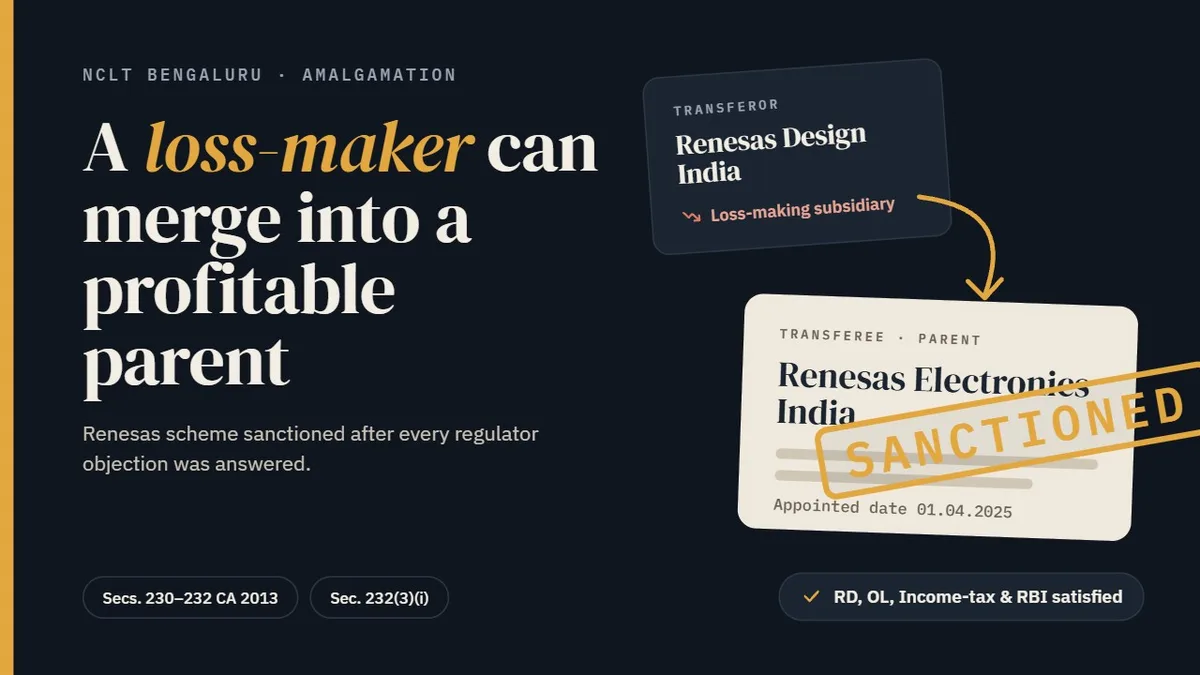
Renesas Design India Pvt. Ltd., a loss-making wholly owned subsidiary engaged in semiconductor design, and its parent Renesas Electronics India Pvt. Ltd. sought sanction of a…