
An 85-year-old senior citizen sought eviction of his son and daughter-in-law from his self-acquired home under the Maintenance and Welfare of Parents and Senior Citizens Act,…
Family LawOther Legal Matters
23/11/20269 min read
Court / Authority
Kerala High Court
Update / Judgement Date
08 Oct 2026
Date of Publication
15 Oct 2026
Case No.
CR No. 1 of 2025
Source
WCP News Bulletin
Author
Pranjal Jha — WCP Legal Desk
Reading Time
3 min read
View Count
4
Headnote
The provision of automatic revocation of a Will by marriage under Section 69 of the Indian Succession Act, 1925, does not violate the fundamental rights enshrined in Part III of the Constitution of India.
Catchwords:
Full Judgement / Attachment
Full Judgement
© 2026 White Collar Professional Technologies Pvt. Ltd. All rights reserved. CIN: U74999MH2024PTC000001
An 85-year-old senior citizen sought eviction of his son and daughter-in-law from his self-acquired home under the Maintenance and Welfare of Parents and Senior Citizens Act,…
A batch of writ appeals was brought by educators engaged on a contractual/guest-faculty basis in Madhya Pradesh Government Colleges, who sought regularisation, pay parity and…

The Madhya Pradesh High Court directed that the petitioner’s bank account be unfrozen while preserving the disputed sum of ₹23,425.21 in a fixed deposit. Following earlier…

The Karnataka High Court quashed a private complaint, the Magistrate’s referral order and the resulting FIR alleging medical negligence against an eye hospital and its doctors.…

The Karnataka High Court allowed an appeal and granted anticipatory bail in a case invoking the SC/ST Prevention of Atrocities Act. The Court took note of the 13-day delay in…

The Karnataka High Court quashed criminal proceedings against two former Karnataka State Open University functionaries after holding that the Magistrate had exceeded jurisdiction…

The Orissa High Court held that a registering authority cannot refuse registration of an arbitral award in its entirety merely because one of the properties covered by the award…

The Bombay High Court granted bail to an accused charged in a dacoity case involving the MCOC Act, taking into account his limited alleged role as a lookout, the absence of…

The petitioner, a retired employee of the Indian Institute of Public Administration IIPA , sought continuation of Central Government Health Scheme CGHS facilities that he had…
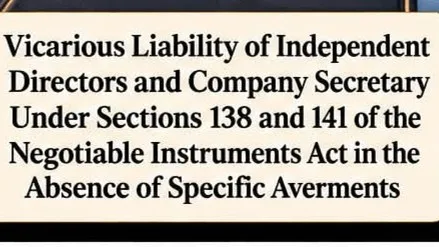
Following an inter-corporate deposit of Rs. 1,00,00,000/- made by the complainant company to M/s. Tantia Constructions Limited, a cheque of Rs. 1,00,00,000/- issued towards…