Delhi High Court Declines to Reopen Arbitral Findings on Construction Delays and Escalation Claims
Court / Authority
Delhi High Court
Update / Judgement Date
03 Nov 2026
Date of Publication
05 Nov 2026
Case No.
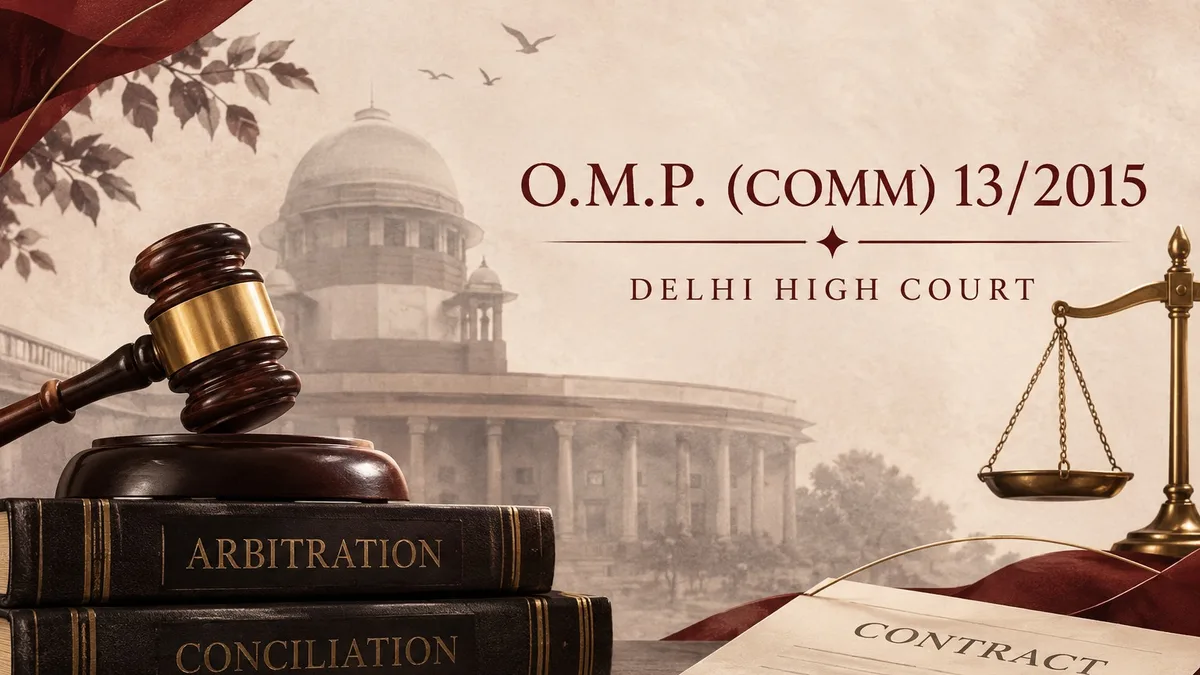
O.M.P. (COMM) 13/2015
Source
WCP News Bulletin
Author
Dipanshi Bansal — WCP Legal Desk
Reading Time
4 min read
View Count
1
The Court held that a Section 34 challenge cannot succeed merely because another interpretation of contractual documents or evidence is possible; interference is confined to recognised statutory grounds, and the contractor had not shown that the arbitrator’s findings on delay, escalation and other claims were unsustainable.
Key Proposition: An award is not patently illegal merely because the court considers another view of the evidence preferable; interference is justified only where the arbitral conclusion cannot reasonably be sustained on the record or any permissible interpretation of the contract.
- Arbitration and Conciliation Act, 1996 – Section 34 – Patent illegality – Whether the arbitrator’s factual and contractual findings could be reappraised – Held, no.
- Construction contract – Delay and escalation – Whether the contractor established employer-attributable delay and entitlement to additional costs – Held, the arbitral findings did not warrant interference.
Background / Synopsis :
- The respondent awarded the petitioner a contract on 30 October 2004 for construction of a new office building at NFM, Azadpur, Delhi. Work scheduled to finish by 13 November 2005 was completed on 30 November 2006.
- The respondent extended time without levying compensation. A joint inspection in March 2008 rated the petitioner’s performance as very good.
- The contractor later raised claims for labour and material escalation, deductions from the final bill, additional establishment expenses during the extended period and interest for delayed payment.
- The arbitrator partly allowed certain claims, including statutory minimum-wage escalation and labour cess, but rejected other claims and the respondent’s counterclaim. The contractor challenged the award under Section 34.
Issues For Consideration :
- Whether the arbitrator’s rejection of claims for delay-related escalation and additional establishment expenses disclosed patent illegality or another Section 34 ground.
- Whether the contractor established that the respondent caused the delay and that the claimed additional costs were contractually recoverable.
- Whether the rejection of the claim for interest on delayed payment and other claims warranted interference.
Submissions Of Parties :
- The petitioner argued that delays were attributable to the respondent and that it was entitled to labour/material escalation, additional establishment expenses and interest on delayed payment.
- The respondent relied on contractual notice and extension provisions, disputed responsibility for delay and contended that the contractor had not produced the required proof or complied with contractual conditions.
Court's Observations & Analysis :
- The Court applied the limited review standard under Section 34 and emphasised that it could not reassess evidence as an appellate court.
- It examined the contractual clauses and the arbitrator’s reasons for finding that the contractor had not established the respondent’s responsibility for the relevant delay or the causal connection between alleged hindrances and claimed costs.
- The Court held that the absence of proof, including required notices and supporting documents, undermined the claims for additional establishment expenses and related amounts.
- The fact that some claims had been allowed under a particular contractual clause did not establish entitlement to other claims under a different contractual basis.
- The Court reiterated that a finding supported by evidence and a permissible interpretation of the contract is not patently illegal merely because another view is possible.
Decision & Directions :
- The Section 34 petition was dismissed.
- The arbitral award remained undisturbed.
Legal Provisions Discussed & Precedents Cited :
- Arbitration and Conciliation Act, 1996 – Section 34: Limited grounds for setting aside an arbitral award.
- Contract – Clauses 5.2 and 5.3: Notice of hindrances and extension of time, as relied on by the respondent.
- Contract – Clause 10CC: Price adjustment/escalation provision discussed in relation to particular claims.
- The judgment discusses Supreme Court authority on the limited scope of Section 34 and the patent-illegality standard; the principle applied is that a plausible evidentiary view cannot be displaced merely because another view is available.
Case Details :
- Case / Party Name: M/s Winner Construction Pvt. Ltd. v. Agricultural Produce Marketing Committee
- Case Number(s): O.M.P. (COMM) 13/2015
- Coram / Judges: Om Prakash Shukla, J. – Single Judge
- Counsel Appearances: Ms. Anusuya Salwan, Ms. Nikita Salwan and Mr. Rachit Wadhwa for the petitioner; Mr. C.S. Parasher, Mr. Ashish and Ms. Mona Sharma for the respondent, with the Assistant Engineer named in the judgment.
Disclaimer: This summary is an editorial aid and does not form part of the judgment. Refer to the original judgment before citing.
Full Judgement / Attachment
Full Judgement
Frequently asked questions about Delhi High Court
- Where does the Delhi High Court sit and which areas does it cover?
- The Delhi High Court sits in New Delhi. It has jurisdiction over the National Capital Territory of Delhi. It was established on 31 October 1966 and is a leading forum for commercial, intellectual property, tax and arbitration matters.
- How do I check Delhi High Court case status and judgements?
- The official website, delhihighcourt.nic.in, provides case status, cause lists, e-filing and judgements searchable by party, judge or date. Orders are also mirrored on the eCourts Judgments portal (judgments.ecourts.gov.in).
- What are the Delhi High Court's Commercial and IP Divisions?
- Delhi High Court has original civil jurisdiction, so high-value suits in Delhi are filed directly before it. Its Commercial Division hears commercial disputes, and its Intellectual Property Division, set up in 2021 after the IPAB was abolished, hears patent, trademark and copyright cases. It is also a major forum for tax appeals from the ITAT Delhi Benches and for arbitration petitions.
- What is an LPA in the Delhi High Court?
- A Letters Patent Appeal (LPA) under Clause 10 of the Letters Patent lets a party challenge certain single-judge orders, typically in writ matters, before a Division Bench. In commercial cases, appeals lie under Section 13 of the Commercial Courts Act instead. Final judgements can be challenged by a Special Leave Petition under Article 136, ordinarily within 90 days.
- How can White Collar Professional help with a Delhi High Court matter?
- Post your requirement on White Collar Professional to receive proposals from verified Advocates, Chartered Accountants and Company Secretaries, compare them, and pay securely through the platform. This page also tracks the latest Delhi High Court judgements and legal updates as they are reported.