Section 479 BNSS Applies to UAPA Bail: Delhi High Court Holds Multiplicity of Cases Is a Factor, Not an Absolute Bar, and Grants Bail to Two ISIS-Module Accused
Court / Authority
Delhi High Court
Update / Judgement Date
25 Nov 2026
Date of Publication
26 Nov 2026
Case No.
CRL.A. 375/2025
Source
WCP News Bulletin
Author
Dipanshi Bansal — WCP Legal Desk
Reading Time
15 min read
View Count
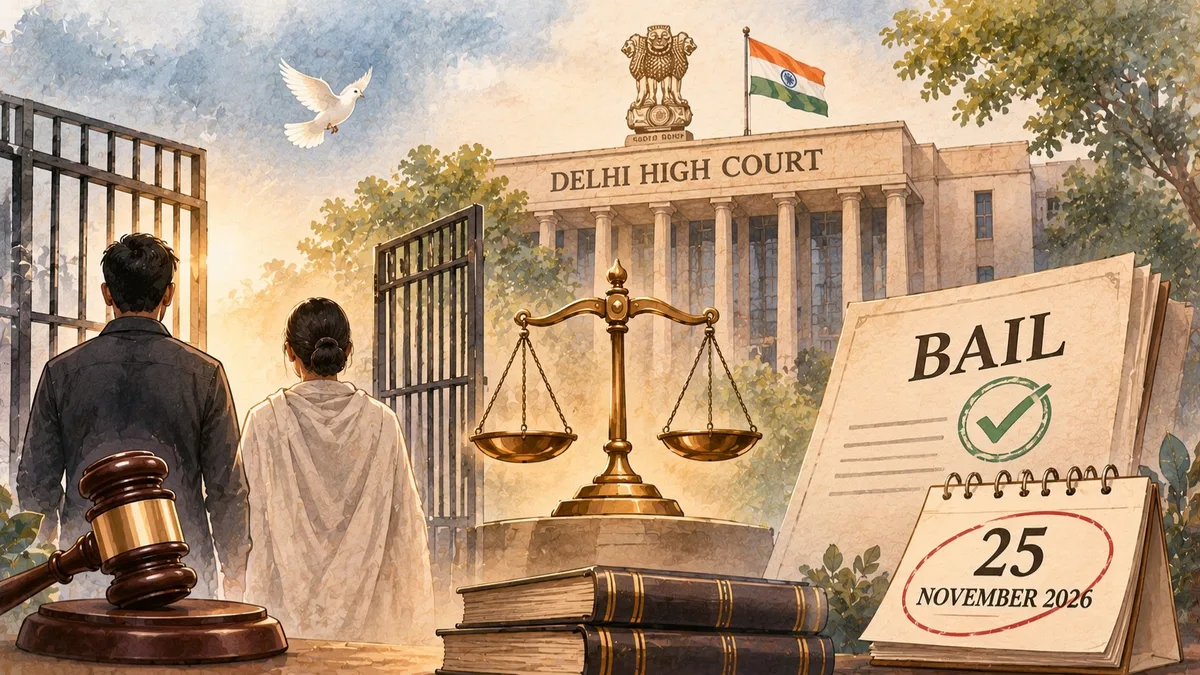
Two accused in an NIA case alleging an ISIS-inspired conspiracy (charged under Sections 38 and 39 UAPA and Section 120B IPC) challenged the refusal of bail by the Special Court. The Division Bench found the allegations prima facie true under Section 43D(5) UAPA and held that prolonged incarceration, by itself, was not made out because the trial was likely to conclude in six to eight months (Paras 43, 52–53). It nevertheless held that Section 436-A Cr.P.C. and Section 479 BNSS apply to special statutes such as the UAPA even where Section 43D(5) is attracted (Paras 57–67). It further held that the bar in Section 479(2) BNSS for multiple offences or multiple cases is not mandatory and must be read harmoniously, with the court retaining discretion once the Section 479(1) custody threshold is met, thereby affirming Leena Paulose (Paras 74–76). Whether sentences would run concurrently or consecutively turns on whether the offences arise from one transaction, and for bail the maximum sentence was taken as ten years, run concurrently (Paras 95–110). Appellant-2, a first-time offender, had served over one-third, and Appellant-1 had served about half, of that period; both were granted bail with stringent conditions (Paras 112–113, 121–123, 130–131).
Key Proposition: The bar in Section 479(2) BNSS against bail where an accused faces more than one offence or multiple cases is not an absolute prohibition but must be read harmoniously with Section 479(1), and the benefit of Section 479 BNSS / Section 436-A Cr.P.C. remains available in UAPA cases even where the accusations are prima facie true under Section 43D(5).
- Unlawful Activities (Prevention) Act, 1967 – Section 43D(5) – Bail – Prima facie true standard – Prolonged incarceration – Whether the trial delay justified bail on constitutional grounds – Held, no, as the trial was likely to conclude within six to eight months. (Paras 43, 52–53)
- Bharatiya Nagarik Suraksha Sanhita, 2023 – Section 479 / Cr.P.C. – Section 436-A – Maximum period of undertrial detention – Whether applicable to special statutes such as the UAPA – Held, yes. (Paras 57–67)
- BNSS – Section 479(2) – Multiple offences or multiple cases – Whether an absolute bar to bail – Held, no; to be read harmoniously with Section 479(1) and applied case by case. (Paras 74–76, 128(d))
- BNSS – Section 25 / Cr.P.C. – Section 31 – Concurrent or consecutive sentences for computing the detention threshold – Held, depends on whether offences arise from one transaction; a prima facie view suffices at the bail stage. (Paras 95–105, 128(e))
Background / Synopsis :
- FIR No. RC/05/2021/NIA/DLI was registered on 5 March 2021 at P.S. NIA, New Delhi, under Sections 17, 18, 18B, 20, 38 and 40 UAPA and Sections 120B, 121 and 121A IPC against seven known accused and others. It alleged a module of radicalised individuals led by Accused-1 with allegiance to ISIS, running propaganda channels on social media and planning hijrah to Jammu and Kashmir. (Paras 4–5)
- The Main Chargesheet was filed on 8 September 2021 and a Supplementary Chargesheet on 28 January 2022, in which Mohd. Waqar Lone (Appellant-1) and Deepthi Marla @ Maryam (Appellant-2) were arrayed as Accused-5 and Accused-4. (Para 6)
- Allegations against Appellant-1: facilitating meetings of the co-accused, raising and receiving funds (about Rs. 70,000) for procuring weapons, and holding ISIS-related content on his devices; he had earlier been arrested in FIR No. 74/2020 (P.S. Bandipora) and FIR No. 30/2020 (P.S. Aragam, Bandipora). He was arrested in this case on 14 August 2021. (Paras 7, 9–10)
- Allegations against Appellant-2: radicalising and recruiting co-accused through encrypted platforms, travelling from Dubai to Tehran in April 2019 for onward travel to Khorasan, and travelling to Srinagar in January 2020. She was arrested on 3 January 2022. (Paras 7, 20)
- The trial court's order on charge dated 31 October 2022 found no prima facie case under Sections 121A IPC and 17, 18, 18B, 20 and 40 UAPA against the Appellants, and framed charges under Section 120B IPC read with Sections 2(o), 13, 38 and 39 UAPA. NIA did not challenge the non-framing of the other charges. (Paras 11, 30)
- Appellant-1's first bail application was rejected on 31 October 2022; liberty to file afresh was granted on 16 May 2024 after Ammar Abdul Rahiman v. NIA (Crl.A. 79/2024, decided 6 May 2024). His second application, based on parity with Accused-10, was dismissed by the impugned order dated 28 January 2025. (Paras 12–16)
- Appellant-2's regular bail application (filed 26 September 2024, relying on Section 479 BNSS) was rejected by the impugned order. The trial court held her a first-time offender who had served over one-third of the maximum term but refused relief on the strength of the material against her. (Paras 22–24)
- Both appeals were filed under Section 21(4) NIA Act read with Section 528 BNSS and were heard together. (Paras 2–3)
Issues For Consideration :
- Whether there is a prima facie case against the Appellants within the meaning of Section 43D(5) UAPA, and whether delay in trial and prolonged incarceration is a ground for bail. (Para 29(A))
- If a prima facie case is made out, whether the benefit of Section 479 BNSS and Section 436-A Cr.P.C. can be extended to the Appellants. (Para 29(B))
- If the benefit is available, whether on the facts the Appellants are entitled to be released on bail. (Para 29(C))
Submissions Of Parties :
Appellant-1 (Mohd. Waqar Lone):
- Nothing was seized from him at arrest; the allegations rest on phones held by J&K Police since July 2020, so tampering cannot be ruled out, and most content was openly accessible online. (Para 18(a)–(b))
- The protected witness 'Delta' was not backed by electronic evidence, and the trial court itself found that no terrorist act was committed. He has been acquitted in FIR No. 74/2020 and bail is pending in FIR No. 30/2020. (Para 18(c)–(f))
- He is entitled to bail under Section 436-A Cr.P.C. and Section 479 BNSS as he has served more than half of the maximum term; Section 479 applies to pending cases irrespective of registration date, as per the MHA letter dated 16 October 2024. (Para 18(m)–(n))
Appellant-2 (Deepthi Marla @ Maryam):
- The case rests on material from her devices up to January 2020, some of it private conversation; there is no evidence of recruitment, and Section 18B UAPA cannot be brought in through the back door. (Para 25(a)–(b))
- Maximum punishment under Sections 38 and 39 UAPA is ten years; she has served over four years, and Section 479 BNSS applies retrospectively and to UAPA cases. (Para 25(c)–(e))
- Sentences ordinarily run concurrently (O.M. Cherian; Mohammad Akhtar Hussain). K.A. Najeeb supports release after substantial custody, and Sections 38 and 39 require proof of intention to further the organisation's activities, not mere ideological commitment (Vernon; Thwaha Fasal). (Para 25(f)–(k))
- Section 479(2) BNSS should not be read per section of charge, relying on Leena Paulose and the Supreme Court's prison-conditions proceedings. (Para 25(m)–(n))
Respondent / NIA:
- Under Watali, once charges are framed the accused must displace the prima facie case; the Appellants were radicalisers and Appellant-2 was the 'linchpin' of the conspiracy, with chats (D-151, D-152) and an FSL voice report (D-85/A) relied on. (Paras 19(a), 26(b)–(d))
- Protected witness 'Delta' gave a Section 164 Cr.P.C. statement and stayed silent before the trial court; Appellant-1 may threaten witnesses. Reliance on Mohd. Heydaitullah v. NIA. (Para 19(c)–(e), (i))
- Section 479(2) BNSS is a non-obstante bar on the court because Appellant-1 faces multiple cases and both Appellants face multiple offences; reliance on K. Ramakrishna, Muninder Singh and Panna Lal Mahto. The Leena Paulose view, at best, makes multiplicity a significant factor. (Para 19(p)–(s))
- Under Muthuramalingam and Section 25 BNSS, sentences run consecutively, so the maximum is 25 years and half has not been served. (Para 19(t)–(u))
- Of 154 witnesses, 61 were examined, 45 would be dropped and 35 remain; the trial could end in six to eight months as new NIA Special Courts have been set up. (Para 26(h))
Court's Observations & Analysis :
Re: Issue (i) – Prima facie case and prolonged incarceration
- Applying Watali (as followed in Gurwinder Singh and Shaikh Javed Iqbal), the Court takes a view on broad probabilities without dissecting evidence. (Paras 34–37)
- Emails, fake IDs, ISIS literature and images disparaging India on the devices, along with the grenade-launcher recovery in FIR No. 30/2020 and the funds received by Appellant-1, show allegiance to ISIS prima facie. Actual ISIS membership is a matter for trial. (Paras 38–42)
- K.A. Najeeb, as explained in Gulfisha Fatima and Syed Iftikhar Andrabi, allows constitutional courts to grant bail despite Section 43D(5) where incarceration is unduly prolonged and the trial will not end within a reasonable time. (Paras 46–50)
- Incarceration of about 5 years 3 months (Appellant-1) and 4 years 10 months (Appellant-2) is not 'prolonged' per se, as NIA's explanation of the remaining 35 witnesses and a likely conclusion in six to eight months, aided by Special Courts notified on 7 July 2026, is reasonable. (Paras 51–52)
- Held: Allegations are prima facie true, but prolonged incarceration per se is not made out. (Paras 43, 53)
Re: Issue (ii) – Applicability of Section 436-A Cr.P.C. / Section 479 BNSS to the UAPA and the bar in Section 479(2)
- Satender Kumar Antil held Section 436-A applicable to special Acts such as the NDPS Act absent a specific provision; Vijay Madanlal Choudhary applied it to the PMLA, and Badshah Majid Malik and Kapil Wadhawan applied Section 479 BNSS. The UAPA test ('prima facie true') is lighter than the NDPS/PMLA 'not guilty' test, so there is no reason to exclude it. (Paras 58–66)
- Held: even where Section 43D(5) applies, an accused may still seek the benefit of Section 479 BNSS / 436-A Cr.P.C. on fulfilling their requirements. (Para 67)
- The Karnataka High Court (K. Ramakrishna) and the J&K High Court (Muninder Singh) treated Section 479(2) as barring relief for multiple offences, while Leena Paulose (Delhi High Court) read the provision harmoniously. (Paras 69–74)
- Charging under more than one provision is usual; reading Section 479(2) as a mandatory bar would defeat the beneficial object of Section 479, which Vijay Madanlal Choudhary says requires case-to-case discretion. (Paras 75–76)
- Held: the view in Leena Paulose is confirmed; Section 479(2) is not a mandatory bar. (Para 76)
Re: Issue (iii) – Concurrent or consecutive sentences and entitlement on facts
- For bail, the maximum sentence under any one charged offence may be considered, but the NIA's point was examined. (Para 84)
- Mohd. Akhtar Hussain, O.M. Cherian, Manoj Alias Panu and S.S. Production show no rule of consecutive sentences; courts look first at whether the offences arise from one transaction. Section 25 BNSS gives wider discretion, guided by gravity of offences. (Paras 85–99)
- The acts alleged (2015 to 2020-21) form one chain of events under one FIR, so the sentence, if any, is most likely to run concurrently, with a maximum of ten years; Sections 38 and 39 UAPA permit even a fine-only sentence. The observation is made only for the bail stage. (Paras 103–106, 110)
- Factors relevant under Section 436-A / 479: single transaction, different FIRs, gravity, likelihood of concurrent sentences, and whether life or death is a punishment. (Para 101)
- Appellant-2, a first-time offender, has served over four years ten months, more than one-third of ten years. (Para 112)
- Appellant-1 is not a first-time offender but has served over five years, about half of the ten-year maximum, so he qualifies under Section 479(1). Section 479(2) does not bar him, as he has been acquitted in FIR No. 74/2020 and seeks bail in FIR No. 30/2020. Section 479 applies to those detained before 1 July 2024, per the Supreme Court's orders in In Re: Inhuman Conditions in 1382 Prisons. (Paras 113–127)
- Held: both Appellants are entitled to bail; Appellant-1 is also entitled under Section 436-A Cr.P.C. Most co-accused are already on bail. (Paras 127, 129–130)
Notable Observations:
- "The discretion has to be left with the Court and there cannot be a mandatory bar." (Para 76)
- "would go against the basic spirit of the Act itself" – on reading Section 479(2) to deny Section 479 relief merely because multiple offences are charged. (Para 76)
Decision & Directions :
- Appeals allowed; the impugned orders dated 28 January 2025 (Appellant-1) and 5 June 2025 (Appellant-2) are set aside, and both Appellants are granted bail in RC/05/2021/NIA/DLI, SC No. 3/2021. (Paras 131, 133)
- Conclusions: allegations prima facie true; prolonged-incarceration argument inapplicable as trial is likely to end in six to eight months; Section 436-A / 479 apply to the UAPA; Section 479(2) is not a mandatory bar; concurrent or consecutive running depends on the one-transaction test, with only a prima facie view at the bail stage. (Para 128)
- Bail may be cancelled by the Trial Court after hearing the Appellants in case of breach. (Para 132)
- Observations are only for deciding bail and do not influence the trial. A copy is to be sent to the trial court and the Jail Superintendent. (Paras 134–135)
- Separate Opinions: None.
Legal Provisions Discussed & Precedents Cited :
- UAPA, 1967 – Section 43D(5) – Bail bar: no release if accusation is prima facie true on perusal of case diary or Section 173 report; the Public Prosecutor must be heard.
- UAPA – Sections 38 and 39 – Membership of, and support to, a terrorist organisation; punishable up to ten years, or with fine, or both.
- UAPA – Sections 2(o) and 13 – Unlawful activity; punishment up to seven years and fine.
- Indian Penal Code, 1860 (IPC) – Section 120B – Criminal conspiracy; ↔ Bharatiya Nyaya Sanhita, 2023 (BNS) Section 61.
- Code of Criminal Procedure, 1973 (Cr.P.C.) – Section 436-A – Release of undertrial after half the maximum sentence; ↔ BNSS Section 479.
- BNSS – Section 479(1), first proviso (one-third for first-time offenders), second proviso (continued detention for reasons) and Section 479(2) (multiple offences or cases) – Central provisions interpreted.
- Cr.P.C. – Section 31 ↔ BNSS Section 25 – Concurrent or consecutive sentences; the BNSS raises the aggregate limit to twenty years and requires regard to the gravity of offences.
- Cr.P.C. – Section 164 – Statement of the protected witness before a Magistrate.
- NIA Act, 2008 – Section 21(4) – Appeal against bail orders.
- Constitution of India – Article 21 – Speedy trial and personal liberty.
- Doctrines and principles: prima facie true standard; constitutional courts' power to grant bail despite statutory bars (Najeeb); bail is the rule and jail the exception; single-transaction rule for sentencing.
- Union of India v. K.A. Najeeb, (2021) 3 SCC 713 – Relied on (as explained in Gulfisha Fatima and Syed Iftikhar Andrabi).
- National Investigation Agency v. Zahoor Ahmad Shah Watali, (2019) 5 SCC 1 – Followed.
- Syed Iftikhar Andrabi v. National Investigation Agency, 2026 SCC OnLine SC 881 – Relied on.
- Gulfisha Fatima v. State, 2026 SCC OnLine SC 10 – Relied on.
- Satender Kumar Antil v. CBI, (2022) 10 SCC 51 – Followed.
- Vijay Madanlal Choudhary v. Union of India, (2023) 12 SCC 1 – Relied on.
- Badshah Majid Malik v. Directorate of Enforcement, SLP (Crl.) No. 10846/2024 (18 October 2024) – Relied on.
- Kapil Wadhawan v. Central Bureau of Investigation, 2025 SCC OnLine SC 3038 – Relied on.
- Leena Paulose v. Directorate of Enforcement, 2026 SCC OnLine Del 2620 – Followed and confirmed.
- K. Ramakrishna v. Directorate of Enforcement, 2024 SCC OnLine Kar 1879, and Muninder Singh @ Sonu v. UT of J&K, 2025 SCC OnLine J&K 1187 – Not followed (contrary view on Section 479(2)).
- O.M. Cherian v. State of Kerala, (2015) 2 SCC 501 – Relied on.
Case Details :
- Case / Party Name: Mohd. Waqar Lone (Appellant in CRL.A. 375/2025) and Deepthi Marla @ Maryam (Appellant in CRL.A. 1025/2025) v. National Investigation Agency & Anr.
- Case Number(s): CRL.A. 375/2025 (with CRL.M.A. 18840/2026 & 18841/2026) and CRL.A. 1025/2025; CNR Nos. DLHC010164092025 and DLHC010479292025
- Coram / Judges: Justice Prathiba M. Singh and Justice Vikas Mahajan – Division Bench (judgment authored by Justice Prathiba M. Singh)
- Counsel Appearances: For Appellant-1: Mr. Aarif Ali, Mr. Pankaj Tiwari, Mr. Mujahid Ahmad, Mr. Mohd. Tauheed, Mr. Mohd. Faiz Ahmed, Mr. M.S. Alam, Ms. Nuzhat Nabi and Ms. Ifrah Farooq, Advocates. For Appellant-2: Ms. Nitya Ramakrishnan, Senior Advocate, with Mr. Rajat Kumar, Mr. Ashwath Sitaraman, Ms. Stuti Rai and Ms. Priya Vats, Advocates. For NIA: Mr. Rahul Tyagi, SPP, with Mr. Jatin, Ms. Priya Rai, Mr. Avinash Kumar Singh, Mr. Shubham Goyal, Mr. Amit Rohila and Mr. Priyansh Raj Singh, Advocates, along with Insp. Hariom Yadav, CIO (NIA).
Disclaimer: This summary is an editorial aid and does not form part of the judgment. Refer to the original judgment before citing.
Full Judgement / Attachment
Full Judgement
Frequently asked questions about Delhi High Court
- Where does the Delhi High Court sit and which areas does it cover?
- The Delhi High Court sits in New Delhi. It has jurisdiction over the National Capital Territory of Delhi. It was established on 31 October 1966 and is a leading forum for commercial, intellectual property, tax and arbitration matters.
- How do I check Delhi High Court case status and judgements?
- The official website, delhihighcourt.nic.in, provides case status, cause lists, e-filing and judgements searchable by party, judge or date. Orders are also mirrored on the eCourts Judgments portal (judgments.ecourts.gov.in).
- What are the Delhi High Court's Commercial and IP Divisions?
- Delhi High Court has original civil jurisdiction, so high-value suits in Delhi are filed directly before it. Its Commercial Division hears commercial disputes, and its Intellectual Property Division, set up in 2021 after the IPAB was abolished, hears patent, trademark and copyright cases. It is also a major forum for tax appeals from the ITAT Delhi Benches and for arbitration petitions.
- What is an LPA in the Delhi High Court?
- A Letters Patent Appeal (LPA) under Clause 10 of the Letters Patent lets a party challenge certain single-judge orders, typically in writ matters, before a Division Bench. In commercial cases, appeals lie under Section 13 of the Commercial Courts Act instead. Final judgements can be challenged by a Special Leave Petition under Article 136, ordinarily within 90 days.
- How can White Collar Professional help with a Delhi High Court matter?
- Post your requirement on White Collar Professional to receive proposals from verified Advocates, Chartered Accountants and Company Secretaries, compare them, and pay securely through the platform. This page also tracks the latest Delhi High Court judgements and legal updates as they are reported.