Widowed Daughter-in-Law Cannot Be Evicted from Father-in-Law's House Without Alternate Accommodation or Rent: Delhi High Court Balances DV Act Shared-Household Right with Owner's Decree for Possession
Court / Authority
Delhi High Court
Update / Judgement Date
25 Nov 2026
Date of Publication
26 Nov 2026
Case No.
RFA 438/2024
Source
WCP News Bulletin
Author
Dipanshi Bansal — WCP Legal Desk
Reading Time
14 min read
View Count
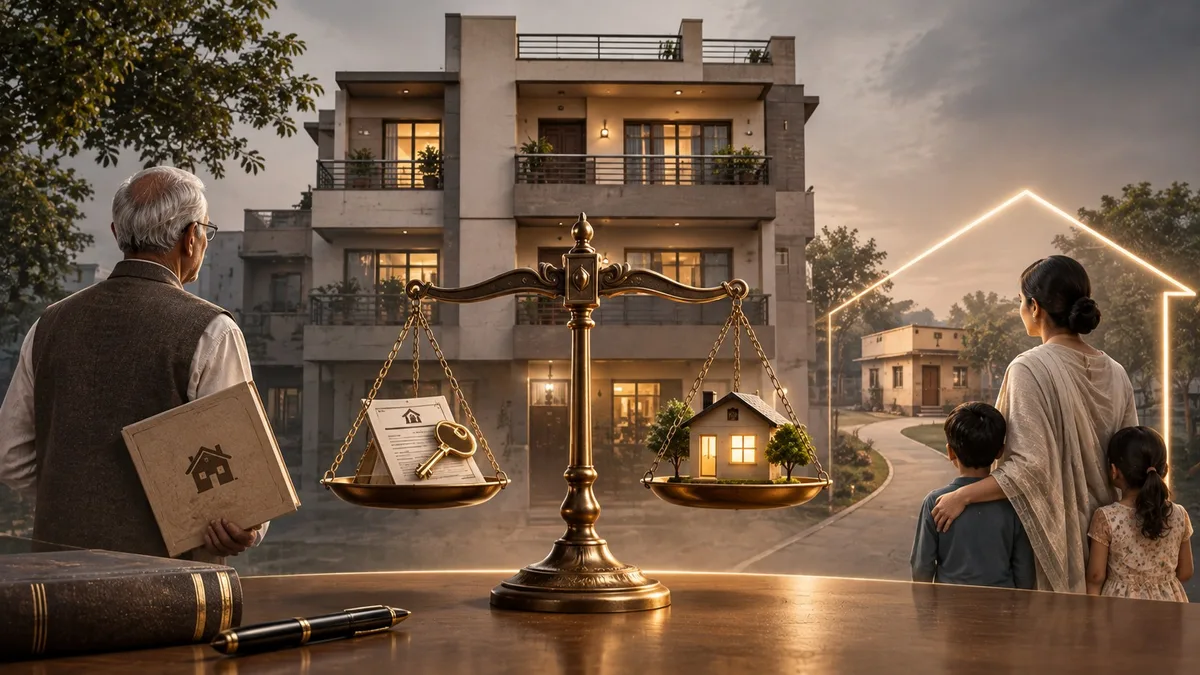
A father-in-law, the admitted owner under a 2001 sale deed, obtained a decree for possession of the ground floor of his Pandav Nagar house against his widowed daughter-in-law and her three children, who had lived there since the 2000 marriage; the Trial Court rejected the plea of shared household. In appeal, the High Court held that the plea of 'shared household' could be raised for the first time on appeal as a pure question of law on admitted facts (Paras 65–66). It held that the house was her shared household under Section 2(s) of the DV Act despite the title being exclusively the father-in-law's, and that her Section 17 right is independent of the licence and survives her husband's death (Paras 69–82). The owner's civil suit is 'procedure established by law' under Section 17(2) and is maintainable, but the Trial Court erred in passing an unconditional decree without balancing the two rights (Paras 86–94). Because Section 19 HAMA, read with Section 3(b), makes the father-in-law liable to maintain a widowed daughter-in-law, including residence, the decree was upheld but made executable only after he provides comparable alternate accommodation or pays Rs. 25,000 per month as rent (Paras 96–116).
Key Proposition: A widowed daughter-in-law living in her father-in-law's self-acquired house in a domestic relationship has a statutory right of residence under Section 17 DV Act that is independent of title and licence, and the owner's decree for possession, though maintainable, must be harmonised with that right by making it executable only after suitable alternate accommodation or rent is provided.
- Protection of Women from Domestic Violence Act, 2005 – Sections 2(s), 17 – Shared household – Daughter-in-law living with husband in father-in-law's self-acquired house – Whether a shared household despite exclusive title of father-in-law – Held, yes. (Paras 69–82)
- DV Act – Section 17(2) – 'Procedure established by law' – Owner's civil suit for possession – Whether maintainable despite DV Act proceedings – Held, yes, but the Civil Court must examine and balance the woman's right of residence. (Paras 86–94)
- Hindu Adoptions and Maintenance Act, 1956 – Sections 3(b), 19, 21, 22 – Widowed daughter-in-law's maintenance including residence from father-in-law – Held, an obligation exists during his lifetime; decree for possession executable only after alternate accommodation or rent of Rs. 25,000 per month. (Paras 96–116)
- Civil Procedure – Plea of shared household not raised in written statement – Whether it can be raised at the appellate stage – Held, yes, as a pure question of law on admitted facts. (Paras 65–66)
Background / Synopsis :
- Plaintiff/Respondent Kishan Lal, the admitted owner of the five-storey property C-249, Pandav Nagar, Delhi (sale deed dated 19 January 2001, Ex.PW-1/D), sought possession of the ground floor and damages at Rs. 25,000 per month in Civil Suit No. 221/2017, claiming the occupants were licensees permitted out of love and affection. (Paras 2–4, 7, 55)
- Defendant No. 1, Smt. Mamta, married his son Manoj Kumar on 11 September 2000 and lived in the property with him; Defendants 2 to 4 are their children. Manoj Kumar died on 1 May 2016. (Paras 8–9, 56)
- The licence was terminated by legal notice dated 16 December 2016; the other two sons vacated, but the Defendants did not. (Paras 5–6)
- The Defendants pleaded that the property was bought from ancestral funds, that it was joint family property, that she had a right to remain as a matrimonial home, and that Partition Suit No. 451/2018 and a DV Act complaint were pending. (Paras 10–23)
- The Trial Court (22 April 2024) decreed possession with costs, holding the property was not proved ancestral, Section 7 of the Family Courts Act did not bar the suit, the DV Act plea was raised only in final arguments, and DV Act proceedings did not bar a civil suit (Satish Chander Ahuja); damages were declined for want of proof. (Paras 28–31)
- The Defendants filed this Regular First Appeal under Section 96 CPC. The Respondent filed CM APPL. 52660/2026 under Section 151 CPC placing on record orders in Execution Petition No. 02/2016, showing she received Rs. 25,13,728.39 in 2016, not about Rs. 1 crore. (Paras 32, 40–41)
Issues For Consideration :
- Whether the suit property is ancestral or joint family property. (Para 58)
- Whether the suit property is the 'shared household' of Appellant No. 1 under the DV Act. (Paras 63–66)
- Whether the Plaintiff is entitled to a decree of possession, balancing the DV Act right of residence with the owner's proprietary rights. (Paras 83–95)
- Whether, after her husband's death, Appellant No. 1 is entitled to protection of her residence and what relief the parties are entitled to. (Paras 96–116)
Submissions Of Parties :
Appellants (Smt. Mamta and her children):
- Satish Chander Ahuja was not correctly appreciated; a daughter-in-law has a right to reside in the matrimonial or shared household even without a proprietary share (departing from S.R. Batra v. Taruna Batra). The Senior Citizens Act and the DV Act must be read harmoniously (S. Vanitha). (Paras 33–35)
- Ambika Jain v. Ram Prakash Sharma requires her subsisting residence claim to be considered before a possession decree is made effective; Gurneb Singh requires that a daughter-in-law be treated as a family member. (Paras 36–37)
- The property was bought from ancestral funds and has been her matrimonial home since marriage; the Plaintiff pressed her to vacate only after her husband's death. (Paras 38–39)
Respondent (Kishan Lal):
- His title is admitted and she admitted in cross-examination that she has no right, title or interest; the joint family character of property must be proved by the person asserting it (D.S. Lakshmaiah). (Paras 43–45)
- A licensee has no possessory right after termination of the licence (Planet M Retail). DV Act proceedings do not create ownership and the standards of proof in civil, criminal and domestic proceedings differ (Satish Chander Ahuja; Kishan Singh v. Gurpal Singh). (Paras 46–48)
- The shared household plea was not pleaded; even if the property is a shared household it gives no indefeasible right (Madalsa Sood). S. Vanitha does not give a daughter-in-law an indefeasible right; Ambika Jain was partly disapproved in Satish Chander Ahuja; Gurneb Singh arose in a criminal appeal. (Paras 49–53)
- By CM APPL. 52660/2026 he placed on record the execution orders regarding the money she received. (Para 40)
Court's Observations & Analysis :
Re: Issue (i) – Whether the suit property is ancestral
- Beyond bald assertions, the Appellants produced no evidence to trace proceeds of the sale or acquisition of other properties to the purchase of the suit property. (Paras 59–60)
- The 2001 sale deed in the Plaintiff's name was never challenged and nothing material emerged in cross-examination. (Para 61)
- Held: the suit property is the Plaintiff's exclusive property. (Para 62)
Re: Issue (ii) – Whether the property is the 'shared household'
- The objection that 'shared household' was not pleaded is rejected: the facts are admitted by the Plaintiff's own plaint and the Written Statement asserted a right to live there on the basis of family ties, so only a pure question of law arises, which can be raised even in appeal. (Paras 64–66)
- Section 17(1) DV Act confers on every woman in a domestic relationship a right of residence irrespective of title; sub-section (2) protects her from eviction save by procedure established by law. (Paras 67–69)
- Prabha Tyagi holds that the right does not depend on proof of domestic violence, is not confined to present residence, and is not extinguished by the husband's death. (Paras 70–72)
- Satish Chander Ahuja holds the definition in Section 2(s) to be exhaustive and not limited to houses of the husband or joint family, holding the narrower view in S.R. Batra not correct; permanency of living is the test, and a father-in-law's house may qualify. Seema Bansal (Delhi High Court) says a decree based only on title documents is not eviction 'in accordance with procedure established by law'. (Paras 73–79)
- She lived there from 2000 for nearly sixteen years until her husband's death, and continued thereafter; her children were born there; it was a settled family home and the Plaintiff lived on the first floor. She was in a domestic relationship with the Plaintiff as well. (Paras 80–81)
- Held: the property is her shared household and her right of residence is independent and not extinguished by her husband's death. (Para 82)
Re: Issue (iii) – Entitlement to a decree of possession; balancing of rights
- The woman's right of residence and the owner's right to possess are distinct and must be harmonised (S. Vanitha). The principle applies even though the Plaintiff relies on a civil suit rather than the Senior Citizens Act. (Paras 83–85)
- Satish Chander Ahuja (paras 116 and 83) says that a civil suit by the owner is 'procedure established by law', that the right is not indefeasible, that the court must examine the claim and balance it, and that it may mould relief such as alternate accommodation or rent. (Paras 86–88)
- The licence-based argument fails because Section 17(1) is a statutory right not derived from the licence. Planet M Retail concerned a commercial licence; Gurneb Singh (criminal appeal) does not decide property rights. (Paras 89–91)
- The relationship has broken down and the Plaintiff's wish to have his property cannot be called unreasonable. The Trial Court held the suit maintainable but passed an unconditional decree without examining how her right of residence was to be protected, which does not accord with the balancing required. (Paras 92–94)
- Held: the Plaintiff is entitled to a decree of possession, subject to balancing of the Appellant's right. (Para 95)
Re: Issue (iv) – Protection of residence after the husband's death; relief
- Section 19 HAMA makes the father-in-law liable to maintain a widowed daughter-in-law who cannot maintain herself; Section 3(b) defines maintenance to include residence; Sections 21(vii) and 22 operate on his death. Kanchana Rai v. Geeta Sharma, 2026 INSC 54, says a widowed daughter-in-law is a dependant and that denial of maintenance would offend Article 21. (Paras 97–106)
- She is educated only up to Class 10 and no evidence shows she has earnings or property. The Rs. 25,13,728.39 received in 2016, over a decade ago, cannot be enough to secure a home for the rest of her life, though it is relevant to what the Plaintiff must provide. (Paras 107–109)
- Section 19 HAMA read with Section 2(s) and Section 17 DV Act imposes on the father-in-law an obligation to maintain her, including providing residence. (Para 110)
- Ravneet Kaur v. Prithpal Singh Dhingra (Delhi High Court, upheld by the Supreme Court) upheld a possession decree but deferred execution until alternate accommodation was provided. (Paras 111–112)
- The Plaintiff's own plaint pegged the rental value of the ground floor at Rs. 25,000 per month, which is a reasonable measure of comparable accommodation. (Paras 113–114)
- Held: the decree stands, but she cannot be evicted until alternate accommodation or rent of Rs. 25,000 per month is provided. (Paras 113, 116)
Notable Observations:
- "Neither can be enforced in a way that completely defeats the other." – on the woman's right of residence and the owner's right to possession. (Para 83)
- "cannot reasonably be regarded as enough to secure her a home for the rest of her life" – on the sum received in 2016. (Para 109)
Decision & Directions :
- The Regular First Appeal is disposed of; the decree for possession dated 22 April 2024 is upheld. (Paras 116–117)
- The decree shall be executable only after the Respondent first secures suitable alternate accommodation for Appellant No. 1 commensurate with that enjoyed in the suit property, or in the alternative pays rent of Rs. 25,000 per month, which is taken as sufficient to secure such accommodation. (Para 116)
- The Executing Court shall ensure compliance with this direction before the decree is given effect. (Para 116)
- The observations on the nature of the suit property are only for deciding possession and do not prejudice the parties in Civil Suit No. 451/2018 (partition), which will be decided on its own merits. (Para 115)
- Pending applications are disposed of. (Para 118)
- Separate Opinions: None.
Legal Provisions Discussed & Precedents Cited :
- Protection of Women from Domestic Violence Act, 2005 (DV Act) – Section 2(f) – 'Domestic relationship' is a relationship of persons who live or have lived together in a shared household.
- DV Act – Section 2(s) – 'Shared household' includes a household whether or not the aggrieved person has any right, title or interest in it.
- DV Act – Section 17(1) and (2) – Right to reside in the shared household and protection from eviction save by procedure established by law.
- DV Act – Sections 12 and 19 – Application for reliefs and residence orders; Section 19(f) alternate accommodation or rent, as referred to in Satish Chander Ahuja.
- Hindu Adoptions and Maintenance Act, 1956 (HAMA) – Sections 3(b), 19, 21(vii) and 22 – Maintenance of widowed daughter-in-law, including residence, from the father-in-law and, after his death, from his estate.
- Code of Civil Procedure, 1908 – Sections 96 and 151 – Regular first appeal and the inherent power under which additional documents were filed.
- Family Courts Act, 1984 – Section 7 – Jurisdiction objection rejected by the Trial Court.
- Maintenance and Welfare of Parents and Senior Citizens Act, 2007 – Considered in S. Vanitha; harmonisation with the DV Act.
- Constitution of India – Article 21 – Right to live with dignity, referred to via Kanchana Rai.
- Doctrines: harmonious construction of competing statutory and proprietary rights; moulding of relief; pure question of law raisable at any stage.
- Satish Chander Ahuja v. Sneha Ahuja, (2021) 1 SCC 414 – Followed.
- Prabha Tyagi v. Kamlesh Devi, (2022) 8 SCC 90 – Followed.
- S. Vanitha v. Deputy Commissioner, Bengaluru Urban District, (2021) 15 SCC 730 – Relied on.
- S.R. Batra v. Taruna Batra, (2007) 3 SCC 169 – Referred to (view held not correct in Satish Chander Ahuja).
- Kanchana Rai v. Geeta Sharma & Ors., 2026 INSC 54 – Relied on.
- Ravneet Kaur v. Prithpal Singh Dhingra, 2022 SCC OnLine Del 594, and SLP(C) No. 12427/2022 (order of 29 July 2022) – Followed.
- Seema Bansal v. Durga Dass Bansal & Ors., RFA 704/2019, 2024:DHC:5899 – Relied on.
- Planet M Retail Ltd. v. Select Infrastructure Pvt. Ltd., 2014 SCC OnLine Del 4869 – Distinguished.
- Gurneb Singh v. State of Punjab, (2013) 4 RCR (Cri) 584 – Distinguished.
- Ambika Jain v. Ram Prakash Sharma, RFA 222/2019 (18 December 2019) – Referred to (noted as partly disapproved in Satish Chander Ahuja).
Case Details :
- Case / Party Name: Smt. Mamta, Master Kushal, Master Gautam and Ms. Sanjana v. Sh. Kishan Lal
- Case Number(s): RFA 438/2024, CM APPL. 40076/2024 & CM APPL. 52660/2026; CNR No. DLHC010416272024; arising from Civil Suit No. 221/2017
- Coram / Judges: Justice Neena Bansal Krishna – Single Judge
- Counsel Appearances: For the Appellants: Mr. Ajay Kumar Yadav, Ms. Piyushi Garg, Mr. Ananay Chopra, Mr. Hardik Saxena, Ms. Aarti, Mr. Rajat Yadav, Ms. Sujith S., Mr. Kanti Tiwari and Mr. Aman Yadav, Advocates. For the Respondent: Ms. Vanshika Gupta, Advocate.
Disclaimer: This summary is an editorial aid and does not form part of the judgment. Refer to the original judgment before citing.
Full Judgement / Attachment
Full Judgement
Frequently asked questions about Delhi High Court
- Where does the Delhi High Court sit and which areas does it cover?
- The Delhi High Court sits in New Delhi. It has jurisdiction over the National Capital Territory of Delhi. It was established on 31 October 1966 and is a leading forum for commercial, intellectual property, tax and arbitration matters.
- How do I check Delhi High Court case status and judgements?
- The official website, delhihighcourt.nic.in, provides case status, cause lists, e-filing and judgements searchable by party, judge or date. Orders are also mirrored on the eCourts Judgments portal (judgments.ecourts.gov.in).
- What are the Delhi High Court's Commercial and IP Divisions?
- Delhi High Court has original civil jurisdiction, so high-value suits in Delhi are filed directly before it. Its Commercial Division hears commercial disputes, and its Intellectual Property Division, set up in 2021 after the IPAB was abolished, hears patent, trademark and copyright cases. It is also a major forum for tax appeals from the ITAT Delhi Benches and for arbitration petitions.
- What is an LPA in the Delhi High Court?
- A Letters Patent Appeal (LPA) under Clause 10 of the Letters Patent lets a party challenge certain single-judge orders, typically in writ matters, before a Division Bench. In commercial cases, appeals lie under Section 13 of the Commercial Courts Act instead. Final judgements can be challenged by a Special Leave Petition under Article 136, ordinarily within 90 days.
- How can White Collar Professional help with a Delhi High Court matter?
- Post your requirement on White Collar Professional to receive proposals from verified Advocates, Chartered Accountants and Company Secretaries, compare them, and pay securely through the platform. This page also tracks the latest Delhi High Court judgements and legal updates as they are reported.