Padgha ISIS Module Case: Delhi High Court Denies UAPA Bail to Alleged Associate of Bomb-Maker but Grants It to Shopkeeper with No Discernible Role, Stressing Role-Specific Scrutiny Under Section 43D(5)
Court / Authority
Delhi High Court
Update / Judgement Date
25 Nov 2026
Date of Publication
26 Nov 2026
Case No.
CRL.A. 1342/2025
Source
WCP News Bulletin
Author
Dipanshi Bansal — WCP Legal Desk
Reading Time
14 min read
View Count
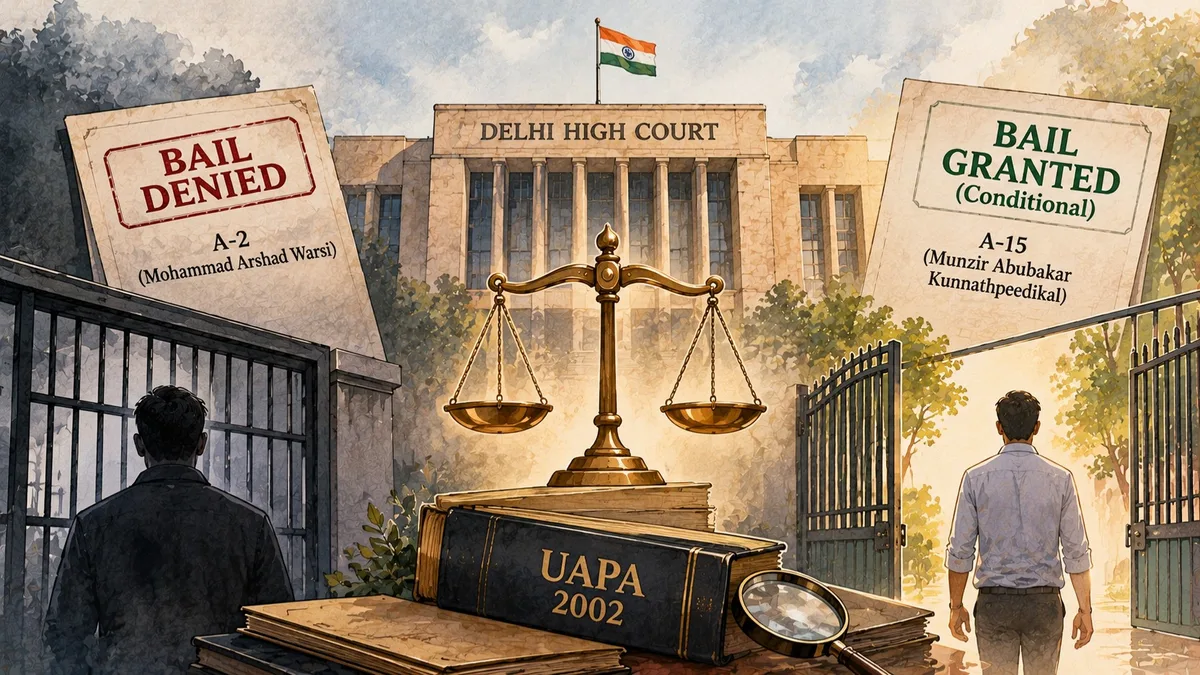
Two accused in the NIA's Delhi-Padgha ISIS case (RC No. 29/2023/NIA/DLI) challenged the refusal of regular bail under Section 43D(5) UAPA. Applying the Watali standard of broad probabilities, the Division Bench held that the allegations against A-2 (Warsi) were prima facie true, given his pointing out of A-3's hideout from which explosive material was seized, the use of his Aadhaar card for A-3's wife's hospital delivery, and protected-witness statements (Paras 98, 102–108). His custody of about three years was not unduly prolonged for Najeeb purposes, as the NIA's pan-India investigation explained the delay, charges were not yet framed, and the risk of influencing protected witnesses was high (Paras 109–122). Bail was refused, with liberty to renew the plea after the protected witnesses are examined or one year, whichever is earlier (Para 123). For A-15 (Munzir), a shopkeeper arrested only on a protected witness's naming him, no substantial or corroborated material disclosed any discernible role; his Article 21 right was held to outweigh the statutory bar and bail was granted with conditions (Paras 128–136). The Court distinguished the two accused on role (Paras 134–135).
Key Proposition: At the bail stage under Section 43D(5) UAPA, the prima facie assessment must be made accused by accused and by role: an alleged harbourer and bomb-making associate may be denied bail, while an accused against whom no substantial or corroborated material is discernible may be released because Article 21 may override the statutory bar.
- Unlawful Activities (Prevention) Act, 1967 – Section 43D(5) – Bail – Whether allegations are prima facie true on broad probabilities – Held, yes for A-2 (harbouring and role in the explosives conspiracy), no for A-15 (no substantial material). (Paras 98, 102–108, 128–135)
- UAPA – Section 43D(5) read with Article 21 – Delay and prolonged incarceration (K.A. Najeeb) – About three years in custody, charges not framed, extensive pan-India investigation – Whether bail on delay – Held, no for A-2. (Paras 109–122)
- UAPA – Article 21 versus Section 43D(5) – Where no substantial material is discernible against the accused – Whether liberty may override the statutory bar – Held, yes, on the facts of A-15. (Paras 132–135)
Background / Synopsis :
- FIR No. 150/2022 (Rajasthan Police) led to the ISIS Ratlam Module Case (RC-18/2022/NIA/DLI); a further FIR in Pune led to the ISIS Pune Module Case (RC-05/2023/NIA/MUM), which revealed a larger conspiracy centred on Padgha, Maharashtra. (Paras 3–7)
- In September 2023 the Special Cell, Delhi Police registered Crime No. 243/2023 on information about movement of ISIS members or sympathisers around Delhi; it was transferred to NIA and re-registered as RC-29/2023/NIA/DLI. (Paras 8, 12, 91)
- Appellant A-2 (Mohammad Arshad Warsi), a Ph.D. student at Jamia Millia Islamia, was apprehended on 1 October 2023 at Moradabad. He allegedly pointed out the Jaitpur, Delhi residence of A-3 (Shahnawaz Alam), from which A-3 was arrested on 2 October 2023 and IED-making material was seized. (Paras 9–11, 19)
- The main chargesheet (21 March 2024) charged A-2 under Sections 120B and 201 IPC and Sections 18, 19, 20, 38 and 39 UAPA, alleging recruitment and propagation of ISIS ideology (including at Aligarh Muslim University), harbouring A-3, and online searches relating to explosives. (Paras 14, 100)
- Appellant A-15 (Munzir Abubakar Kunnathpeedikal), a shopkeeper in Padgha, was arrested on 9 December 2023 and named only in the first supplementary chargesheet (3 June 2024) under Sections 120B and 201 IPC and Sections 13, 18, 20, 38 and 39 UAPA, on allegations of taking bayth from A-13, attending meetings, and deleting data. (Paras 16–18)
- NIA has filed five chargesheets (the latest, the fourth supplementary, on 7 January 2026); trial has not commenced. A-13, Saquib Abdul Hamid Nachan, alleged head of ISIS in India, is now deceased. (Paras 91–92)
- By separate orders dated 14 August 2025, the Special Judge (NIA), Patiala House Courts, rejected both bail applications, holding the allegations prima facie true under Section 43D(5). (Paras 1–2)
Issues For Consideration :
- Whether the allegations against each Appellant (A-2 and A-15) are prima facie true so as to attract the bar under Section 43D(5) UAPA. (Para 94)
- Whether the prolonged incarceration of A-2, and the likely length of trial, entitles him to bail despite Section 43D(5), in light of K.A. Najeeb. (Paras 109–111)
- Whether, on the material, A-15 is entitled to bail on a balance of Article 21 against the statutory bar. (Paras 132–133)
Submissions Of Parties :
Appellant A-2 (Mohammad Arshad Warsi):
- He is the only accused unconnected to Padgha; there is no recovery from his devices, home or person, and no communication with any ISIS handler or co-accused. The case rests on vague witness statements by accomplices. (Paras 19–23, 32)
- His searches (such as 'is potassium permanganate soluble in water') were linked to the school science he taught; no explosive material was recovered from him and the Explosives Act was not invoked. (Para 24)
- He was away in Moradabad and Nainital when A-3 viewed the Jaitpur house; A-3's confession does not name him; the seizure memo records no pointing out; and his disclosure and pointing-out memo is weak evidence (Manoj Kumar Soni). Corroboration is needed for approver evidence (Devendran; Bhiva Doulu Patil; Shankar) and for harbouring (Kalpnath Rai). (Paras 25–34, 37)
- Grounds of arrest were not given; he retracted his custodial statements on 4 December 2023; and with over 500 witnesses and 21 accused, prolonged incarceration looms, violating Article 21. (Paras 35–36)
- Appellant A-15 (Munzir Abubakar Kunnathpeedikal):
- A 39-year-old man with no antecedents, sole caregiver of his family; nothing incriminating was recovered from him and his shop was never searched. (Paras 54–57)
- There is no call, message or financial trail linking him to co-accused or ISIS handlers; Section 18 and Section 20 UAPA are not attracted without a Section 15 terrorist act; the case rests on Section 161 Cr.P.C. statements and the two approvers do not name him. (Paras 58–61)
- The three 'incriminating' images were mass forwards; the bayth allegation and the Ramzan 2022 meeting are uncorroborated; the Section 201 IPC allegation of deleting data is hearsay and unsupported by any retrieved material. (Paras 62–74)
- Grounds of arrest were not supplied (Prabir Purkayastha), and a trial involving 21 accused and over 500 witnesses has not begun. (Paras 75–76)
Respondent / NIA:
- The Special Court correctly applied Watali and Gurwinder Singh; the material, read cumulatively, shows A-2 as an integral part of a pan-India conspiracy who propagated ISIS ideology, recruited youth (including at AMU), collected funds and sheltered A-3 and another accused. (Paras 38–50, 82)
- A-3 used the Aadhaar cards of A-2 and his wife for his own wife's hospital delivery; A-3 was arrested at A-2's behest; witness statements are corroborated by device data. (Paras 43–50)
- A-15 took bayth, provided technical support to A-13, tried to recruit a witness, and deleted data after the arrests of Padgha accused; grounds of arrest were given in writing under Section 43B UAPA and bear his signature. (Paras 78–81, 85–89)
- Under Gulfisha Fatima and Barakathullah, delay alone is not a ground, and Section 18 does not require proof of a completed terrorist act; A-2 and A-15 have not shown unduly prolonged incarceration. (Paras 53, 83, 87–88)
Court's Observations & Analysis :
Re: Issue (i) – Prima facie standard under Section 43D(5) UAPA
- Applying Watali (as followed in Gurwinder Singh and Shaikh Javed Iqbal), the Court forms a prima facie opinion on broad probabilities and does not conduct a mini-trial. It does not venture into the merits of RC-29/2023, which is at a nascent stage. (Paras 93–98)
- A-2 was prima facie closely linked to A-3: he pointed out A-3's residence from where a substantial quantity of explosive material was seized, and the hospital records show his and his wife's Aadhaar cards used for A-3's wife's delivery in Pune on 11 September 2022. (Paras 102–103)
- Protected witnesses give specific incidents of recruitment and instigation, and his seized phones contained ISIS material, explosives-related content, pseudo-identities and deletions. (Paras 106–107)
- His explanation of school-teaching-related searches might appeal in isolation but becomes improbable given the facts that he lent his Aadhaar card to A-3, from whom explosives material was seized. (Para 108)
- For A-15, nothing appears in the main chargesheet; he was a shopkeeper arrested on being named by a protected witness, the main allegation being that his devices held material shown to propagate ISIS ideology and that meetings occurred at his shop. The deletion allegation is unsubstantiated, and no other substantial or corroborated material has come forward. (Paras 126–129)
- Held: allegations against A-2 are prima facie true; those against A-15 are not, and his role is not discernible. (Paras 122, 131, 135)
Re: Issue (ii) – Prolonged incarceration and Najeeb (A-2)
- A-2 has been in custody for over three years; charges are yet to be framed after the fourth supplementary chargesheet of 7 January 2026. (Para 110)
- The investigation spans Rajasthan, Maharashtra, Madhya Pradesh, Uttar Pradesh and Delhi and relates to Padgha, claimed as ISIS territory. The time required is inherent in the network and the delay is not attributable to NIA. (Paras 112–113, 121)
- Najeeb itself said it would have refused bail at the threshold. Gulfisha Fatima's treatment of Article 21 and Section 43D(5) has been doubted in Syed Iftikhar Andrabi, and the issue has been referred to a larger bench in Tasleem Ahmed v. State (NCT of Delhi) (order dated 22 May 2026). (Paras 115–117)
- Jagtar Singh Johal (over 8 years in custody; 40 of 163 witnesses examined) and Naim @ Mohd. Naeem (7½ years; 42 of 112 witnesses examined) are distinguishable on facts. (Paras 118–120)
- The charges could attract up to life imprisonment; he has strong roots in Delhi and there is a high likelihood of his influencing protected witnesses. Even on ordinary bail standards (flight risk, witness influence, tampering) bail is unwarranted at this stage. (Paras 121–122)
- Held: bail refused to A-2; the order of 14 August 2025 is upheld, with liberty to renew the prayer after the protected witnesses are examined or after one year, whichever is earlier. (Paras 122–124)
Re: Issue (iii) – Article 21 versus the statutory bar (A-15)
- A-15 has been in custody for about two years and ten months; the order on charge is yet to be passed and the trial has not begun. (Paras 130, 133)
- The Court could discern no substantial material against him, and his Article 21 right must be balanced against Section 43D(5) and may in fact override it. (Para 132)
- A-2's roles (furthering the conspiracy, harbouring and supporting other accused) are quite distinct from those alleged against A-15. (Para 134)
- Held: A-15 is entitled to bail without any opinion on the merits. (Paras 133, 135–136)
Notable Observations:
• "Such a claim is very disturbing and poses a serious threat to National security." – on the claim that Padgha was ISIS territory in India. (Para 112)
• "may in fact override it" – on Article 21 and the statutory bar where no substantial material is discernible. (Para 132)
Decision & Directions :
- CRL.A. 1342/2025 (A-2, Mohammad Arshad Warsi): Appeal disposed of; the impugned order dated 14 August 2025 is upheld and bail is refused. (Paras 122, 125)
- A-2 may renew his bail prayer before the appropriate Court on completion of the examination of the protected witnesses relied on by NIA, or on expiry of one year from the date of the order, whichever is earlier; any such prayer is to be considered on its own merits and the stage then reached, without being influenced by the impugned order or this order. (Paras 123–124)
- CRL.A. 1337/2025 (A-15, Munzir Abubakar Kunnathpeedikal): Impugned order dated 14 August 2025 set aside; appeal disposed of; A-15 is released on bail on the following conditions (Paras 136–137):
- Personal bond of Rs. 2,00,000 with one surety in the like amount to the satisfaction of the Trial Court / Link Court.
- Surrender passport, if any, or file an affidavit that he holds none.
- Reside in Delhi only during the trial and furnish the full Delhi address to the NIA I.O.; inform the I.O. of any change.
- No travel outside Delhi, especially to Padgha, Maharashtra, without prior permission of the Court, with an application disclosing destination, duration, purpose and contact details.
- Use only one mobile phone, kept switched on at all times; furnish the mobile number and e-mail address to the I.O. and report any change.
- Appear before the Trial Court on every date unless exempted; no conduct delaying the proceedings.
- No direct or indirect contact with, influence on, or threat to any prosecution witness, protected witness or person acquainted with the facts.
- No tampering with evidence, electronic material, records, devices or documents.
- No public statement, including through print, electronic or social media, on the merits, evidence, witnesses or trial.
- No activity prejudicial to public order or integrity of the trial; no uploading, sharing or circulation of anti-national material or material in support of ISIS or any terrorist organisation.
- Report to the NIA I.O. once every fortnight (or as directed by the Trial Court); the I.O. is to maintain a separate attendance register.
- NIA may seek cancellation of bail before the appropriate Court on breach of any condition.
- The observations are not an expression on the merits; a copy of the judgment is to be sent to the Trial Court and the Jail Superintendent. (Paras 138–139)
- Separate Opinions: None.
Legal Provisions Discussed & Precedents Cited :
- UAPA, 1967 – Section 43D(5) – Bar on bail where the accusation is prima facie true on a perusal of the case diary or Section 173 report; Public Prosecutor to be heard.
- UAPA – Sections 18, 19, 20 – Conspiracy and preparatory acts for terrorist acts; recruitment; being a member of a terrorist gang or organisation, as charged.
- UAPA – Sections 38 and 39 – Membership of, and support to, a terrorist organisation, as charged.
- UAPA – Section 43B – Informing the arrested person of the grounds of arrest, as relied on by NIA.
- Indian Penal Code, 1860 (IPC) – Sections 120B and 201 – Criminal conspiracy and causing disappearance of evidence, as charged; ↔ Bharatiya Nyaya Sanhita, 2023 Sections 61 and 238.
- Code of Criminal Procedure, 1973 – Sections 161 and 164 – Witness statements relied upon by the parties; ↔ Bharatiya Nagarik Suraksha Sanhita, 2023 Sections 180 and 183.
- Constitution of India – Article 21 – Personal liberty and speedy trial, balanced against the statutory bar.
- Doctrines: prima facie true standard on broad probabilities; constitutional court's power to grant bail despite statutory restrictions (Najeeb); role-specific scrutiny of accused.
- NIA v. Zahoor Ahmad Shah Watali, (2019) 5 SCC 1 – Followed.
- Gurwinder Singh v. State of Punjab, (2024) 5 SCC 403; Shaikh Javed Iqbal v. State of Uttar Pradesh, 2024 INSC 534 – Referred to (as having applied Watali).
- Union of India v. K.A. Najeeb, (2021) 3 SCC 713 – Relied on and distinguished on facts for A-2.
- Gulfisha Fatima v. State (GNCTD), 2026 INSC 2 – Referred to; its approach to Article 21 and Section 43D(5) noted as doubted in Syed Iftikhar Andrabi.
- Syed Iftikhar Andrabi v. National Investigation Agency, Jammu, 2026 INSC 503 – Referred to (doubted Gulfisha Fatima).
- Tasleem Ahmed v. State Govt. of NCT of Delhi, SLP (Crl.) 2867/2026 (order of 22 May 2026) – Referred to (question referred to a larger bench).
- Jagtar Singh Johal @ Jaggi v. NIA, 2026:DHC:7994-DB; Naim @ Mohd. Naeem v. NIA, 2026:DHC:8533-DB – Distinguished.
Case Details :
- Case / Party Name: Mohammad Arshad Warsi (Accused No. 2) v. National Investigating Agency (CRL.A. 1342/2025); Munzir Abubakar Kunnathpeedikal (Accused No. 15) v. National Investigating Agency (CRL.A. 1337/2025)
- Case Number(s): CRL.A. 1342/2025 & CRL.M.A. 29407/2025 (CNR No. DLHC010743212025); CRL.A. 1337/2025 (CNR No. DLHC010740522025); arising from RC No. 29/2023/NIA/DLI
- Coram / Judges: Justice Prathiba M. Singh and Justice Madhu Jain – Division Bench (judgment authored by Justice Prathiba M. Singh)
- Counsel Appearances: For Appellant in CRL.A. 1337/2025: Ms. Sowjhanya Shankaran, Advocate. For Appellant in CRL.A. 1342/2025: Mr. Archit Krishna, Ms. Tamanna Pankaj and Mr. Ashutosh Shukla, Advocates. For NIA: Mr. Gautam Narayan, Senior Advocate (SPP), Ms. Asmita Singh, Advocate, with Mr. Manoj Yadav and Mr. Bhupendra Giri, NIA.
Disclaimer: This summary is an editorial aid and does not form part of the judgment. Refer to the original judgment before citing.
Full Judgement / Attachment
Full Judgement
Frequently asked questions about Delhi High Court
- Where does the Delhi High Court sit and which areas does it cover?
- The Delhi High Court sits in New Delhi. It has jurisdiction over the National Capital Territory of Delhi. It was established on 31 October 1966 and is a leading forum for commercial, intellectual property, tax and arbitration matters.
- How do I check Delhi High Court case status and judgements?
- The official website, delhihighcourt.nic.in, provides case status, cause lists, e-filing and judgements searchable by party, judge or date. Orders are also mirrored on the eCourts Judgments portal (judgments.ecourts.gov.in).
- What are the Delhi High Court's Commercial and IP Divisions?
- Delhi High Court has original civil jurisdiction, so high-value suits in Delhi are filed directly before it. Its Commercial Division hears commercial disputes, and its Intellectual Property Division, set up in 2021 after the IPAB was abolished, hears patent, trademark and copyright cases. It is also a major forum for tax appeals from the ITAT Delhi Benches and for arbitration petitions.
- What is an LPA in the Delhi High Court?
- A Letters Patent Appeal (LPA) under Clause 10 of the Letters Patent lets a party challenge certain single-judge orders, typically in writ matters, before a Division Bench. In commercial cases, appeals lie under Section 13 of the Commercial Courts Act instead. Final judgements can be challenged by a Special Leave Petition under Article 136, ordinarily within 90 days.
- How can White Collar Professional help with a Delhi High Court matter?
- Post your requirement on White Collar Professional to receive proposals from verified Advocates, Chartered Accountants and Company Secretaries, compare them, and pay securely through the platform. This page also tracks the latest Delhi High Court judgements and legal updates as they are reported.