DGCA's Reclassification of Pipistrel as Light Sport Aircraft Upheld: Delhi HC Division Bench Denies CPL Credit for Flying Hours
Court / Authority
Delhi High Court
Update / Judgement Date
06 Sept 2026
Source
WCP News Bulletin
Author
Dhruv Chotiya — WCP Legal Desk
Reading Time
4 min read
View Count
1
Headnote
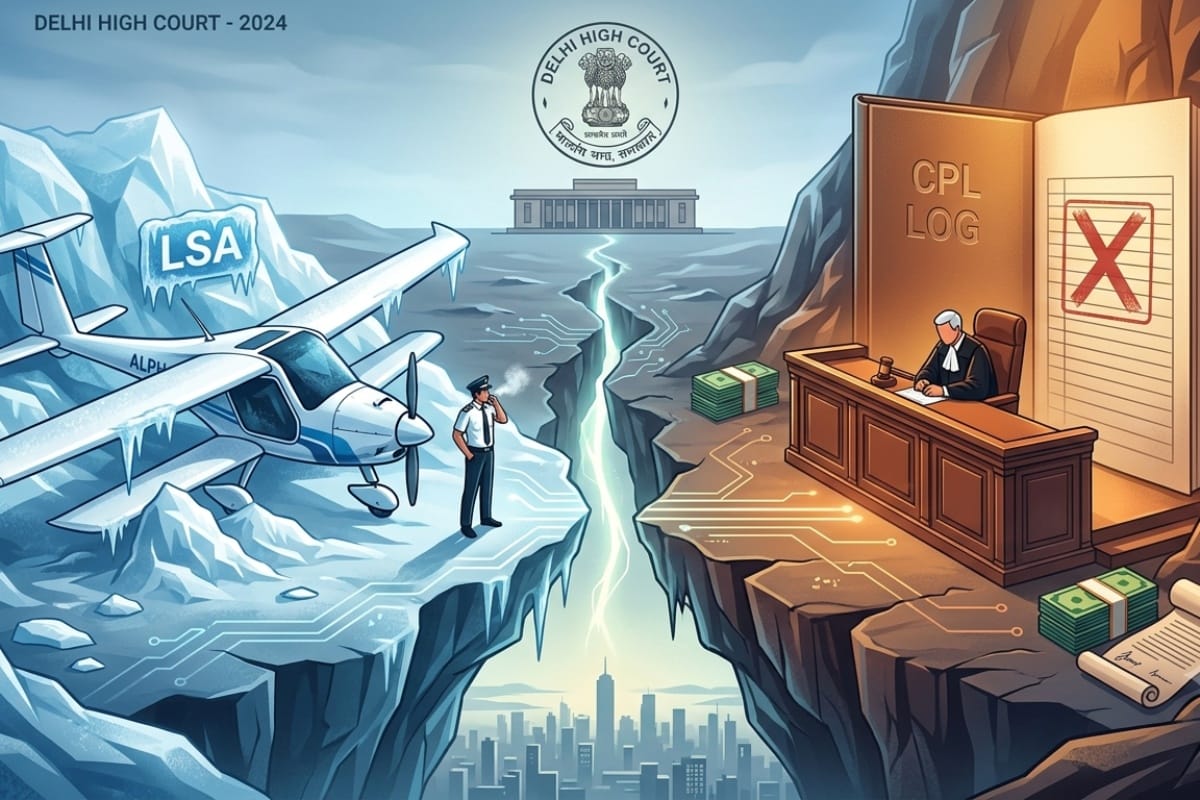
A Division Bench of the Delhi High Court dismissed an intra-court appeal challenging DGCA's classification of the Pipistrel VIRUS SW 121 aircraft as a Light Sport Aircraft (LSA), which resulted in rejection of Commercial Pilot Licence applications for flying hours logged on the aircraft. The Court held that the CS-LSA certification basis recorded in the EASA Type Certificate, rather than the description of the aircraft as "Normal" category, was the relevant consideration for licensing purposes; that a Certificate of Airworthiness does not determine licensing eligibility; and that no estoppel operates against a statutory regulator's safety-related classification. The appeal, condoned for a delay of 468 days, was ultimately dismissed on merits.
Background
- GATI, operating under a Lease-Develop-Operate Agreement with the Appellant, imported two Pipistrel VIRUS SW 121 aircraft from Slovenia in 2021 after EASA granted Type Certification under the CS-LSA certification specification and DGCA accepted the certification and issued Certificates of Airworthiness (CoA) in the "Normal" category.
- The 2023 FTO List published by DGCA reflected the Pipistrel aircraft as LSAs in GATI's fleet; EASA subsequently clarified the aircraft was a "Normal" category aircraft under European rules, but DGCA, by Communication dated 26.02.2024, classified the aircraft as LSA under Indian regulations.
- Consequent Rejection Orders denied Commercial Pilot Licence (CPL) applications of three GATI-trained student pilots (Respondent Nos. 3-5) on the ground that over 90 flying hours logged by each on the Pipistrel — treated as LSA — could not count towards the mandatory 200-hour aeroplane experience requirement.
- A learned Single Judge dismissed the writ petition challenging the classification and rejection orders, holding the LSA classification was known to GATI since 2022 and was a valid exercise of DGCA's statutory power under Section 5A of the Aircraft Act, warranting judicial restraint on a technical safety matter.
- The Appellant's intra-court appeal, filed with a delay of 468 days (condoned), contended that CS-LSA was merely a certification standard distinct from airworthiness category, that valid CoAs recording "Normal" category could not be overridden without formal cancellation/revocation, and that the DGCA was estopped by its prior conduct including approvals, CPL endorsement and maintenance-plan clearances.
Court's Observations
- The CS-LSA certification basis recorded in the EASA Type Certificate Data Sheet, not the description of the aircraft as "Normal" in a subsequent clarification e-mail, was the relevant consideration for DGCA in determining how flying experience should be reckoned under Indian licensing rules.
- A Certificate of Airworthiness concerns an aircraft's fitness to operate safely and is distinct from whether flying experience acquired on it counts towards a Pilot's licence under Schedule II of the Aircraft Rules; the CoAs were neither cancelled nor revoked, so procedural safeguards for cancellation/revocation were not attracted.
- Paragraph 3.4(2)(c) of CAR Section 2 excludes from the LSA category only aircraft holding a CoA issued by a foreign authority, not one issued domestically by DGCA, rendering the "Normal"/LSA mutual-exclusivity argument untenable.
- There can be no estoppel against exercise of a statutory function; prior administrative acts such as maintenance-plan approval, TPM revisions, FTO status and a single CPL endorsement could not compel DGCA to perpetuate an earlier error, particularly in a matter of public safety and licensing standards.
- The distinction between 'Vs0' and 'Vs' stall-speed parameters and the terminology difference between 'Light Sport Aeroplane' (EASA) and 'Light Sport Aircraft' (Indian Rules) were technical and terminological matters within DGCA's specialised domain, not shown to be perverse or mala fide.
- Natural justice was not violated as the Communication followed an extended exchange, correspondence with multiple DGCA directorates and the MCA, a stakeholder meeting, and an Expert Committee report; legitimate expectation must yield to public interest in pilot licensing and safety standards.
Legal Provisions Discussed
- Section 5A of the Aircraft Act, 1934 (now Bharatiya Vayuyan Adhiniyam, 2024) — DGCA's power to classify and reassess aircraft.
- Aircraft Rules, 1937 — Rule 3(33AA), Rule 49E, Rule 49I, and Schedule II (Sections 'A', 'E' and 'J' — pilot licensing experience requirements).
- Civil Aviation Requirements (CAR), Section 6 Series A Part II and Section 2 Series F Part XXIII.
- Article 33 of the Chicago Convention on International Civil Aviation, 1944.
- Articles 14, 19(1)(g) and 21 of the Constitution of India.
Case Details
Court Name
High Court of Delhi at New Delhi
Case Number
LPA 680/2025 & CM APPL. 69961/2025
Case / Party Name
Global Avianautics Limited v. Directorate General of Civil Aviation & Ors.
Court
High Court of Delhi (Division Bench)
Coram / Judges
Hon'ble The Chief Justice Devendra Kumar Upadhyaya; Hon'ble Mr. Justice Tejas Karia
Date of Decision
03.09.2026
Full Judgement / Attachment
Full Judgement
Frequently asked questions about Delhi High Court
- Where does the Delhi High Court sit and which areas does it cover?
- The Delhi High Court sits in New Delhi. It has jurisdiction over the National Capital Territory of Delhi. It was established on 31 October 1966 and is a leading forum for commercial, intellectual property, tax and arbitration matters.
- How do I check Delhi High Court case status and judgements?
- The official website, delhihighcourt.nic.in, provides case status, cause lists, e-filing and judgements searchable by party, judge or date. Orders are also mirrored on the eCourts Judgments portal (judgments.ecourts.gov.in).
- What are the Delhi High Court's Commercial and IP Divisions?
- Delhi High Court has original civil jurisdiction, so high-value suits in Delhi are filed directly before it. Its Commercial Division hears commercial disputes, and its Intellectual Property Division, set up in 2021 after the IPAB was abolished, hears patent, trademark and copyright cases. It is also a major forum for tax appeals from the ITAT Delhi Benches and for arbitration petitions.
- What is an LPA in the Delhi High Court?
- A Letters Patent Appeal (LPA) under Clause 10 of the Letters Patent lets a party challenge certain single-judge orders, typically in writ matters, before a Division Bench. In commercial cases, appeals lie under Section 13 of the Commercial Courts Act instead. Final judgements can be challenged by a Special Leave Petition under Article 136, ordinarily within 90 days.
- How can White Collar Professional help with a Delhi High Court matter?
- Post your requirement on White Collar Professional to receive proposals from verified Advocates, Chartered Accountants and Company Secretaries, compare them, and pay securely through the platform. This page also tracks the latest Delhi High Court judgements and legal updates as they are reported.