← back
Must-ReadDelhi High Court
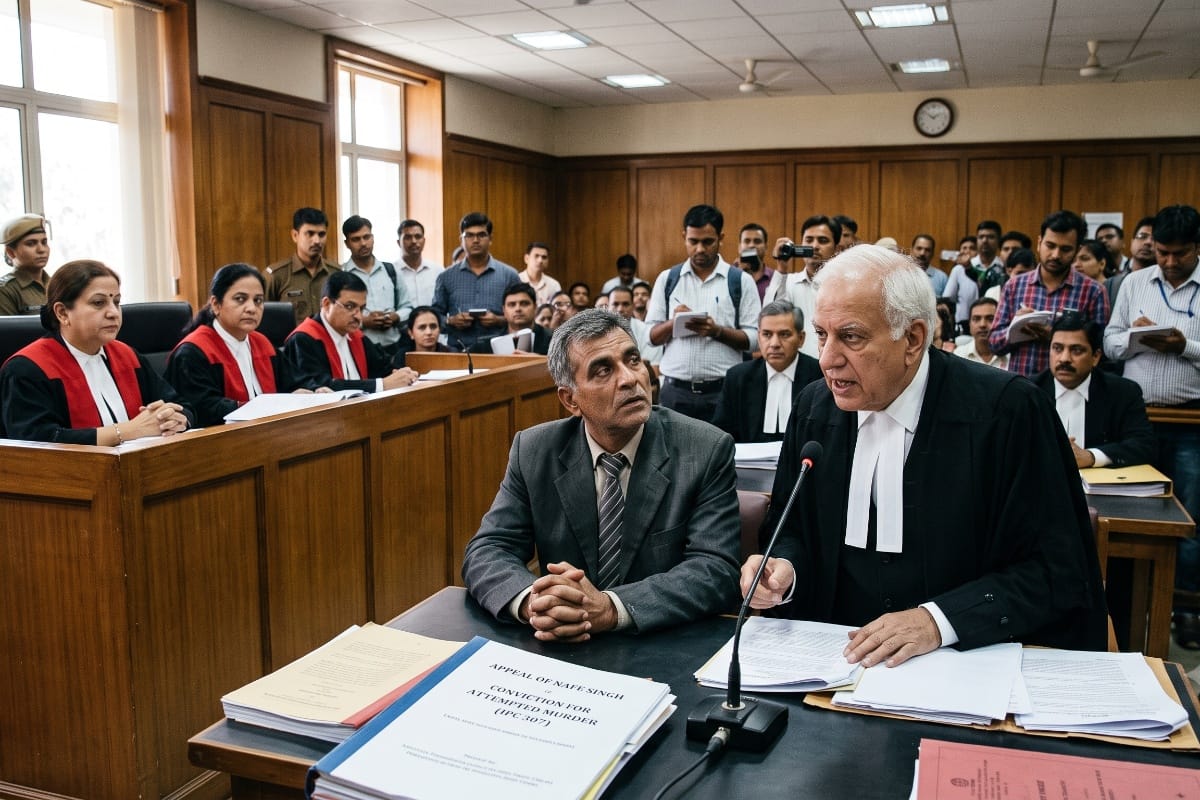
Judgment regarding the appeal filed by Nafe Singh against his conviction for attempted murder
Court / Authority
Delhi High Court
Update / Judgement Date
31 Aug 2026
Source
WCP News Bulletin
Author
Dhruv Chotiya — WCP Legal Desk
Reading Time
2 min read
View Count
Criminal Law
Key Sections & Their Gist
Main Findings / Conclusions
- Section 1: Overview of the matrimonial conflict leading to the legal case, describing the nature of the disputes between Nafe Singh and the victim.
- Section 2: Details of the incident where Nafe Singh allegedly attempted to poison the victim with Baygon Spray.
- Section 3: Summary of the police investigation, FIR, and arrest of the accused.
- Section 4: Trial proceedings, defense arguments, and the prosecution's evidence, including witness testimonies and medical records.
- Section 5: Analysis of the inconsistencies in the victim’s testimony and medical evidence concerning the poisoning allegations.
- Section 6: Conclusion and verdict on the appeal, emphasizing the significance of intent and evidence.
Main Findings / Conclusions
- The prosecution failed to establish beyond reasonable doubt that Nafe Singh had the intention to commit murder by administering poison.
- The medical evidence did not support that the victim exhibited symptoms of poisoning from Baygon Spray.
- The judgment emphasized the need for clear intention and the credibility of witness testimonies, particularly in domestic contexts.
- Incident occurred on 20.04.2001; marriage date was 05.03.2000.
- Victim was reported to Sunder Lal Jain Hospital shortly after the incident.
- No substantial medical evidence of poisoning was found; gastric lavage showed no traces of poison.
- The trial court found the victim's testimony inconsistent, particularly regarding prior domestic violence claims.
- The appeal was allowed, and Nafe Singh was acquitted of the charges.
- Recommendations for future cases to focus on corroborating evidence and the credibility of testimonies, especially in domestic violence contexts.
- The document indicates a lack of forensic evidence, creating uncertainty regarding the victim’s claims.
- The acquittal does not imply innocence but rather highlights reasonable doubt in the prosecution's case.
- The victim's history and psychological state were not thoroughly evaluated, suggesting a need for more comprehensive investigations in similar cases.
Full Judgement / Attachment
Full Judgement
Frequently asked questions about Delhi High Court
- Where does the Delhi High Court sit and which areas does it cover?
- The Delhi High Court sits in New Delhi. It has jurisdiction over the National Capital Territory of Delhi. It was established on 31 October 1966 and is a leading forum for commercial, intellectual property, tax and arbitration matters.
- How do I check Delhi High Court case status and judgements?
- The official website, delhihighcourt.nic.in, provides case status, cause lists, e-filing and judgements searchable by party, judge or date. Orders are also mirrored on the eCourts Judgments portal (judgments.ecourts.gov.in).
- What are the Delhi High Court's Commercial and IP Divisions?
- Delhi High Court has original civil jurisdiction, so high-value suits in Delhi are filed directly before it. Its Commercial Division hears commercial disputes, and its Intellectual Property Division, set up in 2021 after the IPAB was abolished, hears patent, trademark and copyright cases. It is also a major forum for tax appeals from the ITAT Delhi Benches and for arbitration petitions.
- What is an LPA in the Delhi High Court?
- A Letters Patent Appeal (LPA) under Clause 10 of the Letters Patent lets a party challenge certain single-judge orders, typically in writ matters, before a Division Bench. In commercial cases, appeals lie under Section 13 of the Commercial Courts Act instead. Final judgements can be challenged by a Special Leave Petition under Article 136, ordinarily within 90 days.
- How can White Collar Professional help with a Delhi High Court matter?
- Post your requirement on White Collar Professional to receive proposals from verified Advocates, Chartered Accountants and Company Secretaries, compare them, and pay securely through the platform. This page also tracks the latest Delhi High Court judgements and legal updates as they are reported.