Delhi High Court Allows GST Audit Despite Retrospective Cancellation of Registration
Court / Authority
Delhi High Court
Update / Judgement Date
30 Oct 2026
Date of Publication
02 Nov 2026
Case No.
W.P.(C) 15619/2023
Source
WCP News Bulletin
Author
Dipanshi Bansal — WCP Legal Desk
Reading Time
7 min read
View Count
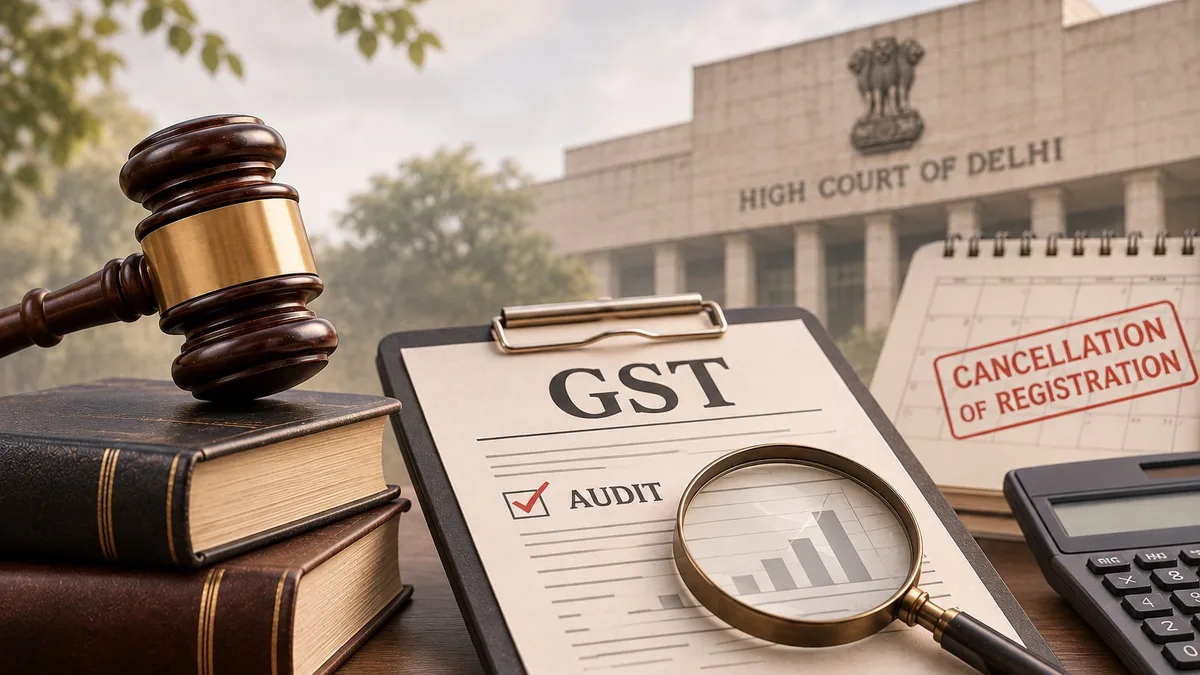
The Delhi High Court dismissed a writ petition challenging a GST audit notice issued under Section 65 of the CGST Act. It held that retrospective cancellation of registration does not, by itself, bar an audit of records and conduct referable to a registration that had been granted and remained uncancelled during the relevant period. The expression “registered person” in Section 65 must be read in the context of an audit, which examines past records and compliance. The Court clarified that this does not validate post-cancellation returns or presume taxable supplies or tax liability for that period. The petitioner’s failure to disclose the audit notice in earlier writ proceedings was an additional reason to refuse discretionary relief (Paras 17–41).
Key Proposition: Retrospective cancellation of GST registration does not automatically remove from Section 65 audit scrutiny the records and conduct referable to a registration that had been granted and remained uncancelled during the period under audit.
- Central Goods and Services Tax Act, 2017 – Sections 2(13), 2(94) and 65 – Audit – Whether retrospective cancellation bars audit of records relating to the registration? – Held, no. (Paras 17–30)
- Central Goods and Services Tax Act, 2017 – Section 29(3) – Cancellation – Whether cancellation extinguishes earlier statutory liabilities? – Held, no; liabilities and obligations for the prior period are preserved. (Para 26)
Background / Synopsis :
- The petitioner obtained GST registration in July 2017 and applied on 11 January 2020 for cancellation with effect from 31 December 2019, citing closure of business.
- While the cancellation application remained pending, the department issued FORM GST ADT-01 dated 15 September 2022 proposing an audit for the period 1 July 2017 to 31 March 2021.
- The petitioner later approached the High Court in W.P.(C) 5805/2023 for cancellation of registration with retrospective effect but did not disclose the audit notice, despite having replied to it on 3 May 2023.
- By order dated 4 May 2023, the Court directed processing of the cancellation application and recorded that cancellation would take effect from 31 December 2019. The petitioner then filed the present writ petition seeking to quash the audit notice and related proceedings.
Issues For Consideration :
- Whether retrospective cancellation of GST registration with effect from 31 December 2019 prevented the department from proceeding with the audit notice under Section 65, either wholly or for the period after that date.
- Whether the petitioner’s non-disclosure of the audit notice in the earlier writ proceedings disentitled it to discretionary relief.
Submissions Of Parties :
Petitioner – Oyster Steel and Iron Private Limited:
- Section 65 authorised audit only of a “registered person”; once registration was cancelled retrospectively from 31 December 2019, the petitioner could not be treated as registered for the audit period after that date.
- The notice proposed an audit up to 31 March 2021, beyond the effective cancellation date. The petitioner relied on Tvl. Raja Stores and the Model All India GST Audit Manual, 2023.
- The petitioner denied that its conduct in the earlier writ proceedings justified refusal of relief.
Respondent – GST Department:
- Cancellation did not extinguish liabilities or statutory obligations relating to the period during which the registration subsisted; reliance was placed on Section 29(3).
- When the audit notice was issued, the cancellation application had not been decided and the registration had not been cancelled.
- The department argued that the petitioner had not disclosed the audit notice in the earlier writ petition and was therefore not entitled to discretionary relief.
Court's Observations & Analysis :
Meaning of “registered person” for audit under Section 65
- Section 2(13) defines audit as examination of records, returns and documents maintained or furnished by a registered person to verify turnover, taxes, refunds, input tax credit and statutory compliance.
- Section 65 and Rule 101 permit audit for a specified period. Rule 21A treats registration as suspended while a cancellation application is pending; suspension does not itself terminate registration.
- An audit looks backwards at records and conduct under a registration. The phrase “registered person” cannot be limited to a person whose registration remains effective on the date the audit is carried out.
- The Court distinguished a period in which no registration ever existed from a period covered by a registration that was later cancelled retrospectively. The latter historical registration and the conduct undertaken under it remain capable of examination.
- Held: Retrospective cancellation did not, by itself, deprive the department of jurisdiction to audit the records and conduct referable to the registration. (Paras 17–30)
Limits of the audit power and treatment of post-cancellation period
- The Court clarified that its ruling did not validate returns filed after 31 December 2019 or presume that the petitioner made taxable supplies, incurred tax liability or carried on business after that date.
- A return treated as void and non-est did not necessarily erase the underlying books, records and transactions that could be relevant to an audit.
- An audit does not itself determine tax liability; any consequential proceedings must independently satisfy the applicable statutory requirements.
- The Court declined to follow Tvl. Raja Stores to the extent it suggested an absolute bar to audit after cancellation, preferring the contextual approach in L.J. Victoria Properties.
- Held: The notice period was not required to be curtailed solely because cancellation was later given retrospective effect. (Paras 31–38)
Non-disclosure in earlier writ proceedings
- The petitioner had replied to the audit notice on 3 May 2023, one day before the earlier writ petition was disposed of, but did not disclose the notice in those proceedings.
- The department’s delay in processing the cancellation application did not remove the petitioner’s obligation to disclose a material pending audit notice when seeking discretionary relief.
- Held: The Court declined discretionary relief on this additional ground and left it open to the department to seek modification of the earlier order in accordance with law. (Paras 39–40)
Notable Observations: None.
Decision & Directions :
- The writ petition was dismissed and the interim stay granted on 5 December 2023 was vacated.
- The audit notice dated 15 September 2022 was not quashed or curtailed on the ground of retrospective cancellation.
- The respondent was left at liberty to seek modification of the order dated 4 May 2023 in W.P.(C) 5805/2023 in accordance with law.
Legal Provisions Discussed & Precedents Cited :
- Central Goods and Services Tax Act, 2017 – Section 2(13): defines audit.
- Central Goods and Services Tax Act, 2017 – Section 2(94): defines registered person
- Central Goods and Services Tax Act, 2017 – Section 25: registration of taxable persons.
- Central Goods and Services Tax Act, 2017 – Section 29(3): preserves liabilities and obligations notwithstanding cancellation.
- Central Goods and Services Tax Act, 2017 – Section 65: audit by tax authorities.
- Central Goods and Services Tax Act, 2017 – Sections 73 and 74: consequential determination of tax not paid, short-paid, erroneously refunded or input tax credit wrongly availed/utilised, as applicable.
- Central Goods and Services Tax Rules, 2017 – Rules 21A and 22: suspension and cancellation procedure.
- Central Goods and Services Tax Rules, 2017 – Rule 101: audit procedure and notice in FORM GST ADT-01.
- L.J. Victoria Properties Private Limited v. Union of India, 2024:BHC-OS:18689-DB – Relied on; contextual interpretation of “registered person” for GST audit after cancellation.
- Ashoka Fabricast Private Limited v. Union of India, 2024:RJ-JP:20409-DB – Relied on to reject an absolute bar on audit after cancellation.
- Tvl. Raja Stores v. Assistant Commissioner (ST), W.P.(MD) No. 15291 of 2023, decided 11 August 2023 – Considered and respectfully not followed to the extent it treated cancellation as an absolute bar to Section 65 audit.
Case Details :
- Case / Party Name: Oyster Steel and Iron Private Limited v. Assistant Commissioner, Circle VII Group 61, Central Goods and Services Tax Audit-I
- Case Number(s): W.P.(C) 15619/2023; CM APPL. 62577/2023
- Coram / Judges: Anil Kshetrapal, J. and Bharat Parashar, J. – Division Bench; judgment authored by Anil Kshetrapal, J.
- Counsel Appearances: For the petitioner: Mr. Abhishek Garg, Mr. Yash Gaiha, Mr. Naman Mehta and Mr. Satyam Singhania. For the respondent: Mr. Aditya Singla, Senior Standing Counsel for CBIC, with Mr. Akhil Sharma, Ms. Nehaol Sri L.V. and Mr. Dhananjay Gautam.
Disclaimer: This summary is an editorial aid and does not form part of the judgment. Refer to the original judgment before citing.
Full Judgement / Attachment
Full Judgement
Frequently asked questions about Delhi High Court
- Where does the Delhi High Court sit and which areas does it cover?
- The Delhi High Court sits in New Delhi. It has jurisdiction over the National Capital Territory of Delhi. It was established on 31 October 1966 and is a leading forum for commercial, intellectual property, tax and arbitration matters.
- How do I check Delhi High Court case status and judgements?
- The official website, delhihighcourt.nic.in, provides case status, cause lists, e-filing and judgements searchable by party, judge or date. Orders are also mirrored on the eCourts Judgments portal (judgments.ecourts.gov.in).
- What are the Delhi High Court's Commercial and IP Divisions?
- Delhi High Court has original civil jurisdiction, so high-value suits in Delhi are filed directly before it. Its Commercial Division hears commercial disputes, and its Intellectual Property Division, set up in 2021 after the IPAB was abolished, hears patent, trademark and copyright cases. It is also a major forum for tax appeals from the ITAT Delhi Benches and for arbitration petitions.
- What is an LPA in the Delhi High Court?
- A Letters Patent Appeal (LPA) under Clause 10 of the Letters Patent lets a party challenge certain single-judge orders, typically in writ matters, before a Division Bench. In commercial cases, appeals lie under Section 13 of the Commercial Courts Act instead. Final judgements can be challenged by a Special Leave Petition under Article 136, ordinarily within 90 days.
- How can White Collar Professional help with a Delhi High Court matter?
- Post your requirement on White Collar Professional to receive proposals from verified Advocates, Chartered Accountants and Company Secretaries, compare them, and pay securely through the platform. This page also tracks the latest Delhi High Court judgements and legal updates as they are reported.