Delhi High Court Holds Corporate Guarantees to Related Companies Taxable Under GST, but Rejects a Mandatory 1% Minimum Valuation
Court / Authority
Delhi High Court
Update / Judgement Date
18 Nov 2026
Case No.
W.P.(C) 2966/2024
Source
WCP News Bulletin
Author
Dipanshi Bansal — WCP Legal Desk
Reading Time
10 min read
View Count

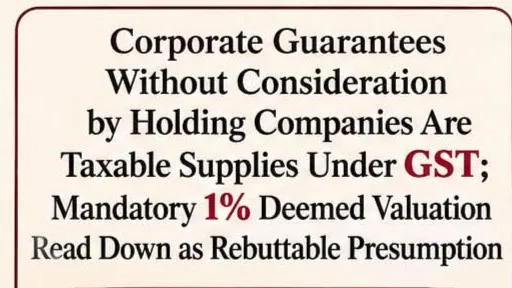
The Delhi High Court held that a corporate guarantee furnished by a holding or group company for the borrowing of a related company is a taxable supply of services under Section 7(1)(c) read with Entry 2 of Schedule I to the Central Goods and Services Tax Act, 2017, even where no fee or commission is charged. The related company whose borrowing is supported is the recipient. However, Rule 28(2) cannot impose 1% of the guaranteed amount as an inflexible minimum where the supplier establishes a lower open-market value. The Court read down the rule to permit proof of a lower value and clarified the temporal reach of GST on guarantees executed before and after 1 July 2017 and 26 October 2023.
Key Legal Proposition
A related-party corporate guarantee is a supply of service because the guarantor assumes the risk of default and extends its creditworthiness to the related borrower; consideration is not necessary because Entry 2 of Schedule I covers related-party supplies without consideration. The supply occurs upon execution of the guarantee, and again upon renewal, extension or enhancement; it is not a continuous supply. Rule 28(2)’s deemed 1% value is a valuation mechanism, not a mandatory floor where a lower open-market value is established.
Factual Background
Several companies challenged GST demands, show-cause notices, orders and related departmental action concerning corporate guarantees furnished by holding or group companies to banks and financial institutions for loans taken by related entities. The guarantees were generally provided without a fee or commission. The dispute concerned whether the guarantee amounted to a taxable supply under the GST regime; whether the subsidiary or lender was the recipient; whether the transaction was excluded as an actionable claim or security; how Rule 28(2) valued the guarantee; when the taxable event occurred; and whether the rule could apply to guarantees executed before its introduction. The petitions also challenged Circulars/Instructions issued in 2023 and 2024 and the retrospective operation of the 2024 amendment.
Issues Before the Court
- Whether a corporate guarantee furnished without consideration to support the borrowing of a related person constitutes a supply of services under the CGST Act, 2017.
- Whether the recipient is the lender or the related borrower whose credit is supported by the guarantee.
- Whether the guarantee is excluded from GST as an actionable claim or as a security.
- Whether Rule 28(2), which prescribes a deemed value linked to 1% of the guarantee amount, is within the rule-making power and constitutionally valid.
- When the supply takes place and whether a corporate guarantee is a continuous supply of services.
- How the GST regime applies to guarantees executed before 1 July 2017, between 1 July 2017 and 25 October 2023, and on or after 26 October 2023.
- Whether the 2023 and 2024 departmental circulars/instructions are valid under Section 168.
Principal Submissions
The petitioners argued that a guarantee is a tripartite contract between guarantor, borrower and lender; the lender, rather than the subsidiary, receives the enforceable promise. They contended that no consideration flows to the guarantor, that the guarantee is a contingent actionable claim or security, and that a rule on valuation cannot create a taxable event. They also challenged the 1% valuation as arbitrary and as an impermissible minimum irrespective of actual market value, and argued that the supply is a one-time event rather than a yearly or continuous service. The Union argued that the guarantor supplies credit support and assumes a real risk for the related borrower; Entry 2 of Schedule I expressly taxes related-party supplies even without consideration. It maintained that the borrower is the recipient, the guarantee is not itself an actionable claim or security supplied to the borrower, and Rule 28(2) is a valid valuation rule.
Court’s Analysis and Reasoning
- Nature of the service and recipient- The Court identified the service as the assumption of the risk of the related person’s default and the extension of the guarantor’s creditworthiness to that person. The benefit is not merely incidental: the related borrower obtains access to finance or financing on supported terms. Although the guarantee is enforceable by the lender, the service for GST purposes is supplied to the related borrower whose borrowing is supported. The lender is the beneficiary of the contractual promise but is not the recipient of the supply taxed under Entry 2 of Schedule I.
- Business connection- The Court accepted that the statutory clauses defining business must be read in context, but found the guarantees in these cases connected with the guarantors’ own commercial activities. The petitioners’ subsidiaries were vehicles through which their projects and investments were pursued; guarantees to secure finance for those projects were incidental or ancillary to the guarantors’ trade or commerce. The Act requires a connection with or furtherance of business, not necessarily that the activity be frequent or part of the guarantor’s ordinary business.
- No consideration is required for related-party supplies- The absence of guarantee commission or fee did not defeat taxability. The Court distinguished the earlier service-tax regime, under which consideration formed part of the definition of service, from the GST framework. Section 7(1)(c) read with Entry 2 of Schedule I expressly treats supplies between related persons in the course or furtherance of business as supplies even when made without consideration. The absence of consideration therefore affects valuation, not the existence of the supply.
- Actionable claim and security exclusions- The actionable-claim exclusion applies where the thing supplied is itself an actionable claim. The related borrower receives credit support, not a claim against the guarantor. If the guarantor pays the lender, the borrower may become indebted to the guarantor; that later consequence does not change the nature of the service supplied when the guarantee is executed. A guarantee may be collateral in a general sense, but it is not a marketable instrument or right/interest in securities within the statutory exclusion for securities.
- Validity and reading down of Rule 28(2)- The Court rejected the excessive-delegation challenge. The parent Act identifies the taxable event, person liable, rate and valuation framework, while delegated rules may prescribe valuation details. A presumptive value can be used where comparables are difficult to find. However, the 1% figure derived from the Income-tax Safe Harbour Rules could not be converted into a compulsory minimum. Rule 28(2), as a non-obstante provision, could otherwise override the open-market-value method even where a lower value was demonstrable. The Court therefore read down the rule: the supplier must be allowed to establish a lower open-market value, and the deemed value cannot operate as an irrebuttable floor.
- Single supply, not continuous supply- The guarantee service is supplied when the guarantor undertakes the risk by executing the guarantee. A fresh supply occurs upon renewal, extension or enhancement. The mere continuation of an existing guarantee does not create a fresh supply each year. The time of supply is governed by Section 13(2)(a) or (b), not by the provisions for continuous supplies. The tax is computed at execution for the entire tenure. The Court observed that the Government may consider a mechanism permitting collection in annual instalments, without changing the single-supply character or time of supply.
- Temporal application- Guarantees executed before 1 July 2017 are not taxable under the GST Act merely because they continue after that date; they become relevant only if renewed, extended or enhanced on or after 1 July 2017. Guarantees executed between 1 July 2017 and 25 October 2023 are taxable, but Rule 28(2) did not yet apply. Their value must be determined under the rules then in force on the material relating to each guarantee; Rule 31 cannot be used to impose the 1% figure indirectly. Rule 28(2) applies only to guarantees executed, renewed, extended or enhanced on or after 26 October 2023.
- 2024 amendment and circulars- The Court upheld the retrospective operation of the 2024 amendment to the extent discussed in the judgment, including the clarification of the 1% rate as per annum, noting the limited retrospective period and the statutory power under Section 164(3). The circulars were not ultra vires Section 168, but must be applied consistently with the judgment. They cannot prevent a supplier from establishing a lower open-market value or treat the continued existence of a pre-26 October 2023 guarantee as a fresh supply.
Precedents and Their Significance
- Union of India v. Mohit Minerals Pvt. Ltd. — The Supreme Court explained the constitutional status of GST Council recommendations: they carry persuasive value as products of cooperative federalism but are not binding in a manner that excludes judicial review of subordinate legislation.
- Commissioner of Central Excise v. Edelweiss Financial Services Ltd. — The earlier service-tax decision concerned a statutory regime in which consideration was part of the definition of service. The Delhi High Court held that it did not determine taxability under GST, because Schedule I expressly covers related-party supplies without consideration.
- Torrent Power Ltd. v. Union of India (Gujarat High Court, 14 August 2026) — The Delhi High Court agreed with Torrent Power on several core propositions, including taxability without consideration, the identity of the recipient, the non-continuous nature of the guarantee and the inability to impose a 1% minimum where actual open-market value is lower. It differed on the temporal reasoning for guarantees existing before 26 October 2023, holding that continued existence alone is not a fresh supply.
- D.P. Jain & Co. Infrastructure Pvt. Ltd. (Bombay High Court) — The Delhi High Court respectfully declined to follow its conclusion that corporate guarantees without consideration were not taxable under GST, reasoning that the earlier decision did not adequately account for Entry 2 of Schedule I, which taxes related-party supplies without consideration.
- Govind Saran Ganga Saran v. Commissioner of Sales Tax; Mineral Area Development Authority v. Steel Authority of India Ltd. — These authorities explain the essential components of a tax levy and informed the Court’s conclusion that the CGST Act supplies the legislative framework while the rules may validly provide valuation detail.
Decision and Operative Directions
The Court held that a corporate guarantee furnished by a holding or group company for the borrowing of a related person is a taxable supply of services under Section 7(1)(c) read with Entry 2 of Schedule I, even without consideration; the related borrower is the recipient. It held that the guarantee is neither excluded as an actionable claim nor as a security. Rule 28(2) is within the rule-making power but was read down so that the supplier may establish a lower open-market value. The guarantee is a single supply on execution, and again on renewal, extension or enhancement, not a continuous supply. Pre-1 July 2017 guarantees are not taxable merely because they continue; guarantees executed from 1 July 2017 to 25 October 2023 are taxable but valued under the rules then in force without applying the 1% figure; Rule 28(2) applies only from 26 October 2023 to guarantees executed or renewed, extended or enhanced on or after that date. The impugned notices, orders and demands were set aside to the extent inconsistent with the judgment, with fresh determination permitted after hearing the petitioners. Several factual issues—including limitation under Section 74, dates of execution or renewal, open-market value, overseas recipients and input-tax-credit eligibility—were left to the competent authorities. W.P.(C) 15738/2024 and W.P.(C) 12955/2025 were to be listed before the roster bench on 9 December 2026 for their additional issues.
Full Judgement / Attachment
Full Judgement
Frequently asked questions about Delhi High Court
- Where does the Delhi High Court sit and which areas does it cover?
- The Delhi High Court sits in New Delhi. It has jurisdiction over the National Capital Territory of Delhi. It was established on 31 October 1966 and is a leading forum for commercial, intellectual property, tax and arbitration matters.
- How do I check Delhi High Court case status and judgements?
- The official website, delhihighcourt.nic.in, provides case status, cause lists, e-filing and judgements searchable by party, judge or date. Orders are also mirrored on the eCourts Judgments portal (judgments.ecourts.gov.in).
- What are the Delhi High Court's Commercial and IP Divisions?
- Delhi High Court has original civil jurisdiction, so high-value suits in Delhi are filed directly before it. Its Commercial Division hears commercial disputes, and its Intellectual Property Division, set up in 2021 after the IPAB was abolished, hears patent, trademark and copyright cases. It is also a major forum for tax appeals from the ITAT Delhi Benches and for arbitration petitions.
- What is an LPA in the Delhi High Court?
- A Letters Patent Appeal (LPA) under Clause 10 of the Letters Patent lets a party challenge certain single-judge orders, typically in writ matters, before a Division Bench. In commercial cases, appeals lie under Section 13 of the Commercial Courts Act instead. Final judgements can be challenged by a Special Leave Petition under Article 136, ordinarily within 90 days.
- How can White Collar Professional help with a Delhi High Court matter?
- Post your requirement on White Collar Professional to receive proposals from verified Advocates, Chartered Accountants and Company Secretaries, compare them, and pay securely through the platform. This page also tracks the latest Delhi High Court judgements and legal updates as they are reported.