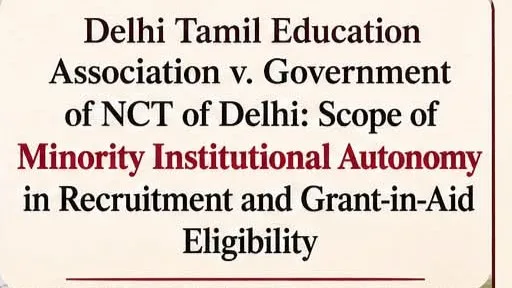
Delhi High Court Orders Individual Reassessment of Grant-in-Aid for 100 Appointments in Minority Schools
Court / Authority
Delhi High Court
Update / Judgement Date
18 Nov 2026
Case No.
W.P.(C) 14795/2025 and W.P.(C) 17099/2025
Source
WCP News Bulletin
Author
Dipanshi Bansal — WCP Legal Desk
Reading Time
8 min read
View Count

The Delhi High Court set aside the Directorate of Education’s blanket rejection of grant-in-aid for all 100 appointments made by the Delhi Tamil Education Association (DTEA), holding that objections of different kinds and consequences could not justify a consolidated rejection. The Court settled important questions of law concerning recruitment in aided minority schools, but left individual eligibility and grant-in-aid entitlement to a fresh, reasoned employee-wise determination. It also clarified that refusal of State grant-in-aid does not automatically extinguish the institution’s liability to remunerate employees for work actually performed.
Key Legal Proposition
Aided minority institutions retain constitutionally protected management autonomy, but appointments for which public grant-in-aid is claimed must satisfy the applicable statutory qualifications and procedures. The State must assess each appointment on its own record and cannot reject an entire recruitment exercise through a blanket order. Deemed approval under Rule 98(4) cannot cure non-compliance with essential qualifications or dispense with separate statutory requirements.
Factual Background
DTEA, a registered linguistic-minority association established in 1923, administers seven recognised government-aided minority schools serving approximately 7,000 students and employing about 400 teaching and non-teaching staff. The schools receive 95% grant-in-aid towards salary expenditure. Following earlier litigation, DTEA advertised 107 vacancies in June 2024 and filled 100 posts: four Principals, 42 Assistant Teachers, 35 other teaching posts and 19 clerical, laboratory and support posts. DTEA forwarded appointment records to the Directorate of Education (DoE), seeking grant-in-aid. The DoE raised objections relating to qualifications, experience, sanctioned vacancies, recruitment mode, selection committees, verification and reservation compliance. On 4 November 2025, it rejected grant-in-aid for all 100 appointments. The employees separately approached the Court, stating that they had joined service but had not received salaries.
Issues Before the Court
- Which recruitment rules governed Assistant Teachers in DTEA’s aided schools, and whether B.Ed. alone could satisfy the prescribed elementary-teacher training requirement.
- How the DoE was required to assess appointments to Principal, teaching and non-teaching posts, including age, experience, sanctioned vacancies and recruitment method.
- Whether the DoE’s failure to nominate representatives or its alleged failure to respond within the period under Rule 98 could result in deemed approval.
- Whether the DoE could reject grant-in-aid for all 100 appointments through one blanket decision.
- Whether employees were entitled to remuneration for services rendered even if the State refused grant-in-aid.
Principal Submissions
DTEA argued that its status as a linguistic-minority institution entitled it to make appointments without prior DoE approval, subject to the governing rules, and that the DoE could not use the grant-in-aid process to impose restrictions inconsistent with that autonomy. It relied, among other things, on the 2022 Assistant Teacher Recruitment Rules and on Rule 98(4), contending that appointments stood approved because no timely disapproval had been communicated. The employees relied on their appointment letters, services actually rendered, Rule 98 and Section 10 of the Delhi School Education Act, 1973, to seek salaries and arrears. The DoE maintained that public funding could be refused where appointments failed to meet statutory qualifications or procedural requirements, and that the 1989 Recruitment Rules prescribing JBT/BTC continued to govern Assistant Teachers in aided schools.
Court’s Analysis and Reasoning
- Minority autonomy and statutory compliance- The Court recognised DTEA’s Article 30(1) protection and its autonomy in managing its minority schools. However, the earlier litigation between DTEA and the DoE had not determined the qualifications or grant-in-aid eligibility of the individuals subsequently appointed. The Court emphasised that management autonomy does not exempt appointments seeking public funds from applicable qualifications and statutory conditions. The legal findings in the earlier proceedings, including the directions concerning Rule 96, continued to bind the parties.
- Assistant Teachers: B.Ed. is not a substitute for JBT/BTC- The 1989 Recruitment Rules governed Assistant Teachers in aided schools. The 2022 Rules were made for recruitment to the DoE’s own establishment and did not supersede or extend to the separate aided-school rules. B.Ed. alone was not the prescribed elementary-teacher training qualification and could not be treated automatically as a higher teachers-training qualification warranting relaxation. Rule 97 required prior approval for relaxation of an essential qualification. The Court also explained that the protection recognised in Navin Kumar was limited to qualifying appointments made before 11 August 2023; DTEA’s recruitment commenced in 2024. Individual records still had to be checked, including the qualifications and recognition of institutions for certain named candidates.
- Principals and other posts- DTEA was not required to exhaust promotion before making direct appointments to Principal posts, consistently with the protection of minority management’s choice of head of institution. That autonomy did not remove the requirement to satisfy qualifications, experience and age conditions. The DoE had to consider Rule 104 and the 2023 change to the corresponding Government-school age limit rather than mechanically apply an earlier 45-year limit. Experience acquired before a degree could not be excluded unless the applicable rules expressly required experience after obtaining that degree. Conversely, experience as a college Assistant Professor could not automatically replace the specific school-level experience prescribed by the rules. The Court also identified distinct factual issues concerning other teaching and non-teaching appointments, which required post-wise and employee-wise verification.
- Selection committees and departmental participation- The Court distinguished the requirement to seek or involve DoE nominees from the separate question whether a particular appointment satisfied the applicable rules. The DoE’s failure to nominate representatives could not be treated as a general licence to disregard the prescribed procedure. The legal effect had to be assessed in the context of the earlier orders and the particular selection records.
- Rule 98 and deemed approval- Rule 98(3) requires particulars of each appointment to be communicated to the Director in the prescribed manner. Under Rule 98(4), an appointment may be deemed approved if disapproval is not communicated within 15 days of such communication. A general notice of proposed recruitment is not necessarily equivalent to communication of the particulars of selected candidates. The Court required verification of the contents, mode of transmission, proof of receipt and any timely response for each appointment. Further, deemed approval cannot by itself cure a failure to meet essential qualifications or override Rule 66(2), which governs exclusion of the pay of an unqualified teacher from grant-in-aid.
- Separate State funding liability and employer remuneration liability- The State’s liability to provide grant-in-aid is distinct from DTEA’s potential liability to pay employees for services actually received. The appointment-letter condition postponing salary until grant-in-aid was received did not necessarily extinguish the institution’s independent liability. Nor could resignation during probation, by itself, forfeit remuneration already earned. The amount and period payable nevertheless required individual factual determination.
Precedents and Their Significance
- Tej Prakash Pathak v. Rajasthan High Court, (2025) 2 SCC 1 — Eligibility criteria lawfully governing a recruitment process cannot ordinarily be changed midway. The Court explained that this principle does not permit a recruiter to rely on a different set of rules that never governed the posts.
- P.M. Latha v. State of Kerala, (2003) 3 SCC 541; Yogesh Kumar v. Govt. of NCT of Delhi, (2003) 3 SCC 548; Devesh Sharma v. Union of India, (2023) 18 SCC 339 — These decisions distinguish elementary-teacher training from B.Ed. training and reject the assumption that B.Ed. is automatically a higher or interchangeable qualification for primary teaching.
- Navin Kumar v. Union of India, 2024 SCC OnLine SC 2360 — The Supreme Court recognised limited protection for certain B.Ed.-qualified candidates appointed before 11 August 2023. The Delhi High Court held that this limited protection did not cover DTEA’s 2024 recruitment.
- St. Anthony’s Girls Senior Secondary School v. Govt. of NCT of Delhi, 2008 SCC OnLine Del 1174 — The decision protects the minority institution’s choice in selecting its Principal and prevents an inflexible promotion-first requirement from overriding that autonomy, while leaving prescribed eligibility conditions intact.
- Binu Chaudhary v. Lt. Governor of Delhi, 2016 SCC OnLine Del 1651; Promila Dixit v. Govt. of NCT of Delhi, 2010 SCC OnLine Del 4156 — These decisions explain the operation of deemed approval under Rule 98(4), including the need for proper communication and compliance with essential qualifications and related statutory requirements.
- Government of A.P. v. K. Brahmanandam, (2008) 5 SCC 241 — The Supreme Court distinguished the State’s statutory responsibility to fund eligible appointments from a school’s responsibility to remunerate persons for services actually rendered.
Decision and Operative Directions
The Court set aside the DoE’s order dated 4 November 2025 rejecting grant-in-aid for all 100 appointments. It directed DTEA to provide an indexed employee-wise statement within two weeks. The Director of Education must designate an officer not below the rank of Additional Director within one week. The officer must reconcile records, issue appointment-specific deficiency statements, provide a reasonable opportunity to respond, and pass a separate reasoned order for every employee within 12 weeks. Where grant-in-aid is found admissible, the DoE must determine salary and allowances, including arrears for verified service, and arrange payment of its 95% share within four weeks of the individual determination; DTEA must deposit its corresponding share. If grant-in-aid is refused, that decision does not by itself terminate employment or extinguish DTEA’s liability for remuneration for services actually rendered. Both petitions were partly allowed. The Court did not decide DTEA’s internal management dispute.
Full Judgement / Attachment
Full Judgement
Frequently asked questions about Delhi High Court
- Where does the Delhi High Court sit and which areas does it cover?
- The Delhi High Court sits in New Delhi. It has jurisdiction over the National Capital Territory of Delhi. It was established on 31 October 1966 and is a leading forum for commercial, intellectual property, tax and arbitration matters.
- How do I check Delhi High Court case status and judgements?
- The official website, delhihighcourt.nic.in, provides case status, cause lists, e-filing and judgements searchable by party, judge or date. Orders are also mirrored on the eCourts Judgments portal (judgments.ecourts.gov.in).
- What are the Delhi High Court's Commercial and IP Divisions?
- Delhi High Court has original civil jurisdiction, so high-value suits in Delhi are filed directly before it. Its Commercial Division hears commercial disputes, and its Intellectual Property Division, set up in 2021 after the IPAB was abolished, hears patent, trademark and copyright cases. It is also a major forum for tax appeals from the ITAT Delhi Benches and for arbitration petitions.
- What is an LPA in the Delhi High Court?
- A Letters Patent Appeal (LPA) under Clause 10 of the Letters Patent lets a party challenge certain single-judge orders, typically in writ matters, before a Division Bench. In commercial cases, appeals lie under Section 13 of the Commercial Courts Act instead. Final judgements can be challenged by a Special Leave Petition under Article 136, ordinarily within 90 days.
- How can White Collar Professional help with a Delhi High Court matter?
- Post your requirement on White Collar Professional to receive proposals from verified Advocates, Chartered Accountants and Company Secretaries, compare them, and pay securely through the platform. This page also tracks the latest Delhi High Court judgements and legal updates as they are reported.