Delhi High Court Discharges Husband of Abetment and Cruelty Charges, While Reassessing Dowry-Death Allegations
Court / Authority
Delhi High Court
Update / Judgement Date
04 Nov 2026
Date of Publication
05 Nov 2026
Case No.
CRL.REV.P. 29/2020
Source
WCP News Bulletin
Author
Dipanshi Bansal — WCP Legal Desk
Reading Time
5 min read
View Count
1
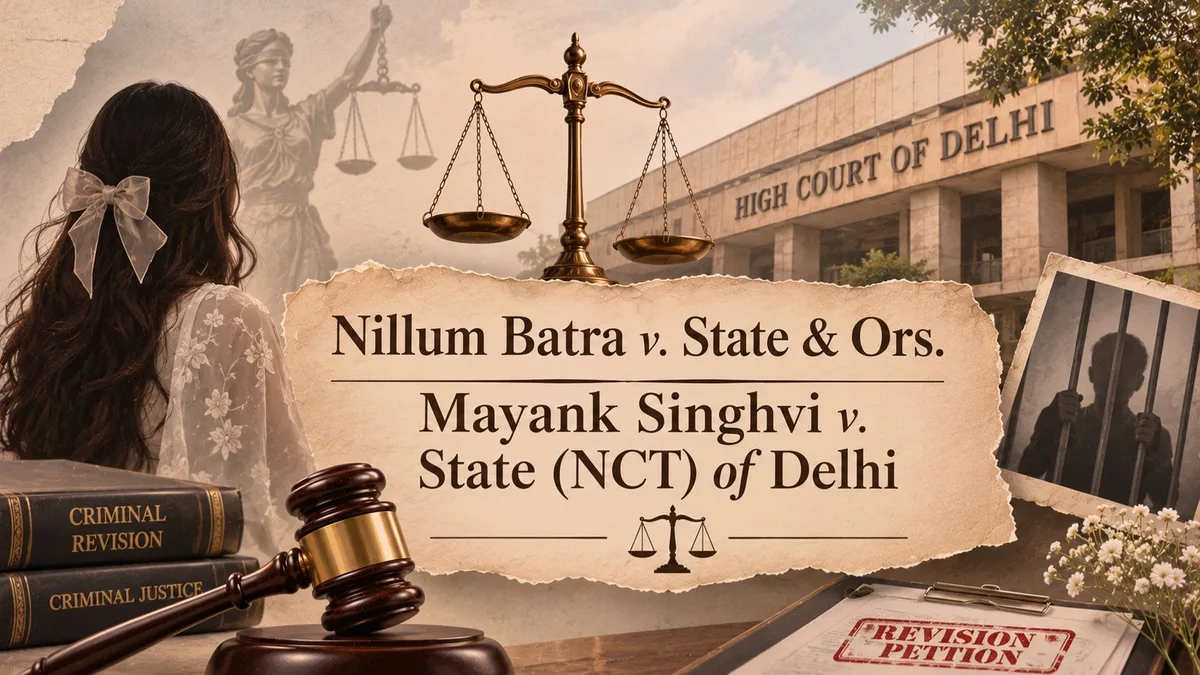
The Court held that the material collected during investigation must be independently assessed offence by offence at the stage of charge, and that matrimonial discord or a suicide note/message, without sufficient material showing the statutory ingredients of abetment or cruelty, cannot by itself justify a criminal trial.
Key Proposition: At the charge stage, the court must assess whether the material, taken at face value and considered cumulatively, discloses the ingredients of each alleged offence; suspicion alone is insufficient.
- Indian Penal Code, 1860 – Sections 498A, 304B and 306 – Matrimonial cruelty and abetment of suicide – Whether the material justified framing charges? – Held, the ingredients had to be assessed separately for each offence.
- Indian Evidence Act, 1872 – Section 113A – Presumption as to abetment of suicide – Whether the presumption automatically establishes abetment? – Held, no; the circumstances must still be evaluated.
Background / Synopsis :
- The revision petitions arose from an order on charge in a prosecution following the death by suicide of Anissia Batra, who had married Mayank Singhvi in February 2016.
- The prosecution relied on allegations of physical and mental cruelty, financial demands, matrimonial disputes and events shortly before the death. These were prosecution allegations, not findings of guilt.
- The Sessions Court had discharged Mayank Singhvi under Section 304B read with Section 34 IPC but directed charges under Sections 498A and 306 IPC; his parents were discharged of the relevant offences.
- The deceased’s mother and the State challenged aspects of the discharge, while Mayank Singhvi challenged the direction to frame charges against him.
Issues For Consideration :
- What is the permissible scope of revisional interference with an order framing charge or discharging an accused?
- Whether the material disclosed sufficient grounds to proceed against Mayank Singhvi under Sections 498A and 306 IPC.
- Whether the discharge of the accused persons in relation to Section 304B and the allegations against the parents warranted interference.
Submissions Of Parties :
- The complainant and State relied on the alleged pattern of cruelty, financial demands, communications and surrounding circumstances to contend that the discharge decisions required interference.
- Mayank Singhvi argued that the material did not establish the ingredients of cruelty or instigation/intentional aid for abetment of suicide; matrimonial discord and a message blaming him were insufficient.
- The defence also contended that Section 113A of the Evidence Act did not create an automatic presumption of abetment and could not replace proof of foundational circumstances.
Court's Observations & Analysis :
- The Court reiterated that a charge-stage court must evaluate the material independently and determine whether the facts, taken at face value, disclose the ingredients of the alleged offence; it must not conduct a full trial or accept the prosecution version mechanically.
- The Court treated the offences separately because Sections 304B, 498A and 306 IPC have distinct ingredients.
- For Section 306 IPC, the Court examined whether the material disclosed instigation, conspiracy or intentional aid within Section 107 IPC. Distress, matrimonial discord and the deceased’s attribution of responsibility did not, without sufficient material of the required nexus, establish abetment.
- Section 113A of the Evidence Act was not treated as an automatic answer. The permissive presumption required consideration of all circumstances and could not dispense with the assessment of abetment.
- The Court also considered the allegations of cruelty in the statutory context and found the material insufficient to sustain the Section 498A charge against Mayank Singhvi.
Decision & Directions :
- CRL.REV.P. 29/2020 filed by Nillum Batra and CRL.REV.P. 297/2022 filed by the State were dismissed. CRL.REV.P. 170/2021 filed by Mayank Singhvi was allowed. The discharge of Mayank Singhvi under Section 304B read with Section 34 IPC, and of Rajender Singh Singhvi and Sushma Singhvi under Sections 304B and 498A read with Section 34 IPC, was affirmed. Mayank Singhvi was also discharged of Sections 498A and 306 IPC, and the direction to frame charges under those provisions was set aside.
- The impugned charge-stage order was dealt with in the terms set out in the judgment; the revision petitions and connected applications were disposed of.
- Interim orders, if any, were vacated. A copy was directed to be sent to the Trial Court and the concerned Jail Superintendent for information and necessary compliance.
Legal Provisions Discussed & Precedents Cited :
- Indian Penal Code, 1860 – Section 304B: Dowry death; the charge-stage discharge challenge.
- Indian Penal Code, 1860 – Section 498A: Cruelty by husband or relatives of husband.
- Indian Penal Code, 1860 – Section 306 read with Section 107: Abetment of suicide and its constituent acts.
- Indian Evidence Act, 1872 – Section 113A: Permissive presumption as to abetment of suicide by a married woman.
- Code of Criminal Procedure, 1973 – Sections 227 and 228: Discharge and framing of charge.
- Sajjan Kumar v. CBI – principles governing evaluation of material at the stage of charge – Relied on.
- Manju Ram Kalita v. State of Assam – meaning and threshold of cruelty under Section 498A IPC – Referred to / applied.
Case Details :
- Case / Party Name: Nillum Batra v. State & Ors.; Mayank Singhvi v. State (NCT of Delhi); State (NCT of Delhi) v. Mayank Singhvi & Ors.
- Case Number(s): CRL.REV.P. 29/2020, CRL.REV.P. 170/2021 and CRL.REV.P. 297/2022
- Coram / Judges: Madhu Jain, J. – Single Judge
- Counsel Appearances: As recorded in the judgment: senior advocates and advocates appearing for the revisionists, State and other respondents; see appearances in the judgment.
Disclaimer: This summary is an editorial aid and does not form part of the judgment. Refer to the original judgment before citing.
Full Judgement / Attachment
Full Judgement
Frequently asked questions about Delhi High Court
- Where does the Delhi High Court sit and which areas does it cover?
- The Delhi High Court sits in New Delhi. It has jurisdiction over the National Capital Territory of Delhi. It was established on 31 October 1966 and is a leading forum for commercial, intellectual property, tax and arbitration matters.
- How do I check Delhi High Court case status and judgements?
- The official website, delhihighcourt.nic.in, provides case status, cause lists, e-filing and judgements searchable by party, judge or date. Orders are also mirrored on the eCourts Judgments portal (judgments.ecourts.gov.in).
- What are the Delhi High Court's Commercial and IP Divisions?
- Delhi High Court has original civil jurisdiction, so high-value suits in Delhi are filed directly before it. Its Commercial Division hears commercial disputes, and its Intellectual Property Division, set up in 2021 after the IPAB was abolished, hears patent, trademark and copyright cases. It is also a major forum for tax appeals from the ITAT Delhi Benches and for arbitration petitions.
- What is an LPA in the Delhi High Court?
- A Letters Patent Appeal (LPA) under Clause 10 of the Letters Patent lets a party challenge certain single-judge orders, typically in writ matters, before a Division Bench. In commercial cases, appeals lie under Section 13 of the Commercial Courts Act instead. Final judgements can be challenged by a Special Leave Petition under Article 136, ordinarily within 90 days.
- How can White Collar Professional help with a Delhi High Court matter?
- Post your requirement on White Collar Professional to receive proposals from verified Advocates, Chartered Accountants and Company Secretaries, compare them, and pay securely through the platform. This page also tracks the latest Delhi High Court judgements and legal updates as they are reported.