Unilateral Appointment of an Ineligible Arbitrator: Participation Cannot Cure Statutory Invalidity under Section 12(5) of the Arbitration Act
Court / Authority
Delhi High Court
Update / Judgement Date
30 Oct 2026
Date of Publication
03 Nov 2026
Case No.
FAO (COMM) 198/2026
Source
WCP News Bulletin
Author
Pranjal Jha — WCP Legal Desk
Reading Time
6 min read
View Count
Summary
Background and Facts
- The Government of NCT of Delhi, through its Public Works Department (PWD), awarded a contract worth approximately ₹2.96 crore to M/s Ram Krishan Yudhister Prakash for the construction of Aam Aadmi Mohalla Clinics in Delhi. Although the work was scheduled to be completed by April 2019, it was completed in March 2020.
- Disputes subsequently arose between the parties regarding additional payments, escalation costs, expenses incurred during the extended contract period, additional work and other contractual claims.
- In October 2023, the Chief Engineer of PWD appointed a retired Principal Chief Engineer of the same department, Mr. Avendra Kumar Garg, as the sole arbitrator. The arbitrator eventually passed an award dated 20 January 2025, allowing certain claims in favour of the contractor while rejecting others. The Government also had a counterclaim, which the arbitrator failed to adjudicate upon.
- Aggrieved by the award, the Government challenged it under Section 34 of the Arbitration and Conciliation Act, 1996. The challenge was dismissed by the Commercial Court, which held that the arbitrator's view was plausible and that the Government had participated in the proceedings. The Commercial Court also rejected the objection to the arbitrator's appointment on the ground that the appointment had been made with the Government's concurrence.
- The Government thereafter approached the Delhi High Court under Section 13(1A) of the Commercial Courts Act, 2015, read with Section 37 of the Arbitration and Conciliation Act, 1996.
Central Legal Issue
The principal issue before the High Court was:
Can a party's unilateral appointment of an arbitrator, followed by participation in the arbitral proceedings, amount to a valid waiver of the arbitrator's statutory ineligibility under Section 12(5) of the Arbitration and Conciliation Act, 1996?
The Court examined whether participation in arbitration, failure to object at an earlier stage, or following an appointment procedure contained in the original contract could substitute the specific written waiver required by the statute.
Court's Observations and Legal Reasoning
A. Section 12(5) requires an express written waiver after disputes arise
Section 12(5), introduced through the 2015 Amendment, makes a person ineligible to be appointed as an arbitrator where their relationship with the parties or the subject matter falls within the categories specified in the Seventh Schedule.
The proviso permits parties to waive this ineligibility, but only through an express agreement in writing entered into after disputes have arisen.
The Court identified three essential requirements for a valid waiver:
- The waiver must take place after the disputes have arisen.
- It must be based on an agreement between the parties.
- The agreement must be express and in writing.
Consequently, waiver cannot simply be inferred from the parties' conduct or circumstances.
B. Participation in arbitration does not amount to waiver
- The Government had participated in the arbitral proceedings, filed its statement of defence and even submitted a counterclaim. However, the Court held that these actions could not be treated as a substitute for the express written agreement required under Section 12(5).
- The statutory requirement is different from the general principle of waiver by conduct. Even where a party participates in proceedings without immediately objecting to the arbitrator's appointment, such participation does not automatically validate an otherwise ineligible appointment.
C. Unilateral appointment cannot validate itself
- An important aspect of the judgment was the Court's rejection of the argument that an appointment made under the original contractual arbitration clause could itself demonstrate consent to the arbitrator's appointment.
- The Court relied on the distinction between following a contractual appointment procedure and consciously waiving statutory ineligibility. A contractual clause cannot override the mandatory requirements of Section 12(5).
- In other words, merely exercising a contractual power to appoint an arbitrator does not establish that both parties subsequently agreed, in writing, to waive the arbitrator's ineligibility.
D. Relevant Supreme Court and High Court precedents
The Court relied on the principles laid down in:
- Bharat Broadband Network Ltd. v. United Telecoms Ltd., (2019) 5 SCC 755, which clarified that Section 12(5) requires an express written waiver after disputes arise.
- Bhadra International (India) Pvt. Ltd. v. Airports Authority of India, concerning the essential requirements of waiver and the inability of participation or conduct to substitute for an express agreement.
- Mahavir Prasad Gupta and Sons v. Government of NCT of Delhi, 2025 SCC OnLine Del 4241, which held that unilateral appointment by a party cannot itself constitute an express waiver.
- M/s Ahluwalia Contracts (India) Limited v. Airports Authority of India, FAO(OS)(Comm) 246/2026, decided by the Delhi High Court on 25 September 2026, which had addressed the same legal question.
The Court also observed that an objection concerning the inherent jurisdiction of an arbitral tribunal may be raised at the stage of challenging the award, relying on the principles recognised in Bhadra International.
Final Decision
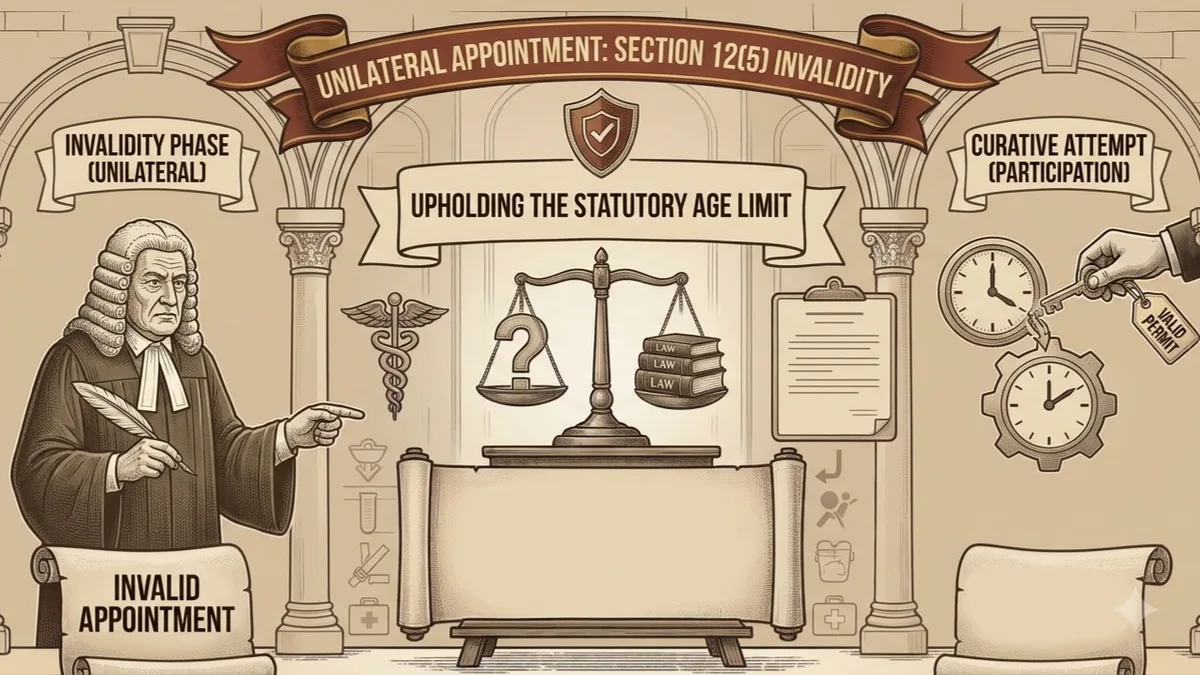
The Delhi High Court held that the appointment of the sole arbitrator was invalid because the arbitrator had been unilaterally appointed by PWD and there was no express written agreement between the parties, entered into after the disputes arose, waiving the applicability of Section 12(5).
The Court clarified that:
- Participation in arbitral proceedings does not amount to statutory waiver.
- Filing a statement of defence or counterclaim does not validate an ineligible appointment.
- Failure to object at an earlier stage does not cure the defect.
- An appointment made under the original contract cannot replace the express written waiver required by Section 12(5).
Since the very constitution of the arbitral tribunal was legally invalid, the subsequent proceedings and the award could not be sustained.
Accordingly, the High Court allowed the appeal and set aside both the Commercial Court's order dated 8 May 2026 and the arbitral award dated 20 January 2025. The Court did not consider it necessary to examine the remaining grounds challenging the award.
Legal Principle and Significance
- The judgment reinforces the mandatory nature of Section 12(5) of the Arbitration and Conciliation Act, 1996. It makes clear that statutory ineligibility cannot be cured through implied consent, acquiescence, participation in proceedings or reliance on a pre-existing contractual appointment mechanism.
- Its most important contribution is the distinction between consent to an appointment procedure and a conscious statutory waiver of an arbitrator's ineligibility. Even where a party itself appoints the arbitrator, the appointment does not amount to a valid waiver unless both parties expressly agree in writing after the dispute has arisen.
- The decision is particularly significant for government contracts and public works arbitration, where arbitration clauses frequently provide for appointment of arbitrators from panels maintained by government departments. It reinforces the principle that party autonomy in arbitration operates within the limits imposed by mandatory statutory safeguards ensuring independence and impartiality.
The central takeaway: An invalid appointment cannot become valid merely because the parties proceeded with the arbitration. Where Section 12(5) applies, the statutory requirement of an express written waiver must be strictly satisfied.
Full Judgement / Attachment
Full Judgement
Frequently asked questions about Delhi High Court
- Where does the Delhi High Court sit and which areas does it cover?
- The Delhi High Court sits in New Delhi. It has jurisdiction over the National Capital Territory of Delhi. It was established on 31 October 1966 and is a leading forum for commercial, intellectual property, tax and arbitration matters.
- How do I check Delhi High Court case status and judgements?
- The official website, delhihighcourt.nic.in, provides case status, cause lists, e-filing and judgements searchable by party, judge or date. Orders are also mirrored on the eCourts Judgments portal (judgments.ecourts.gov.in).
- What are the Delhi High Court's Commercial and IP Divisions?
- Delhi High Court has original civil jurisdiction, so high-value suits in Delhi are filed directly before it. Its Commercial Division hears commercial disputes, and its Intellectual Property Division, set up in 2021 after the IPAB was abolished, hears patent, trademark and copyright cases. It is also a major forum for tax appeals from the ITAT Delhi Benches and for arbitration petitions.
- What is an LPA in the Delhi High Court?
- A Letters Patent Appeal (LPA) under Clause 10 of the Letters Patent lets a party challenge certain single-judge orders, typically in writ matters, before a Division Bench. In commercial cases, appeals lie under Section 13 of the Commercial Courts Act instead. Final judgements can be challenged by a Special Leave Petition under Article 136, ordinarily within 90 days.
- How can White Collar Professional help with a Delhi High Court matter?
- Post your requirement on White Collar Professional to receive proposals from verified Advocates, Chartered Accountants and Company Secretaries, compare them, and pay securely through the platform. This page also tracks the latest Delhi High Court judgements and legal updates as they are reported.