CISF Personnel Entitled to Full HRA Where Government Accommodation Was Not Provided
Court / Authority
Delhi High Court
Update / Judgement Date
18 Nov 2026
Date of Publication
20 Nov 2026
Case No.
W.P.(C) 16811/2026
Source
WCP News Bulletin
Author
Dipanshi Bansal — WCP Legal Desk
Reading Time
4 min read
View Count
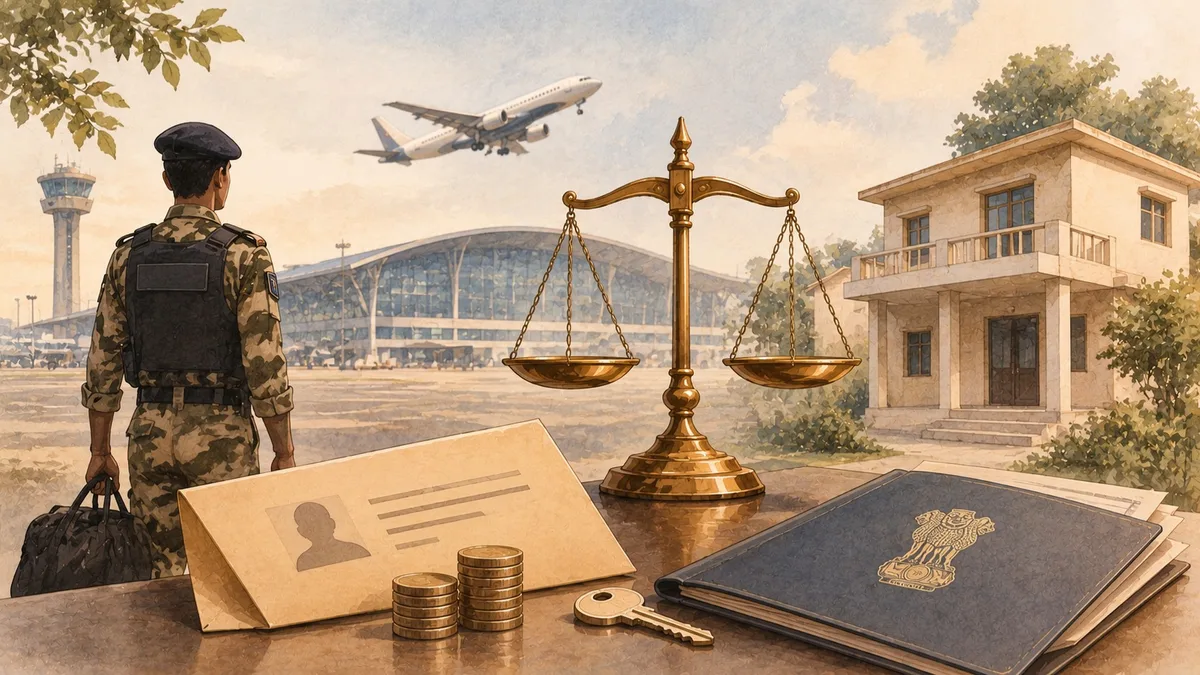
The Court directed payment of the petitioner’s HRA entitlement for periods when government accommodation had not been provided, applying the governing service rules and precedent on HRA for eligible force personnel. The petitioner gave up the TA/DA claim in these proceedings.
Key Proposition: Where eligible CISF personnel are not provided government accommodation, HRA must be determined and paid in accordance with the applicable rules and binding precedent rather than reduced without legal basis.
- Constitution of India – Article 226 – service benefits – whether HRA arrears were payable for periods without government accommodation? Yes, subject to applicable rules.
- CISF / Central Government service rules – HRA – whether reimbursement could be reduced by 5% despite entitlement to the applicable rate? Considered in light of precedent.
- Service law – arrears – whether delayed payment attracts interest? Yes, 6% simple interest after the granted period.
Background / Synopsis :
- The petitioner, a CISF employee, sought full HRA for 29 May 2022 to 20 May 2023 at CISF Unit, Vadodara Airport and 20 May 2023 to 12 August 2025 at CISF Unit, IGI Airport, New Delhi.
- He also initially sought TA and DA, but gave up that relief in the writ petition with liberty to pursue separate proceedings.
- The petitioner’s case was that he had not been provided government accommodation during the relevant periods and was entitled to HRA; he challenged a 5% reduction.
- The respondents relied on the applicable rules and prior decisions concerning HRA entitlement.
Issues For Consideration :
- Whether the petitioner was entitled to full HRA for the periods during which government accommodation was not provided.
- Whether the applicable rules permitted a 5% reduction in the HRA amount.
- Whether the petitioner could pursue TA/DA separately and whether interest should be awarded on delayed HRA arrears.
Submissions Of Parties :
Petitioner / Appellant:
- The petitioner submitted that he was entitled to 30% HRA in lieu of government accommodation and that reducing the amount by 5% had no legal justification.
- He relied on prior Division Bench decisions, including decisions concerning force personnel and HRA entitlement.
- The petitioner gave up the TA/DA relief in the present proceedings, reserving liberty to pursue it separately.
- The Union opposed the claim through its standing counsel
Respondent / State: The respondent’s position is set out in the submissions and analysis above, based on the judgment.
Court's Observations & Analysis :
Re: Issues for consideration
- The Court considered the governing service rules and the earlier decisions on HRA entitlement where government accommodation was not provided.
- The judgment noted that prior decisions had recognised full HRA entitlement for similarly placed personnel and addressed the relevant rule by reading it consistently with those decisions.
- The Court directed payment of the HRA amount found due for the relevant periods.
- The TA/DA claim was not adjudicated on merits because the petitioner gave it up with liberty to pursue appropriate legal proceedings.
Decision & Directions :
- Respondents were directed to release the HRA arrears due to the petitioner within three months from the date of judgment.
- If arrears were not paid within the granted period, the petitioner would be entitled to simple interest at 6% per annum until actual payment.
- The petitioner was granted liberty to take appropriate legal proceedings regarding TA and DA.
- The writ petition was disposed of.
Legal Provisions Discussed & Precedents Cited :
- Constitution of India – Article 226 – writ jurisdiction in service matters.
- Applicable Central Government / CISF service rules governing HRA and accommodation entitlement, including Rule 61 as discussed in the judgment.
- Jaspal Singh Mann – cited in the judgment as upheld by the Supreme Court in Civil Appeal No.1132/2009.
- Brijesh Kumar – cited as upheld in Union of India v. Paramisivan M., Civil Appeal No.4967/2023 and connected matters.
- Union of India v. Paramisivan M., Civil Appeal No.4967/2023 and connected matters – referred to in relation to the HRA rule.
- Ashish Sharma v. Union of India, W.P.(C) 8154/2024, decided 21 May 2026 – referred to as a batch decision concerning full HRA.
Case Details :
- Case / Party Name: Sandeep v. Union of India and others
- Case Number(s): W.P.(C) 16811/2026; CNR No. DLHC010546542026
- Coram / Judges: Jyoti Singh, J. and Gurvinder Pal Singh, J. – Division Bench
- Counsel Appearances: P. Sureshan and Nilanjani Tandon for the petitioner; Satyam Pahal, Standing Counsel, with Sarthak Rana, Government Pleader, and CISF officials for the respondents.
Disclaimer: This summary is an editorial aid and does not form part of the judgment. Refer to the original judgment before citing.
Full Judgement / Attachment
Full Judgement
Frequently asked questions about Delhi High Court
- Where does the Delhi High Court sit and which areas does it cover?
- The Delhi High Court sits in New Delhi. It has jurisdiction over the National Capital Territory of Delhi. It was established on 31 October 1966 and is a leading forum for commercial, intellectual property, tax and arbitration matters.
- How do I check Delhi High Court case status and judgements?
- The official website, delhihighcourt.nic.in, provides case status, cause lists, e-filing and judgements searchable by party, judge or date. Orders are also mirrored on the eCourts Judgments portal (judgments.ecourts.gov.in).
- What are the Delhi High Court's Commercial and IP Divisions?
- Delhi High Court has original civil jurisdiction, so high-value suits in Delhi are filed directly before it. Its Commercial Division hears commercial disputes, and its Intellectual Property Division, set up in 2021 after the IPAB was abolished, hears patent, trademark and copyright cases. It is also a major forum for tax appeals from the ITAT Delhi Benches and for arbitration petitions.
- What is an LPA in the Delhi High Court?
- A Letters Patent Appeal (LPA) under Clause 10 of the Letters Patent lets a party challenge certain single-judge orders, typically in writ matters, before a Division Bench. In commercial cases, appeals lie under Section 13 of the Commercial Courts Act instead. Final judgements can be challenged by a Special Leave Petition under Article 136, ordinarily within 90 days.
- How can White Collar Professional help with a Delhi High Court matter?
- Post your requirement on White Collar Professional to receive proposals from verified Advocates, Chartered Accountants and Company Secretaries, compare them, and pay securely through the platform. This page also tracks the latest Delhi High Court judgements and legal updates as they are reported.