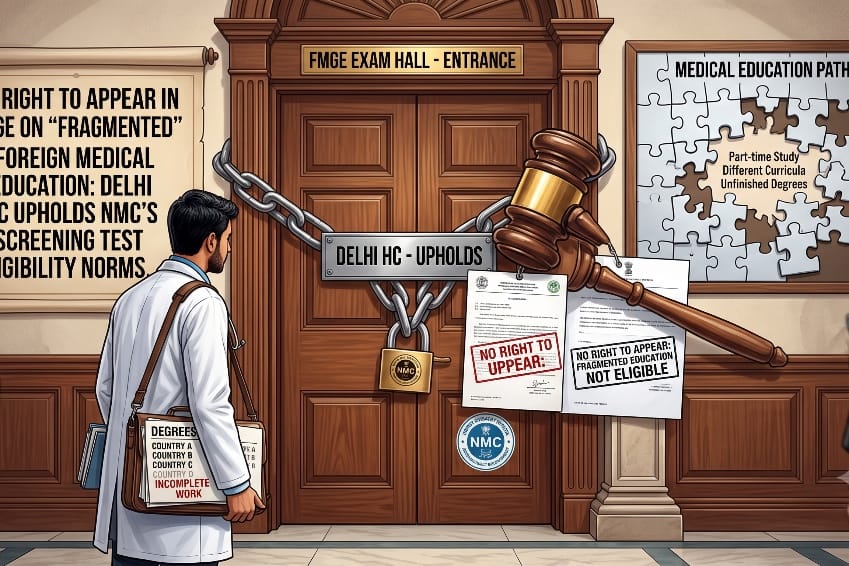
No Right to Appear in FMGE on "Fragmented" Foreign Medical Education: Delhi HC Upholds NMC's Screening Test Eligibility Norms
Court / Authority
Delhi High Court
Update / Judgement Date
06 Sept 2026
Source
WCP News Bulletin
Author
Team — WCP Legal Desk
Reading Time
5 min read
View Count
1
Brij Sharadbhai Bhatt & Ors. v. National Medical Commission & Ors. | High Court of Delhi (Division Bench) | Decided on: 03.09.2026
The Delhi High Court dismissed a challenge by Indian citizens who had pursued fragmented medical education across multiple foreign institutions, upholding Regulation 4(1) of the Screening Test Regulations, 2002 (excluding WHO-listed institutions not confirmed by the Indian Embassy) and Clause 2.14 of the FMGE Information Bulletin (requiring apostille/attestation of foreign degrees). The Court held such provisions concern authentication of eligibility, not creation of fresh eligibility criteria, and are within the National Medical Commission's expert domain; it further upheld the Commission's decision declaring the petitioners ineligible for submitting alternate degree certificates from two different foreign institutions for the same period of study.
Background
- The petitioners, having pursued allopathic medical studies abroad, sought to appear in the Foreign Medical Graduate Examination (FMGE) conducted by the National Board of Examination in Medical Sciences to qualify for registration as medical practitioners by the National Medical Commission (NMC).
- They challenged Regulation 4(1) of the Screening Test Regulations, 2002 (as substituted in 2009), which excludes WHO World Directory-listed institutions from automatically conferring eligibility unless the qualification is separately confirmed as recognised by the concerned Indian Embassy, and Clause 2.14 of the Information Bulletin requiring attestation/apostille of foreign medical degrees.
- The petitioners had originally obtained a Primary Medical Qualification (PMQ) from New Tokyo Medical College, Federated States of Micronesia, but were denied permission for FMGE June 2023 as the certificate was not apostilled/attested by the Indian Embassy; the Indian Embassy in Manila later clarified it could not authenticate Micronesia degrees since Micronesia did not respond to its verification queries and is not a signatory to the Hague Apostille Convention.
- For FMGE December 2023, the petitioners submitted an alternate PMQ from Central America Health Sciences University, Belize, for the same period of study (validated under an MOU between the two foreign institutions), but by communication dated 14.05.2025, NMC's Examination Ethics Committee declared them ineligible for having furnished certificates from two different institutions for the same study period.
- The petitioners contended Regulation 4(1) was ultra vires Section 33(ma) of the IMC Act, 1956, relying on Rohit Naresh Agarwal v. Union of India, and that the fresh Belize certificate should independently qualify them, notwithstanding the fragmented education across multiple institutions.
Court's Observations
- Regulation 4(1) of the Screening Regulations and Clause 2.14 of the Information Bulletin do not prescribe eligibility criteria; they only require authentication of a foreign medical degree, a process distinct from and not equivalent to determination of substantive eligibility, so Rohit Naresh Agarwal (which concerned a fresh eligibility criterion under Regulation 4(3)) had no application.
- As an expert body regulating medical education, NMC's exclusion of WHO-listed but Embassy-unconfirmed institutions, based on its regulatory experience, is entitled to judicial deference under Article 226 unless shown to be absolutely arbitrary — no such arbitrariness was demonstrated.
- The challenge to Clause 2.14 also failed as belated, since the petitioners had earlier applied for FMGE June 2023 without challenging the clause, and only did so after being declared ineligible; in any event, requiring authentication causes no prejudice and serves the legitimate purpose of excluding fake or false qualifications.
- The Indian Embassy in Manila's clarification — that it could not authenticate Micronesia Medical College degrees, coupled with Micronesia not being a Hague Apostille Convention signatory — provided a valid basis for the impugned communication declaring the petitioners ineligible.
- Submitting PMQ certificates from two different foreign institutions for the identical period of study reflected fragmented medical education, which the Court held could compromise the quality of medical professionals and was not in the public interest, relying on the Supreme Court's reasoning in Yash Ahuja v. Medical Council of India on the purpose of the screening test (to prevent commercialisation of medical education and "half-baked" doctors).
- The subsequent Belize Medical University certificate, issued under an MOU crediting the Micronesia coursework, could not cure the fragmentation or independently confer FMGE eligibility for the same disputed period of study.
Legal Provisions Discussed
- Section 13(4A) and Section 33(ma) of the Indian Medical Council Act, 1956.
- Section 61(2) of the National Medical Commission Act, 2019 (transitory provisions continuing IMC regulations).
- Regulation 4(1) and Clause 2(f), Clause 3 of the Screening Test Regulations, 2002.
- Clause 2.14 of the FMGE Information Bulletin; Foreign Medical Graduate Licentiate Regulations, 2021.
- Hague Convention of 5 October 1961 (Apostille Convention).
- Precedents applied: Yash Ahuja & Ors. v. Medical Council of India & Ors., (2009) 10 SCC 313; Rohit Naresh Agarwal v. Union of India, 2013 SCC OnLine Del 3904 (distinguished).
Case Details :
Court Name: High Court of Delhi at New Delhi
Case Number: W.P.(C) 11266/2025 & connected CM Applications
Case / Party Name: Brij Sharadbhai Bhatt & Ors. v. National Medical Commission & Ors.
Court: High Court of Delhi (Division Bench)
Coram / Judges: Hon'ble The Chief Justice Devendra Kumar Upadhyaya; Hon'ble Mr. Justice Tejas Karia
Date of Decision: 03.09.2026
Letters Patent / Appeals (if any): Not Applicable
Full Judgement / Attachment
Full Judgement
Frequently asked questions about Delhi High Court
- Where does the Delhi High Court sit and which areas does it cover?
- The Delhi High Court sits in New Delhi. It has jurisdiction over the National Capital Territory of Delhi. It was established on 31 October 1966 and is a leading forum for commercial, intellectual property, tax and arbitration matters.
- How do I check Delhi High Court case status and judgements?
- The official website, delhihighcourt.nic.in, provides case status, cause lists, e-filing and judgements searchable by party, judge or date. Orders are also mirrored on the eCourts Judgments portal (judgments.ecourts.gov.in).
- What are the Delhi High Court's Commercial and IP Divisions?
- Delhi High Court has original civil jurisdiction, so high-value suits in Delhi are filed directly before it. Its Commercial Division hears commercial disputes, and its Intellectual Property Division, set up in 2021 after the IPAB was abolished, hears patent, trademark and copyright cases. It is also a major forum for tax appeals from the ITAT Delhi Benches and for arbitration petitions.
- What is an LPA in the Delhi High Court?
- A Letters Patent Appeal (LPA) under Clause 10 of the Letters Patent lets a party challenge certain single-judge orders, typically in writ matters, before a Division Bench. In commercial cases, appeals lie under Section 13 of the Commercial Courts Act instead. Final judgements can be challenged by a Special Leave Petition under Article 136, ordinarily within 90 days.
- How can White Collar Professional help with a Delhi High Court matter?
- Post your requirement on White Collar Professional to receive proposals from verified Advocates, Chartered Accountants and Company Secretaries, compare them, and pay securely through the platform. This page also tracks the latest Delhi High Court judgements and legal updates as they are reported.