Liquor-Case Vehicles Can Be Released Pending Trial: Gujarat High Court Holds Section 98(2) Prohibition Act No Bar to Interim Custody Under Section 497 BNSS, Circulates Ruling to All Magistrates
Court / Authority
Gujarat High Court
Update / Judgement Date
23 Nov 2026
Date of Publication
25 Nov 2026
Source
WCP News Bulletin
Author
Arshee Saifi — WCP Legal Desk
Reading Time
7 min read
View Count
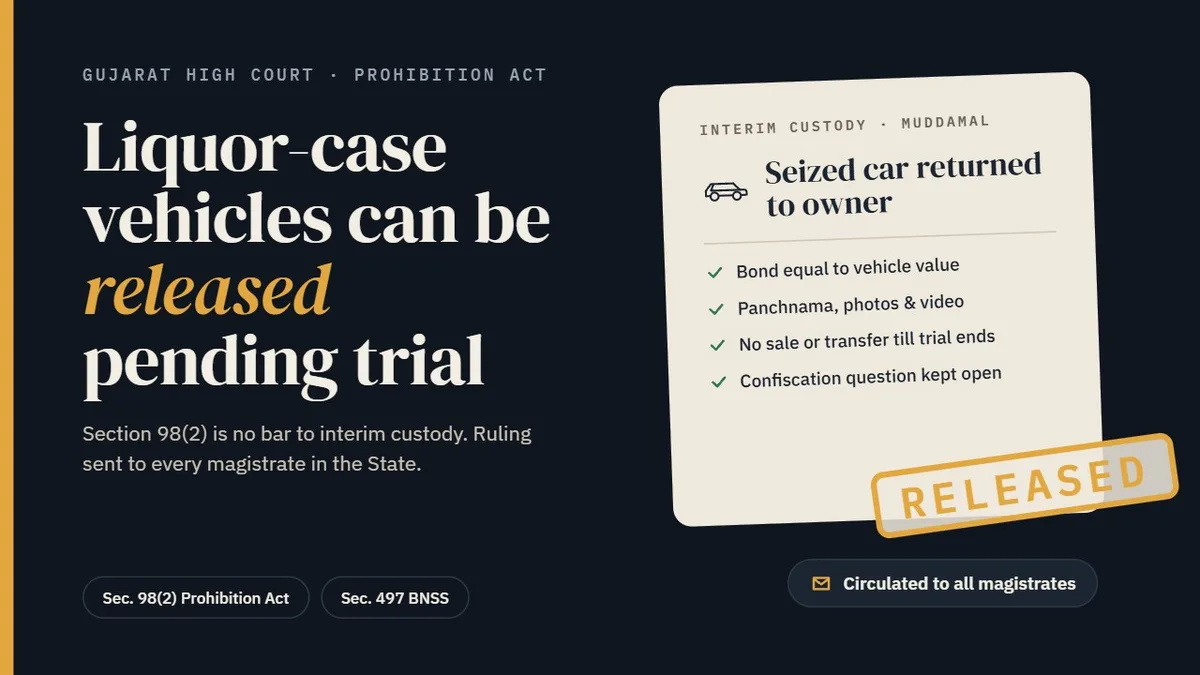
Key Proposition: Section 98(2) of the Gujarat Prohibition Act, 1949, especially after its 2024 amendment, is not an absolute bar to interim custody of a vehicle seized in a liquor case; the Magistrate must decide an application under Section 497 BNSS on its merits and may release the vehicle on safeguards, since interim custody and eventual confiscation operate in different fields.
Background / Synopsis :
- The petitioner's Swift car (GJ-05-JV-6128) was seized in C.R. No. 11210015260010 of DCB Police Station, Surat for alleged transport of prohibited liquor (Paras 1, 21.1).
- He claimed to be the lawful owner, said the vehicle was deteriorating, and offered bond and security (Para 2).
- The State argued that the quantity of liquor exceeded the prescribed limit, so the vehicle was liable to confiscation under Section 98(2) and could not be released during the proceedings (Para 3).
Issues For Consideration :
- Whether Section 98(2) of the Gujarat Prohibition Act is an absolute embargo against interim release of a vehicle seized with liquor above the prescribed quantity (Para 5).
- Whether the criminal court's power to grant interim custody under Section 497 BNSS (Section 451 CrPC) is ousted merely because the vehicle may eventually be confiscated (Para 5).
Submissions Of Parties :
- Petitioner (owner):
He is the lawful owner; prolonged retention exposes the vehicle to deterioration and loss of value; he will furnish bond and security (Para 2).
- State (APP):
The vehicle was used to transport liquor above the permissible limit and is liable to confiscation; Section 98(2) bars release pending trial (Para 3).
Court's Observations & Analysis :
- Re: Scope of Section 497 BNSS
The provision aims to preserve seized property and avoid needless retention; its statement, photograph and videography mechanism shows that evidentiary identity does not require continued physical detention (Paras 6–7.1).
- Re: Section 98(2) after M/s ABC Express
The Supreme Court has held Section 98(2) is not an absolute embargo; Sections 98 and 132 of the Act and Section 451 CrPC operate in different fields (Khengarbhai) (Paras 8–9).
Courts must not take a narrow view of their powers; seized property should not be kept longer than necessary (Basavva Kom Dyamangouda Patil; Sunderbhai Ambalal Desai; General Insurance Council) (Paras 10–12.1).
Uday Singh (Forest Act) and Multani Hanifbhai (Animal Preservation Act) are distinguishable regimes; the Prohibition Act has its own confiscation procedure with notice and hearing (Paras 12.2–12.3).
The 2024 amendment removed the bar on release on bond or surety; Pareshkumar (2017) must be read in that light (Paras 12.4–13).
- Re: Application to the facts
The State's objection rests on Section 98(2) alone, which by itself is not a ground for rejection; the vehicle's use in an alleged offence does not make its detention throughout trial indispensable (Para 14).
Deterioration, depreciation and loss of use can be avoided while evidence is preserved by panchnama, photography and videography (Paras 15–16).
Interim custody is not acquittal and does not extinguish the power of confiscation (Para 17).
Held: The Magistrate is competent, and required, to decide such applications on merits with safeguards; continued detention of this vehicle is not warranted. (Paras 18–20)
Notable Observations:
"…grant of interim custody would not amount to acquittal, discharge or any determination concerning the allegations levelled against the accused nor would it extinguish the power of confiscation available under the Gujarat Prohibition Act." (Para 17)
"A motor vehicle is a valuable movable asset. Its prolonged detention in an open police compound exposes it to natural deterioration, depreciation, damage and loss of utility." (Para 15)
Decision & Directions :
Petition allowed; Rule made absolute. (Paras 21, 24)
1. Personal bond with solvent surety equal to the vehicle's price as stated in the FIR. (Para 21.2)
2. Undertaking to produce the vehicle before the IO or court when directed. (Para 21.3)
3. No sale, transfer, mortgage or third-party interest without the court's permission. (Para 21.4)
4. IO to prepare a detailed panchnama (make, model, registration, chassis and engine numbers, condition) with photographs and videography from all sides, in the presence of the petitioner and two independent witnesses, to be placed on the trial-court record. (Paras 21.5–21.6)
5. Undertaking not to use the vehicle for any offence under the Prohibition Act. (Para 21.7)
6. If the vehicle is ultimately confiscated, the security may be proceeded against or the vehicle auctioned as permissible in law. (Para 21.8)
7. On compliance, the IO to hand over the vehicle expeditiously. (Para 21.10)
Copy to the RTO to record the restraint on transfer until final disposal, subject to trial-court permission. (Para 23)
Registry to circulate the judgment to all judicial officers of the District Judiciary in Gujarat. (Para 25)
Record notes: Para 7 splices a sentence of the Court's own commentary into the middle of the quoted text of Section 497(3) BNSS; condition 21.2 asks for security 'to the satisfaction of this Court' though compliance will ordinarily be before the trial court or IO; 'Copy of this order be send' (Para 23).
Separate Opinions: None.
Legal Provisions Discussed & Precedents Cited :
- Gujarat Prohibition Act, 1949 – Sections 98, 132; Gujarat Prohibition (Amendment) Ordinance No. 2 of 2024.
- Bharatiya Nagarik Suraksha Sanhita, 2023 – Sections 497, 503, 504, 505 (Code of Criminal Procedure, 1973 – Sections 451, 457, 458, 459).
- Constitution of India – Article 141.
- M/s ABC Express v. State of Gujarat, 2026 INSC 940 – Followed.
- Khengarbhai Lakhabhai Dambhala v. State of Gujarat, 2024 INSC 285 – Followed.
- Sunderbhai Ambalal Desai v. State of Gujarat, (2002) 10 SCC 283 – Followed.
- Basavva Kom Dyamangouda Patil v. State of Mysore, (1977) 4 SCC 358 – Followed.
- General Insurance Council v. State of Andhra Pradesh, 2010 INSC 225 – Followed.
- State of M.P. v. Uday Singh, (2020) 4 SCC (Cri) 473; Multani Hanifbhai Kalubhai v. State of Gujarat, 2013 INSC 69 – Distinguished.
- Pareshkumar Jaykarbhai Brahmbhatt v. State of Gujarat, 2018 (1) GLH 558 – Explained (rendered on the unamended provision).
Case Details :
- Case / Party Name: Rakesh @ Akash Santoshbhai Ahire v. State of Gujarat & Anr.
- Case Number(s): R/Special Criminal Application (Possession of Muddamal) No. 16069 of 2026 (CNR GJHC240816702026) – no neutral citation printed
- Coram / Judges: J.C. Doshi, J. – Single Judge
- Counsel Appearances: For the Petitioner: Mr. N.P. Pandya and Mr. Dharmik G. Khadawala. For the State: Mr. Manan Mehta, APP.
Disclaimer: This summary is an editorial aid and does not form part of the judgment. Refer to the original judgment before citing.
Full Judgement / Attachment
Full Judgement
Frequently asked questions about Gujarat High Court
- Where does the Gujarat High Court sit and which areas does it cover?
- The Gujarat High Court sits at Sola, Ahmedabad. It has jurisdiction over the State of Gujarat. It was established on 1 May 1960, when Gujarat was formed from the former Bombay State.
- Can I watch Gujarat High Court hearings live?
- Yes. The Gujarat High Court was the first High Court in India to live-stream its court proceedings, on its official YouTube channel. Case status, cause lists and judgements are on its website, gujarathighcourt.nic.in, and on the eCourts High Court Services portal (hcservices.ecourts.gov.in).
- What kinds of cases does the Gujarat High Court hear?
- It hears writs, civil and criminal appeals for Gujarat, along with a large volume of tax litigation, including income-tax appeals from the ITAT Ahmedabad, Rajkot and Surat Benches and GST and customs matters linked to the state's ports and industrial hubs.
- How is a single-judge order appealed in the Gujarat High Court?
- Certain single-judge orders, mainly in writ matters, can be challenged before a Division Bench by a Letters Patent Appeal under Clause 15 of the Letters Patent. A final judgement can be challenged by a Special Leave Petition under Article 136, ordinarily within 90 days.
- How can White Collar Professional help with a Gujarat High Court matter?
- Post your requirement on White Collar Professional to receive proposals from verified Advocates, Chartered Accountants and Company Secretaries, compare them, and pay securely through the platform. This page also tracks the latest Gujarat High Court judgements and legal updates as they are reported.