IBBI Proposes Tighter CoC Oversight, Cost Controls and Procedural Clarity Under CIRP Regulations
Court / Authority
Insolvency & Bankruptcy Board
Update / Judgement Date
17 Jul 2026
Source
WCP News Bulletin
Author
Manas Yadav — WCP Legal Desk
Reading Time
2 min read
View Count
1
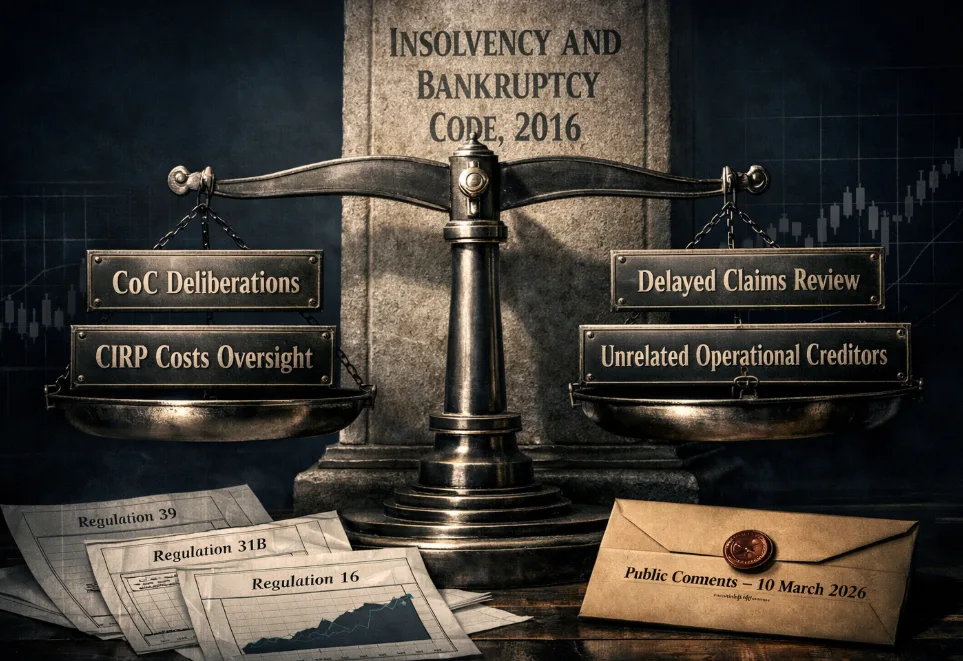
The Insolvency and Bankruptcy Board of India has released a discussion paper dated 16 February 2026 proposing significant refinements to the Corporate Insolvency Resolution Process (CIRP) Regulations, 2016, aimed at strengthening creditor oversight, improving procedural discipline and reinforcing value maximisation under the Insolvency and Bankruptcy Code, 2016.
A key proposal seeks to standardise the recording of Committee of Creditors (CoC) deliberations while approving resolution plans. Beyond feasibility and viability, CoCs would now document expected recoveries vis-à-vis fair and liquidation values, adequacy of market discovery processes, and the credibility and funding certainty of resolution applicants. The move is intended to enhance transparency without diluting the CoC’s commercial wisdom.
The Board has also proposed a structured framework for approval of CIRP costs and decisions on running the corporate debtor as a going concern. Insolvency professionals may incur limited costs during the initial pre-CoC phase, subject to post-facto approval, while a mandatory Going Concern Assessment Report would guide early commercial decisions on operational continuation.
Further, the paper clarifies that all acceptable delayed claims must be placed before the Adjudicating Authority for condonation and adjudication, with the CoC’s role confined to recommendations on treatment within resolution plans.
Finally, to prevent conflicts of interest, IBBI has proposed excluding related operational creditors from CoCs constituted exclusively of operational creditors.
Public comments have been invited until 10 March 2026, signalling another calibrated step in tightening India’s insolvency framework.
Full Judgement / Attachment
Full Judgement
Frequently asked questions about Insolvency & Bankruptcy Board
- What is the IBBI?
- The Insolvency and Bankruptcy Board of India, set up on 1 October 2016 under the Insolvency and Bankruptcy Code, 2016 (IBC), regulates insolvency professionals, insolvency professional agencies, information utilities and registered valuers. It also frames the regulations for insolvency processes.
- When can insolvency be started against a company?
- A financial creditor, an operational creditor or the company itself can apply to the National Company Law Tribunal (NCLT) once there is a default of at least ₹1 crore. On admission, a moratorium starts and an interim resolution professional takes charge.
- How long does the corporate insolvency process take?
- The Code provides 180 days for the corporate insolvency resolution process (CIRP), extendable up to an overall limit of 330 days, including time spent in litigation. In practice, many cases take longer. The IBC (Amendment) Act, 2026, largely in force from 26 May 2026, requires the NCLT to decide admission applications within 14 days and to record reasons for any delay.
- Where can an NCLT insolvency order be appealed?
- An appeal lies to the National Company Law Appellate Tribunal (NCLAT) within 30 days, extendable by up to 15 days for sufficient cause. A further appeal lies to the Supreme Court on a question of law.
- How can White Collar Professional help with a insolvency matter?
- Post your requirement on White Collar Professional to receive proposals from verified Insolvency Professionals, Chartered Accountants and Advocates, compare them, and pay securely through the platform. This page also tracks the latest insolvency IBC and IBBI updates as they are reported.