NCLT Mumbai Admits Union Bank’s Section 7 Plea Against Vitthal Corporation; Rejects Limitation and Default Date Objections
Court / Authority
Insolvency & Bankruptcy Board
Update / Judgement Date
23 Aug 2026
Source
WCP News Bulletin
Author
Manas Yadav — WCP Legal Desk
Reading Time
2 min read
View Count
Key Facts and Tribunal Findings
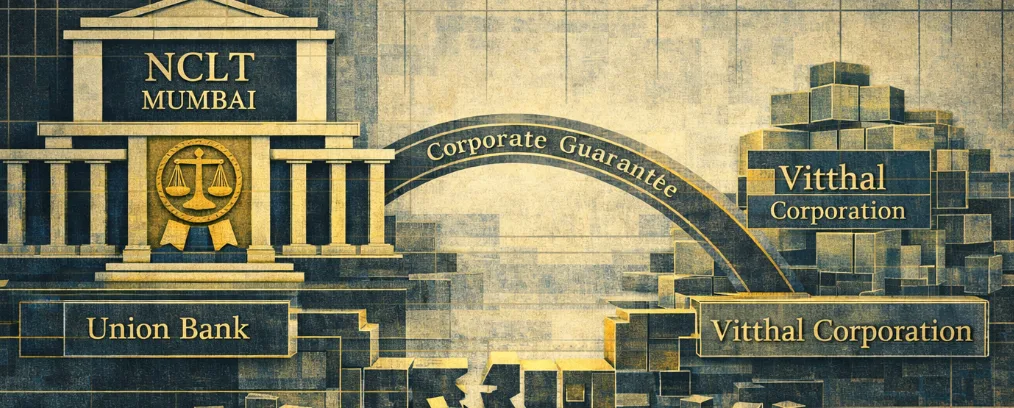
The National Company Law Tribunal (NCLT), Mumbai Bench-VI, has admitted a Section 7 application filed by Union Bank of India against Vitthal Corporation Ltd., initiating the Corporate Insolvency Resolution Process (CIRP). The Financial Creditor had extended credit facilities aggregating to ₹30 crore to farmers under a sugarcane cultivation scheme, for which the Corporate Debtor executed a corporate guarantee dated 14 September 2016. Upon default by the principal borrowers, the loan accounts were classified as Non-Performing Assets in March and April 2021.
The total amount in default as on 31 August 2025 was ₹46.81 crore, comprising principal and accrued interest. The Financial Creditor relied on default dates of 31 January 2019 and 31 October 2019, corresponding to defaults by the principal borrowers. The Corporate Debtor raised objections on maintainability, contending that the actual default occurred only after invocation of the guarantee on 14 December 2021, and that the petition filed in October 2025 was barred by limitation. It further argued that reliance on borrower default dates was erroneous and that acknowledgment through a One Time Settlement (OTS) proposal in May 2023 could not revive a time-barred debt.
The Tribunal rejected these objections. It held that in cases of corporate guarantee, the liability of the guarantor is triggered upon default by the principal borrower, relying on the Supreme Court ruling in Laxmi Pat Surana v. Union Bank of India. Accordingly, the dates of default mentioned in the application were held to be valid.
On limitation, the Tribunal observed that the guarantee was invoked on 14 December 2021 and that the OTS proposal dated 12 May 2023 constituted acknowledgment of debt. The petition was therefore held to be within limitation.
Finding that financial debt and default were established, and the application was complete, the Tribunal admitted the petition under Section 7 of the Code.
Full Judgement / Attachment
Full Judgement
Frequently asked questions about Insolvency & Bankruptcy Board
- What is the IBBI?
- The Insolvency and Bankruptcy Board of India, set up on 1 October 2016 under the Insolvency and Bankruptcy Code, 2016 (IBC), regulates insolvency professionals, insolvency professional agencies, information utilities and registered valuers. It also frames the regulations for insolvency processes.
- When can insolvency be started against a company?
- A financial creditor, an operational creditor or the company itself can apply to the National Company Law Tribunal (NCLT) once there is a default of at least ₹1 crore. On admission, a moratorium starts and an interim resolution professional takes charge.
- How long does the corporate insolvency process take?
- The Code provides 180 days for the corporate insolvency resolution process (CIRP), extendable up to an overall limit of 330 days, including time spent in litigation. In practice, many cases take longer. The IBC (Amendment) Act, 2026, largely in force from 26 May 2026, requires the NCLT to decide admission applications within 14 days and to record reasons for any delay.
- Where can an NCLT insolvency order be appealed?
- An appeal lies to the National Company Law Appellate Tribunal (NCLAT) within 30 days, extendable by up to 15 days for sufficient cause. A further appeal lies to the Supreme Court on a question of law.
- How can White Collar Professional help with a insolvency matter?
- Post your requirement on White Collar Professional to receive proposals from verified Insolvency Professionals, Chartered Accountants and Advocates, compare them, and pay securely through the platform. This page also tracks the latest insolvency IBC and IBBI updates as they are reported.