IBBI Rejects RTI Appeal Seeking Collated Disciplinary Committee Orders
Court / Authority
Insolvency & Bankruptcy Board
Update / Judgement Date
03 Nov 2026
Date of Publication
05 Nov 2026
Source
WCP News Bulletin
Author
Dipanshi Bansal — WCP Legal Desk
Reading Time
4 min read
View Count
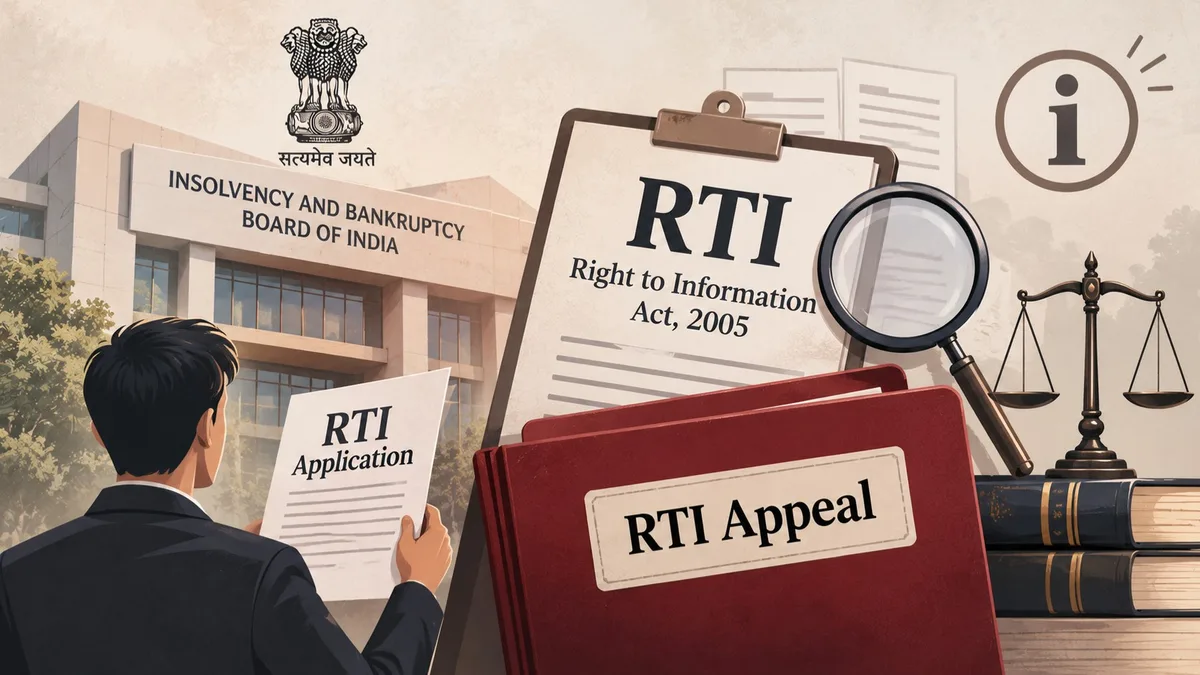
The Insolvency and Bankruptcy Board of India’s First Appellate Authority disposed of Dr. Rajansh Thukral’s RTI appeal concerning the authority for constituting IBBI Disciplinary Committees and copies of their constitution orders. The Authority accepted that the CPIO’s link to the regulations relating to advisory committees under Section 197 of the Insolvency and Bankruptcy Code provided the relevant information, and held that the RTI Act did not require IBBI to collate documents or information not maintained as records.
Key Highlights :
- The First Appellate Authority issued the order on 03 November 2026 under Section 19 of the Right to Information Act, 2005.
- The RTI application was filed on 01 August 2026; the appeal was dated 22 September 2026.
- The applicant sought the competent authority for constituting IBBI Disciplinary Committees, the office order or notification authorising that authority, and office orders constituting all ten committees.
- The Authority found that the link supplied by the CPIO led to two PDFs, the second of which contained information relevant to the constitution of the Disciplinary Committee.
- The Authority held that the RTI Act does not oblige a public authority to collate information or create a compilation where the requested material is not held as a record or required to be maintained.
- The appeal was disposed of without directing IBBI to provide a separate compilation of all committee constitution orders.
Background :
- The applicant contended that the CPIO had supplied a general website reference rather than the specific information and office orders requested.
- The appeal challenged the adequacy of the response to all three questions, including the accessibility of the individual office orders.
- The Authority examined the RTI application, the CPIO’s response and the appeal, and decided the matter on the material available.
What Has Changed :
- Issue: Whether IBBI was required under the RTI Act to provide the specific office orders and compile records relating to the constitution of all ten Disciplinary Committees.
- Finding: The Authority held that the link supplied by the CPIO to the regulations relating to advisory committees under Section 197 directed the applicant to two PDFs, with the second containing the information sought regarding constitution of the Disciplinary Committee.
- Finding: Information under Section 2(f) is material held by or under the control of a public authority. The RTI Act does not require an authority to collect or collate non-available information, draw inferences or create information that is not part of its records.
- Outcome: The appeal was disposed of. No direction was issued requiring IBBI to prepare a consolidated set of office orders for the applicant.
Compliance Action Points :
- No direct compliance action for regulated entities or insolvency professionals.
- RTI applicants should identify existing records or documents held by the public authority; the RTI Act does not require the authority to create a new compilation, draw inferences or provide advice or opinion.
- No further deadline or direction is specified in the order.
References :
- Right to Information Act, 2005 – Section 2(f): definition of information, including records and material held in electronic form.
- Right to Information Act, 2005 – Section 2(j): right to information in respect of information accessible under the Act and held by or under the control of a public authority.
- Right to Information Act, 2005 – Section 3: right to information, subject to the Act.
- Right to Information Act, 2005 – Section 8: exemptions from disclosure, referred to in the order.
- Right to Information Act, 2005 – Section 19(6): time for disposal of a first appeal; the order states that it was disposed of within 45 days of receipt.
- Insolvency and Bankruptcy Code, 2016 – Sections 197 and 220: provisions referred to in the order in relation to committees, including the Disciplinary Committee.
- Central Board of Secondary Education & Anr. v. Aditya Bandopadhyay & Ors. (Supreme Court, 9 August 2011): cited for the principle that a public authority need not create or collate information not held or required to be maintained.
Source & Attribution :
Primary source: IBBI First Appellate Authority order under Section 19 of the RTI Act, dated 03 November 2026, RTI Appeal Registration No. ISBBI/A/E/26/00049, supplied as the source PDF. No external URL is stated in the supplied document.
Disclaimer: This summary is an editorial aid prepared from publicly available information. It is not legal, tax or investment advice. Refer to the original notification, circular, order or report before acting.
Full Judgement / Attachment
Full Judgement
Frequently asked questions about Insolvency & Bankruptcy Board
- What is the IBBI?
- The Insolvency and Bankruptcy Board of India, set up on 1 October 2016 under the Insolvency and Bankruptcy Code, 2016 (IBC), regulates insolvency professionals, insolvency professional agencies, information utilities and registered valuers. It also frames the regulations for insolvency processes.
- When can insolvency be started against a company?
- A financial creditor, an operational creditor or the company itself can apply to the National Company Law Tribunal (NCLT) once there is a default of at least ₹1 crore. On admission, a moratorium starts and an interim resolution professional takes charge.
- How long does the corporate insolvency process take?
- The Code provides 180 days for the corporate insolvency resolution process (CIRP), extendable up to an overall limit of 330 days, including time spent in litigation. In practice, many cases take longer. The IBC (Amendment) Act, 2026, largely in force from 26 May 2026, requires the NCLT to decide admission applications within 14 days and to record reasons for any delay.
- Where can an NCLT insolvency order be appealed?
- An appeal lies to the National Company Law Appellate Tribunal (NCLAT) within 30 days, extendable by up to 15 days for sufficient cause. A further appeal lies to the Supreme Court on a question of law.
- How can White Collar Professional help with a insolvency matter?
- Post your requirement on White Collar Professional to receive proposals from verified Insolvency Professionals, Chartered Accountants and Advocates, compare them, and pay securely through the platform. This page also tracks the latest insolvency IBC and IBBI updates as they are reported.