IBBI Disciplinary Committee Order: Two-Year Suspension of Insolvency Professional
Court / Authority
Insolvency & Bankruptcy Board
Update / Judgement Date
13 Nov 2026
Source
WCP News Bulletin
Author
Dipanshi Bansal — WCP Legal Desk
Reading Time
8 min read
View Count
2
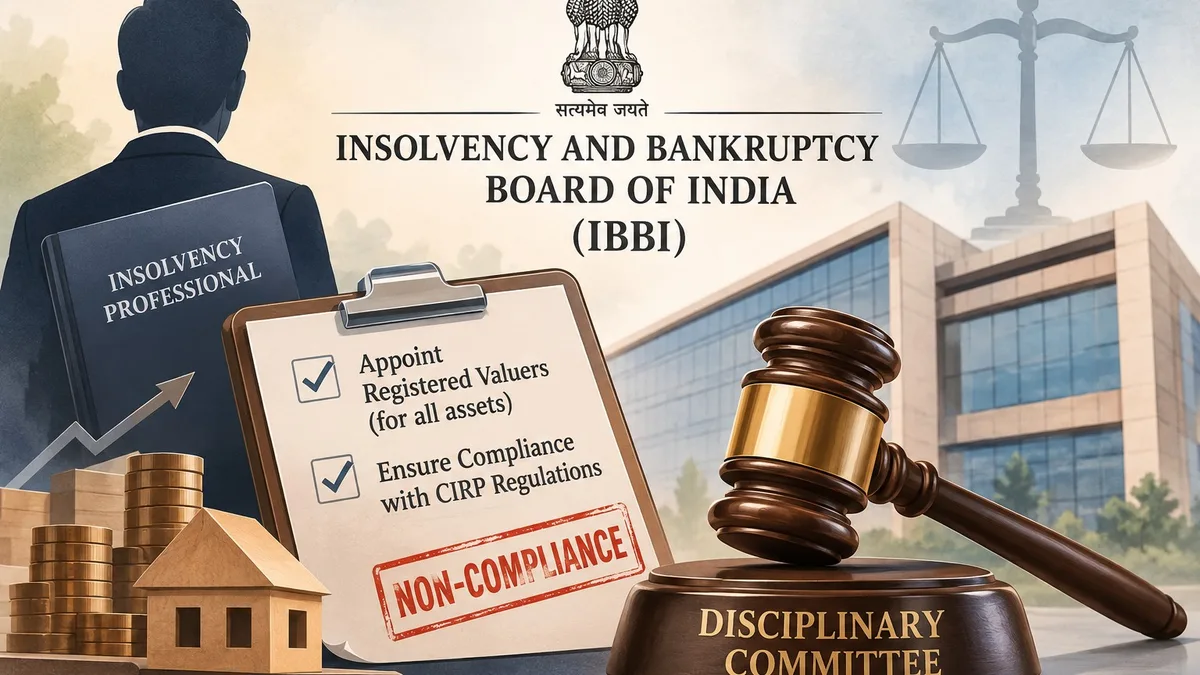
IBBI’s Disciplinary Committee has suspended the registration of insolvency professional Alok Kailash Saksena for two years over multiple failures in the CIRP of Associate Decor Limited. The Committee found deficiencies relating to the Information Memorandum, delayed appointment of the statutory auditor, preservation and insurance follow-up for damaged inventory, maintenance and production of records before tax authorities, delayed circulation of Committee of Creditors (CoC) minutes, and failure to obtain a fresh GST registration under the applicable 2020 notification. The Committee did not decide the separate allegation concerning consideration of the resolution plan because that issue remained pending before the Adjudicating Authority. It also accepted the IP’s defence on the notice for the adjourned 19th CoC meeting.
Key Highlights
- The Information Memorandum did not contain audited financial statements for the last two financial years, as required by Regulation 36(2)(c) of the CIRP Regulations.
- Although the absence of audited accounts was known from the early CoC meetings, the statutory auditor was appointed only after the 10th CoC meeting; the audited report was submitted on 3 February 2020.
- The CoC had directed the RP to explore an insurance claim for damaged/scrap inventory previously attached by the GST Department, but the RP did not adequately update the CoC on the outcome.
- The RP failed to maintain and/or produce important underlying records before the tax authorities. The relevant intelligence report referred to missing purchase orders, cancellation and quality-related communications, debit/credit notes, movement evidence, ledgers and stock accounts.
- The tax intelligence report proposed additional tax of approximately ₹15.52 crore and an equal amount of penalty for July 2017 to March 2020; the IBBI order treats the record-keeping failure as exposing the Corporate Debtor to substantial tax risk.
- Minutes of several CoC meetings were circulated beyond the 48-hour period prescribed by Regulation 24(7) of the CIRP Regulations.
- The RP did not obtain a new GST registration as required by Notification No. 11/2020-Central Tax dated 21 March 2020, despite continuing to manage the Corporate Debtor’s affairs.
- The DC imposed a two-year suspension. The order becomes effective 30 days after its issue.
Background / Legal Context
Associate Decor Limited entered CIRP on 26 October 2018. Saksena was appointed IRP and subsequently RP. Following a complaint dated 17 May 2024, IBBI sought explanations and issued the SCN. The IP argued, among other things, that substantially similar allegations had been raised in proceedings before the NCLT, the Karnataka High Court and the Supreme Court, and sought deferral of the disciplinary process. The DC reviewed those proceedings and distinguished the issues already decided from the regulatory duties it was required to examine. The Supreme Court had set aside the Karnataka High Court’s 22 April 2024 order on grounds including delay and the availability of remedies under the IBC; it had not adjudicated the merits of the underlying allegations.
Detailed Issues, Findings and Outcome
- Issue 1 — Audited financial statements in the Information Memorandum: Regulation 36(2)(c) required audited financial statements for the preceding two financial years. The IM contained provisional statements instead. The DC found that the RP failed to ensure the required financial information was included.
- Issue 2 — Delay in appointing the statutory auditor: The RP knew from the first and third CoC meetings that the accounts were unaudited, but the auditor appointment was pursued only much later. The delay meant audited statements were unavailable when the IM was prepared and circulated. The DC treated this as a failure of diligence and statutory compliance.
- Issue 3 — Preservation of inventory value: After the GST Department’s attachment of stock worth approximately ₹30 crore was lifted by the Karnataka High Court on 13 February 2019, the CoC directed the RP to explore an insurance claim for damaged inventory. The DC found that the RP did not act with adequate diligence or keep the CoC informed of the outcome.
- Issue 4 — Maintenance and production of records: The tax authorities recorded that relevant transactional and inventory records were not produced. The DC rejected the explanation that the records had been sufficiently supplied and found a failure to maintain/produce necessary records during the CIRP period.
- Issue 5 — Consideration of the resolution plan: The allegation concerned the RP’s handling of the METL resolution plan and compliance with Section 30(2) of the IBC. The DC expressly refrained from recording a finding because the conditional nature and approval of the plan remained to be finally adjudicated by the NCLT. IBBI reserved liberty to examine the issue afresh after the outcome of IA 161/2020 and related proceedings.
- Issue 6 — Circulation of CoC minutes: Regulation 24(7) required minutes to be circulated electronically within 48 hours. The DC found that minutes of several identified meetings were circulated late and treated this as a contravention.
- Issue 7 — Fresh GST registration: The DC found that the RP did not obtain a new GST registration in accordance with Notification No. 11/2020-Central Tax dated 21 March 2020, notwithstanding his continued management of the Corporate Debtor.
- Issue 8 — Notice of the adjourned 19th CoC meeting: The DC accepted the RP’s submission. The meeting had been adjourned in-session to a fixed date and time to continue the same business; it was not treated as a fresh meeting requiring a new notice. The suspended directors’ representative had participated in the earlier meeting and the RP had informed the directors before the adjourned meeting began.
Decision / Regulatory Consequences
The DC suspended Saksena’s IBBI registration for two years under Section 220(2) of the IBC read with Regulation 13 of the Inspection and Investigation Regulations. During the suspension, he is not eligible to continue his existing assignments under Section 206 of the Code. He must keep IBBI informed of the outcome of IA 161/2020 before the NCLT and any further proceedings. The Board may examine the resolution-plan-related contravention afresh in light of those outcomes. The order takes effect after 30 days from 13 November 2026. The CoC/SCC of other corporate debtors for whom he is providing services must take necessary steps for his replacement in accordance with law. Copies are to be sent to the relevant CoCs/SCCs, the Indian Institute of Insolvency Professionals of ICAI and the Registrar of the NCLT Principal Bench.
Practical Compliance Action Points
- Prepare the Information Memorandum using the financial statements and disclosures specifically required by Regulation 36; do not treat provisional statements as a substitute for audited statements where audited statements are mandated.
- Identify missing books and records immediately after appointment, document efforts to obtain them, and escalate unresolved gaps to the CoC with a clear action plan.
- Initiate statutory auditor appointment early enough to meet CIRP milestones and maintain an auditable record of follow-up.
- Preserve and protect inventory and other assets; where insurance or recovery options are identified by the CoC, pursue them and report progress and outcomes at subsequent meetings.
- Maintain complete purchase, sales, stock, movement, tax and accounting records, and ensure they can be produced to statutory authorities.
- Circulate CoC minutes within the 48-hour period under Regulation 24(7), retaining dispatch records.
- Check GST registration and other indirect-tax requirements applicable to the Corporate Debtor under the relevant notifications when the RP takes over management.
- On suspension or ineligibility of an IP, the relevant CoC/SCC should promptly undertake replacement steps in accordance with the Code.
Analysis / Practical Impact
The order reinforces that an RP’s role is not merely procedural or administrative. The RP must secure reliable financial information, preserve assets, maintain statutory records and meet meeting-related timelines. Delayed audit arrangements can undermine the quality of the Information Memorandum and the transparency of the resolution process. Failures in tax and inventory records can also expose the Corporate Debtor to substantial fiscal claims and impair value maximisation. The DC’s treatment of the adjourned CoC meeting is fact-specific: it relied on the meeting being adjourned in-session to a fixed time to continue the same business. The order should not be read as a general exemption from statutory notice requirements.
Related Laws / Regulations / Precedents
Key provisions referred to include Sections 25(1), 30(2), 206, 208(2)(a), 208(2)(e) and 220(2) of the Insolvency and Bankruptcy Code, 2016; Regulations 19, 24(7) and 36(2)(c) of the CIRP Regulations, 2016; Regulations 7(2)(a) and 7(2)(h) of the IP Regulations; the Code of Conduct for Insolvency Professionals; Notification No. 11/2020-Central Tax dated 21 March 2020; and Regulation 13 of the Inspection and Investigation Regulations. The DC also discusses the Supreme Court’s decision in Mohammed Enterprises (Tanzania) Ltd. v. Farooq Ali Khan (2025 INSC 25) on the IBC’s statutory remedial framework and delay in invoking writ jurisdiction, and Chandrakant Khaire v. Dr. Shantaram Kale (1988) 4 SCC 577 on adjourned meetings.
Disclaimer
This summary is based solely on IBBI Disciplinary Committee Order No. IBBI/DC/353/2026 dated 13 November 2026. It is an editorial aid and not a substitute for the complete order, the IBC, applicable regulations, tax records or legal advice. The resolution-plan allegation under Contravention V remains undecided in this order; the summary does not treat it as an established finding.
Full Judgement / Attachment
Full Judgement
Frequently asked questions about Insolvency & Bankruptcy Board
- What is the IBBI?
- The Insolvency and Bankruptcy Board of India, set up on 1 October 2016 under the Insolvency and Bankruptcy Code, 2016 (IBC), regulates insolvency professionals, insolvency professional agencies, information utilities and registered valuers. It also frames the regulations for insolvency processes.
- When can insolvency be started against a company?
- A financial creditor, an operational creditor or the company itself can apply to the National Company Law Tribunal (NCLT) once there is a default of at least ₹1 crore. On admission, a moratorium starts and an interim resolution professional takes charge.
- How long does the corporate insolvency process take?
- The Code provides 180 days for the corporate insolvency resolution process (CIRP), extendable up to an overall limit of 330 days, including time spent in litigation. In practice, many cases take longer. The IBC (Amendment) Act, 2026, largely in force from 26 May 2026, requires the NCLT to decide admission applications within 14 days and to record reasons for any delay.
- Where can an NCLT insolvency order be appealed?
- An appeal lies to the National Company Law Appellate Tribunal (NCLAT) within 30 days, extendable by up to 15 days for sufficient cause. A further appeal lies to the Supreme Court on a question of law.
- How can White Collar Professional help with a insolvency matter?
- Post your requirement on White Collar Professional to receive proposals from verified Insolvency Professionals, Chartered Accountants and Advocates, compare them, and pay securely through the platform. This page also tracks the latest insolvency IBC and IBBI updates as they are reported.