IBBI Disciplinary Committee Order in Re: Rajan Garg, Insolvency Professional
Court / Authority
Insolvency & Bankruptcy Board
Update / Judgement Date
30 Aug 2026
Source
WCP News Bulletin
Author
Manas Yadav — WCP Legal Desk
Reading Time
3 min read
View Count
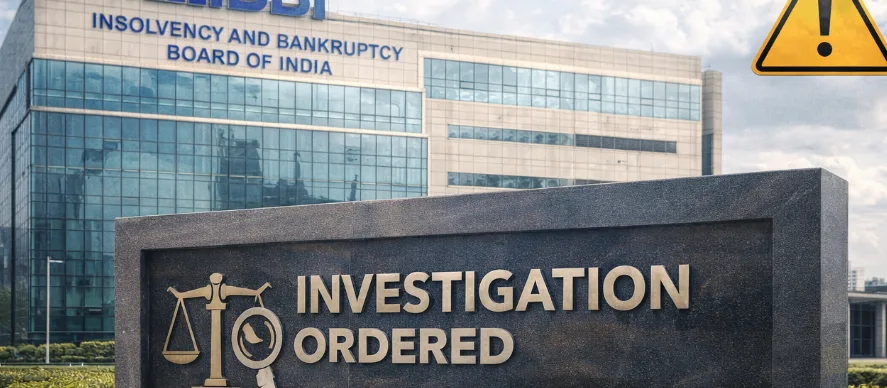
The Insolvency and Bankruptcy Board of India (IBBI), through its Disciplinary Committee, in its order dated 30 March 2026, examined allegations of procedural irregularities against Insolvency Professional Rajan Garg in the CIRP of Truly Creative Developers Private Limited, ultimately referring the matter for further investigation while refraining from imposing immediate penalties.
Allegations and Context
The CIRP was initiated on 11 November 2022, with Mr. Rajan Garg acting as Interim Resolution Professional and later confirmed as Resolution Professional. The primary allegation concerned the wrongful constitution of the Committee of Creditors due to the inclusion of Western Habitat Partnership Firm as a financial creditor with approximately 24.6 percent voting share. This inclusion enabled Western Habitat to participate in the first five CoC meetings, during which critical decisions were taken, including confirmation of the RP, approval of CIRP costs, and issuance of expression of interest.
Subsequently, Western Habitat was removed from the CoC after it was determined that its claim did not qualify as “financial debt” under Section 5(8) of the Code. The Disciplinary Committee observed that such inclusion without adequate verification indicated a lack of due diligence, especially given the underlying Joint Development Agreement relationship between the parties. Mr. Garg defended his conduct by invoking Regulation 14, asserting that initial admission was based on available documents and subject to further verification. He also highlighted procedural disruptions caused by appellate stays and lack of cooperation from the suspended management. Importantly, he argued that exclusion of Western Habitat would not have materially altered voting outcomes in CoC decisions.
Findings and Broader Regulatory Concerns
The Disciplinary Committee, however, identified systemic concerns extending beyond mere procedural lapse. It noted that Western Habitat’s role as a joint developer should have triggered heightened scrutiny at the admission stage. The delayed reclassification, after participation in multiple CoC meetings, raised serious questions about the integrity of the CoC’s composition. Further, the Committee flagged a broader pattern in the conduct of the Resolution Professional. It observed that pre-CIRP litigation involving allegations against Western Habitat was not actively pursued, and subsequent legal proceedings were narrowly framed around moratorium issues without adequately representing stakeholder interests, particularly those of homebuyers and financial creditors. Judicial observations by the Bombay High Court were also noted, criticizing the limited scope and merit of such proceedings.
The Committee also highlighted unexamined allegations regarding other creditors, including PVG Enterprises, Labh Shubh Properties, and Mitej Developers, whose claims may similarly fail the test of “financial debt.” If so, their inclusion could have significantly altered CoC composition and voting dynamics, undermining the legitimacy of earlier decisions.
In light of these cumulative concerns, the Disciplinary Committee refrained from issuing a conclusive finding on misconduct but referred the matter to the Board for a comprehensive investigation. The order thus underscores the critical importance of rigorous claim verification and institutional integrity in insolvency processes, particularly where CoC composition directly impacts the trajectory of resolution.
Full Judgement / Attachment
Full Judgement
Frequently asked questions about Insolvency & Bankruptcy Board
- What is the IBBI?
- The Insolvency and Bankruptcy Board of India, set up on 1 October 2016 under the Insolvency and Bankruptcy Code, 2016 (IBC), regulates insolvency professionals, insolvency professional agencies, information utilities and registered valuers. It also frames the regulations for insolvency processes.
- When can insolvency be started against a company?
- A financial creditor, an operational creditor or the company itself can apply to the National Company Law Tribunal (NCLT) once there is a default of at least ₹1 crore. On admission, a moratorium starts and an interim resolution professional takes charge.
- How long does the corporate insolvency process take?
- The Code provides 180 days for the corporate insolvency resolution process (CIRP), extendable up to an overall limit of 330 days, including time spent in litigation. In practice, many cases take longer. The IBC (Amendment) Act, 2026, largely in force from 26 May 2026, requires the NCLT to decide admission applications within 14 days and to record reasons for any delay.
- Where can an NCLT insolvency order be appealed?
- An appeal lies to the National Company Law Appellate Tribunal (NCLAT) within 30 days, extendable by up to 15 days for sufficient cause. A further appeal lies to the Supreme Court on a question of law.
- How can White Collar Professional help with a insolvency matter?
- Post your requirement on White Collar Professional to receive proposals from verified Insolvency Professionals, Chartered Accountants and Advocates, compare them, and pay securely through the platform. This page also tracks the latest insolvency IBC and IBBI updates as they are reported.