IBBI Suspends Insolvency Professional for Two Years Over Multiple CIRP Breaches
Court / Authority
Insolvency & Bankruptcy Board
Update / Judgement Date
03 Nov 2026
Source
WCP News Bulletin
Author
Dipanshi Bansal — WCP Legal Desk
Reading Time
6 min read
View Count
2
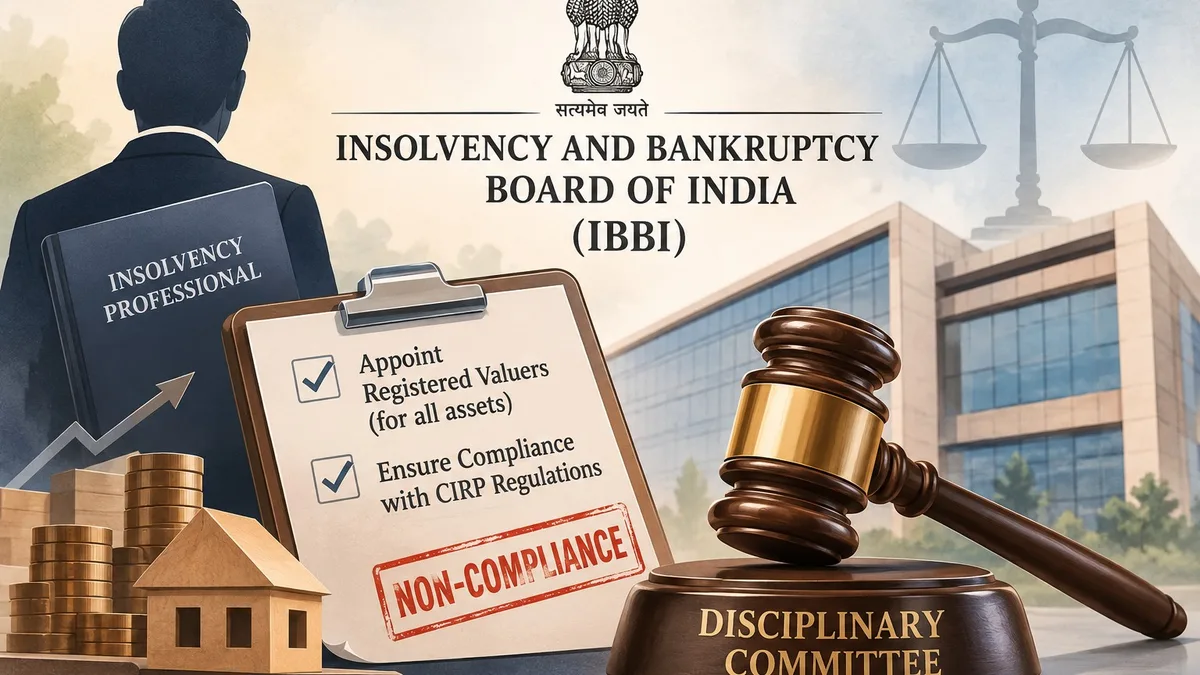
The Insolvency and Bankruptcy Board of India has suspended insolvency professional P.R. Raman’s registration for two years after finding multiple failures in the corporate insolvency resolution process of Hallmark Infrastructure Private Limited. The order also makes him ineligible to continue his existing assignments, with the relevant committees of creditors required to replace him after the suspension takes effect.
Key Highlights :
- The disciplinary order is IBBI/DC/350/2026 dated 03 November 2026.
- The proceedings concerned P.R. Raman’s conduct as resolution professional in the CIRP of Hallmark Infrastructure Private Limited, which commenced on 23 August 2024.
- IBBI found that registered valuers were not appointed for the asset class Securities or Financial Assets, despite such assets appearing in the company’s financial statements and homebuyers seeking valuation.
- The RP did not make the required determination concerning avoidance transactions within the prescribed timeline, did not file Form CIRP 8 and directed the write-off of diamonds worth about ₹8 crore without examining whether the loss arose from a transaction covered by the Code.
- Form G was published on 31 December 2024, around 70 days after the stated due date of 22 October 2024.
- An expression of interest received on 04 February 2025, after the 15 January 2025 deadline, was treated as a substitution and placed before the CoC without explaining Regulation 36A(6).
Background :
- The CIRP of Hallmark Infrastructure Private Limited began by an order of the NCLT, Chennai Bench, dated 23 August 2024 on an application by Bank of India under Section 7 of the Insolvency and Bankruptcy Code, 2016. P.R. Raman was appointed IRP and later confirmed as RP.
- IBBI received a complaint from the authorised representative of the homebuyers concerning the RP’s conduct. After considering the RP’s replies, IBBI issued the show cause notice on 21 November 2025.
- The disciplinary inquiry examined failures relating to valuation, avoidance transactions, publication of Form G and the handling of a late expression of interest.
What Has Changed :
- Issue: Whether the RP discharged his statutory and regulatory duties in the CIRP, particularly in relation to valuation, avoidance transactions, timelines and the treatment of a late expression of interest.
- Finding: The RP failed to appoint registered valuers for the Securities or Financial Assets class and failed to facilitate the required meeting for valuers to explain their methodology to the CoC before estimates were computed.
- Finding: The RP did not form an opinion or make a determination on avoidance transactions within the prescribed period, did not file Form CIRP 8 and directed the write-off of diamonds worth about ₹8 crore without examining whether the loss arose from a potentially avoidable transaction.
- Finding: Form G was published on 31 December 2024 despite the due date being 22 October 2024. The delay was approximately 70 days.
- Finding: The RP treated an expression of interest received on 04 February 2025, after the 15 January 2025 deadline, as a substitution and placed it before the CoC without drawing attention to the statutory requirement in Regulation 36A(6). The Committee held that the MSME-related relaxation under Section 240A did not relax the timelines under Regulation 36A.
- Outcome: The IBBI Disciplinary Committee found contraventions of Section 208(2)(a) and (e) of the IBC; specified provisions of the CIRP Regulations, including Regulations 27(1), 35(1), 35A, 36A(1), 36A(6), 40A and 40B; and Regulation 7(2)(a) and (h) of the IP Regulations read with Clauses 11, 13 and 14 of the Code of Conduct. It suspended the registration for two years under Section 220 of the Code read with Regulation 13 of the Inspection and Investigation Regulations, 2017.
Who Is Affected :
- P.R. Raman, whose registration is suspended for two years and who cannot continue his existing assignments.
- Committees of creditors of corporate debtors for whom the insolvency professional is currently engaged; they must replace him with another RP or liquidator.
- Insolvency professionals handling valuation, avoidance transactions, public announcements and expressions of interest during CIRP.
- Homebuyers and other creditors who rely on transparent valuation and proper conduct of the resolution process.
Compliance Action Points :
- IBBI suspension → the two-year suspension becomes operative after 30 days from 03 November 2026.
- Existing assignments → the concerned insolvency professional is ineligible to continue; the relevant CoCs must replace him with another resolution professional or liquidator.
- Communication → the order is to be sent to the CoCs, the ICSI Institute of Insolvency Professionals and the Registrar of the NCLT Principal Bench.
Analysis & Impact :
- For CA / CS / Tax & Legal Professionals: Review CIRP calendars and maintain evidence of timely valuation appointments, CoC valuation presentations, avoidance-transaction reviews, Form CIRP 8 filings, Form G publication and EoI cut-off compliance. Section 240A’s MSME relief should not be assumed to relax Regulation 36A timelines.
- For Businesses & Investors: The order may affect continuity of ongoing CIRP assignments because the concerned CoCs must appoint replacements. It also highlights the importance of complete asset-class valuation and timely identification of potentially avoidable transactions.
- For News Readers: The insolvency regulator has imposed a two-year professional suspension after identifying several lapses in the handling of a real-estate company’s insolvency process.
- Points to Watch: The suspension starts only after the 30-day period specified in the order. The order also directs the relevant CoCs to replace the RP; implementation across his existing assignments is the immediate follow-up.
References :
- Insolvency and Bankruptcy Code, 2016 – Section 7: initiation of CIRP by a financial creditor.
- Insolvency and Bankruptcy Code, 2016 – Sections 208(2)(a) and (e): duties of insolvency professionals to take reasonable care and diligence and comply with applicable requirements.
- Insolvency and Bankruptcy Code, 2016 – Section 220: disciplinary action by IBBI.
- Insolvency and Bankruptcy Code, 2016 – Section 240A: specified relaxations for MSMEs; the order clarifies that this does not relax Regulation 36A timelines.
- IBBI (CIRP) Regulations, 2016 – Regulations 27(1), 35(1), 35A, 36A(1), 36A(6), 40A and 40B: valuation, avoidance transactions, invitation for expressions of interest and prescribed timelines / filings.
- IBBI (Insolvency Professionals) Regulations, 2016 – Regulation 7(2)(a) and (h), read with the Code of Conduct in the First Schedule.
- IBBI (Inspection and Investigation) Regulations, 2017 – Regulation 13: disciplinary process referred to in the order.
Source & Attribution :
IBBI Disciplinary Committee, Order No. IBBI/DC/350/2026 dated 03 November 2026, concerning P.R. Raman and the CIRP of Hallmark Infrastructure Private Limited. The uploaded order is the primary source.
Disclaimer: This summary is an editorial aid prepared from the uploaded source document. It is not legal, tax or investment advice. Refer to the original order or judgment before acting.
Full Judgement / Attachment
Full Judgement
Frequently asked questions about Insolvency & Bankruptcy Board
- What is the IBBI?
- The Insolvency and Bankruptcy Board of India, set up on 1 October 2016 under the Insolvency and Bankruptcy Code, 2016 (IBC), regulates insolvency professionals, insolvency professional agencies, information utilities and registered valuers. It also frames the regulations for insolvency processes.
- When can insolvency be started against a company?
- A financial creditor, an operational creditor or the company itself can apply to the National Company Law Tribunal (NCLT) once there is a default of at least ₹1 crore. On admission, a moratorium starts and an interim resolution professional takes charge.
- How long does the corporate insolvency process take?
- The Code provides 180 days for the corporate insolvency resolution process (CIRP), extendable up to an overall limit of 330 days, including time spent in litigation. In practice, many cases take longer. The IBC (Amendment) Act, 2026, largely in force from 26 May 2026, requires the NCLT to decide admission applications within 14 days and to record reasons for any delay.
- Where can an NCLT insolvency order be appealed?
- An appeal lies to the National Company Law Appellate Tribunal (NCLAT) within 30 days, extendable by up to 15 days for sufficient cause. A further appeal lies to the Supreme Court on a question of law.
- How can White Collar Professional help with a insolvency matter?
- Post your requirement on White Collar Professional to receive proposals from verified Insolvency Professionals, Chartered Accountants and Advocates, compare them, and pay securely through the platform. This page also tracks the latest insolvency IBC and IBBI updates as they are reported.