IBBI Strengthens Insolvency Rules for Real Estate Projects
Court / Authority
Insolvency & Bankruptcy Board
Update / Judgement Date
31 Oct 2026
Source
WCP News Bulletin
Author
Dipanshi Bansal — WCP Legal Desk
Reading Time
3 min read
View Count
1
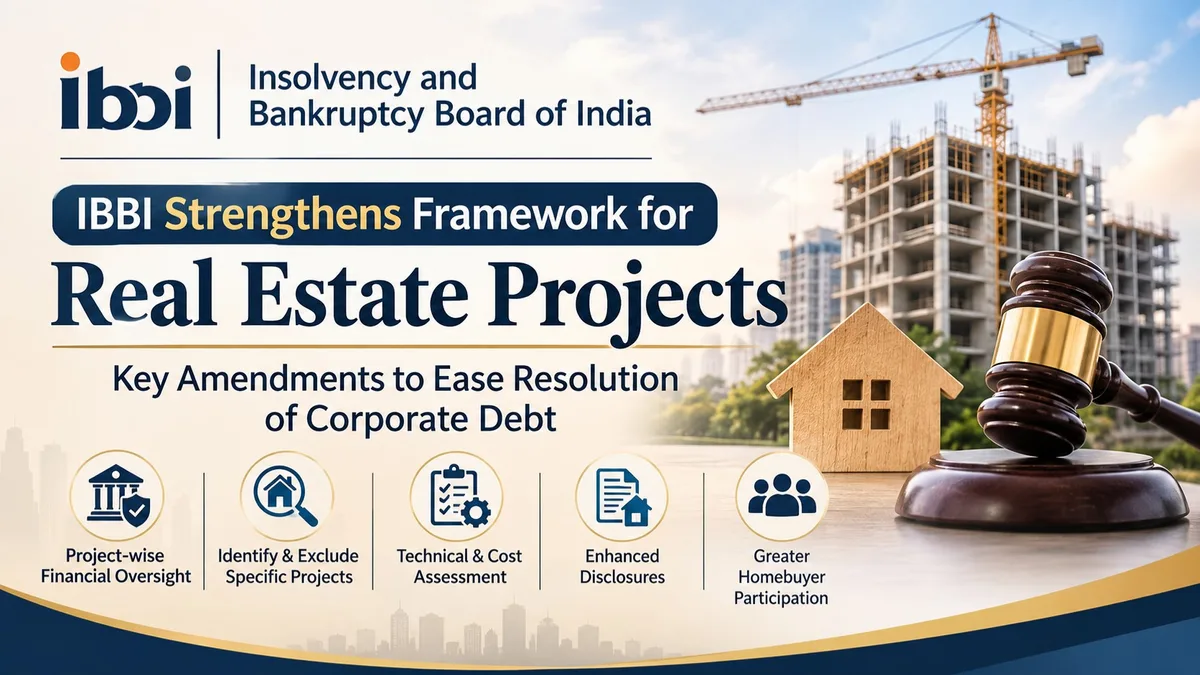
IBBI has notified the Insolvency and Bankruptcy Board of India (Insolvency Resolution Process for Corporate Persons) (Fifth Amendment) Regulations, 2026 to make insolvency resolution of real estate projects more transparent and project-specific. The changes focus particularly on protecting homebuyers, improving financial monitoring and making resolution plans more realistic.
Key Highlights
- A separate bank account must be maintained for each real estate project of a corporate debtor. Project-wise receipts, payments and other financial information must also be placed before the Committee of Creditors (CoC).
- Where a corporate debtor has multiple projects, the CoC can, with at least 66% voting share, recommend exclusion of a particular project from CIRP, subject to the Adjudicating Authority's decision.
- Before inviting expressions of interest, an independent professional must undertake a technical and cost-to-complete assessment covering construction status, approvals, inventory, completion costs, funding needs, timelines and risks.
- The Information Memorandum must provide detailed project-wise disclosures, including construction progress, inventory, approvals, encumbrances, litigation, statutory dues, regulatory proceedings and RERA bank-account balances.
- Homebuyers get greater representation through authorised representatives. Their profiles, roles and meeting minutes must be disclosed, and their views must be recorded in CoC proceedings.
- Monitoring committees implementing resolution plans may include representatives of homebuyers, RERA authorities and competent authorities, subject to the required agreement
- Resolution plans must contain project-wise completion and possession timelines and specify how different categories of homebuyer claims will be dealt with.
- The CoC may give an in-principle approval for handing over possession, allowing the RP to process eligible homebuyer requests without seeking separate approval each time.
- The RP must continue performing CIRP responsibilities until the Adjudicating Authority decides a withdrawal application under Section 12A. Confidentiality has also been extended to valuation reports.
Who Is Affected
The changes primarily affect corporate debtors with real estate projects, resolution professionals, CoCs, prospective resolution applicants, homebuyers/allottees and regulatory authorities involved in the CIRP.
Compliance Action Points
- Maintain separate bank accounts for individual real estate projects
- Ensure project funds are used in accordance with RERA requirements.
- Provide project-wise financial and construction information to the CoC.
- Arrange the required technical and cost-to-complete assessment before inviting expressions of interest.
- Include the expanded project-wise disclosures in the Information Memorandum.
- Ensure resolution plans contain project-specific treatment of homebuyer claims and completion timelines.
Analysis & Impact
- For Legal/Compliance Professionals: The amendment makes project-level documentation, fund tracking and homebuyer claims central to real estate CIRP.
- For Real Estate Businesses: Developers undergoing insolvency will face greater project-wise reporting and monitoring requirements.
- For Homebuyers: The changes provide stronger visibility into project finances, completion timelines and treatment of their claims.
- For News Readers: The practical shift is from treating a real estate developer's insolvency broadly to dealing with individual projects based on their financial and completion status.
References
- Insolvency and Bankruptcy Board of India (Insolvency Resolution Process for Corporate Persons) (Fifth Amendment) Regulations, 2026.
- IBBI Press Release No. IBBI/PR/2026/18, dated 31 October 2026.
Source & Attribution
Primary Source: Insolvency and Bankruptcy Board of India, Press Release No. IBBI/PR/2026/18, 31 October 2026. The source states that the amended regulations are available on the IBBI website.
Disclaimer: This summary is an editorial aid prepared from publicly available information. It is not legal, tax or investment advice. Refer to the original notification before acting.
Full Judgement / Attachment
Full Judgement
Frequently asked questions about Insolvency & Bankruptcy Board
- What is the IBBI?
- The Insolvency and Bankruptcy Board of India, set up on 1 October 2016 under the Insolvency and Bankruptcy Code, 2016 (IBC), regulates insolvency professionals, insolvency professional agencies, information utilities and registered valuers. It also frames the regulations for insolvency processes.
- When can insolvency be started against a company?
- A financial creditor, an operational creditor or the company itself can apply to the National Company Law Tribunal (NCLT) once there is a default of at least ₹1 crore. On admission, a moratorium starts and an interim resolution professional takes charge.
- How long does the corporate insolvency process take?
- The Code provides 180 days for the corporate insolvency resolution process (CIRP), extendable up to an overall limit of 330 days, including time spent in litigation. In practice, many cases take longer. The IBC (Amendment) Act, 2026, largely in force from 26 May 2026, requires the NCLT to decide admission applications within 14 days and to record reasons for any delay.
- Where can an NCLT insolvency order be appealed?
- An appeal lies to the National Company Law Appellate Tribunal (NCLAT) within 30 days, extendable by up to 15 days for sufficient cause. A further appeal lies to the Supreme Court on a question of law.
- How can White Collar Professional help with a insolvency matter?
- Post your requirement on White Collar Professional to receive proposals from verified Insolvency Professionals, Chartered Accountants and Advocates, compare them, and pay securely through the platform. This page also tracks the latest insolvency IBC and IBBI updates as they are reported.