IP's Replies to Complaints Are Held in Trust: IBBI Appellate Authority Refuses RTI Access to Complaints and Show-Cause Notices Against Two Insolvency Professionals
Court / Authority
Insolvency & Bankruptcy Board
Update / Judgement Date
17 Nov 2026
Date of Publication
24 Nov 2026
Source
WCP News Bulletin
Author
Arshee Saifi — WCP Legal Desk
Reading Time
4 min read
View Count
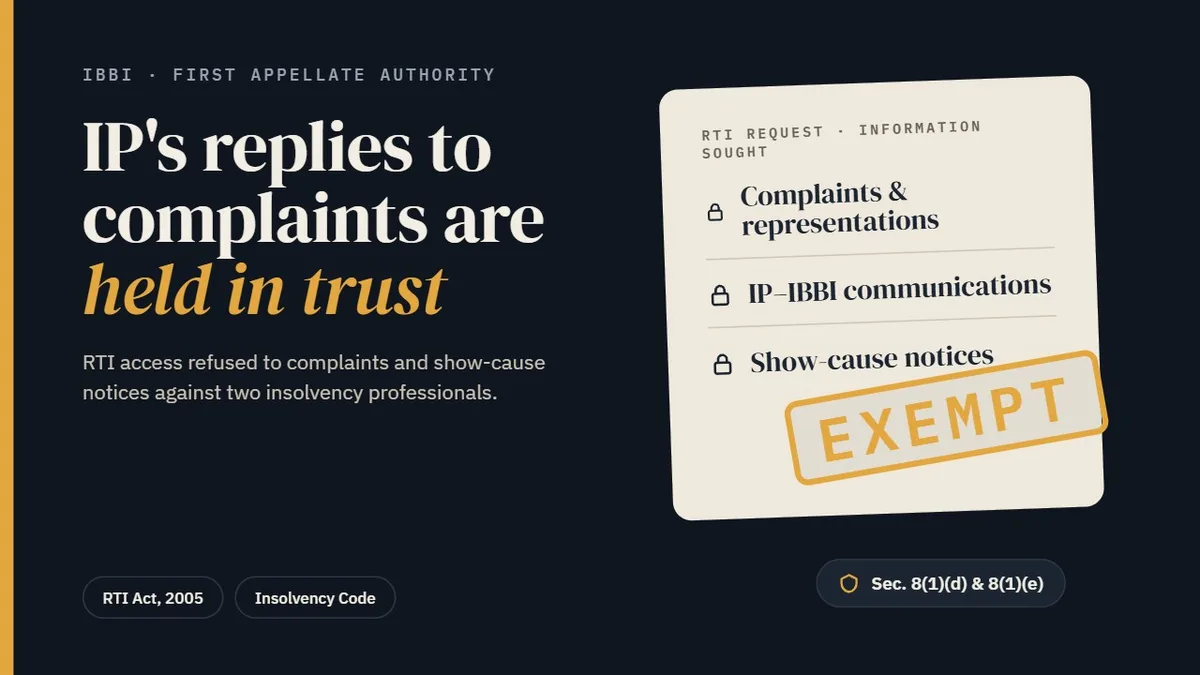
Key Proposition: Communications between an insolvency professional and IBBI on a complaint, including the IP's responses, are received by the regulator in a fiduciary relationship and may carry commercially sensitive details of the insolvency process, and are therefore exempt from disclosure under Sections 8(1)(d) and 8(1)(e) of the RTI Act.
Background / Synopsis :
- The appellant's RTI application concerned the insolvency resolution process of M/s Revital Reality Pvt. Ltd. and two IPs, Shri Gaurav Katiyar and Shri Deepak Kumar Goyal (Para 2).
- The IBBI Disciplinary Committee had passed orders on 20.08.2026 in IBBI/DC/340/2026 and IBBI/DC/341/2026 (Para 3).
- The CPIO replied on 25.09.2026; the appeal was filed on 20.10.2026 (Paras 1–2).
Issues For Consideration :
- Whether complaints, representations, IP–IBBI communications and show-cause notices in disciplinary proceedings are exempt from disclosure under the RTI Act (Paras 2, 4).
Submissions Of Parties :
- Appellant:
Sought the complaints and representations, IP–IBBI communications and the show-cause notices issued to the two IPs (Para 2).
- CPIO, IBBI:
The material is third-party information held in a fiduciary capacity, exempt under Section 8(1)(e) (Para 1, second series).
Court's Observations & Analysis :
- Re: Exemption
An identical appeal (ISBBI/A/E/26/00057) was disposed of the same day (Para 3).
Disclosure of IP–IBBI communications on a complaint could harm commercial transactions in the insolvency process or the persons connected with it – Section 8(1)(d) (Para 4).
IBBI receives IPs' responses to complaints in a fiduciary relationship governed by the Code – Section 8(1)(e) (Para 4).
Held: The CPIO's reply does not merit interference. (Para 5)
Notable Observations:
"…IBBI being the regulatory authority for IPs, receives their responses to complaints received against them under a fiduciary relationship governed by the Code." (Para 4)
Decision & Directions :
- CPIO's reply upheld; appeal disposed of. (Paras 5–6)
- Points to note: the order adds Section 8(1)(d), which the CPIO had not invoked; it does not deal separately with the show-cause notices themselves (issued by IBBI, not received from the IPs), nor with whether the Disciplinary Committee's orders of 20.08.2026 are already public; no larger-public-interest test under Section 8(2) is recorded.
- Record notes: paragraph numbering restarts – the paragraphs after 2 are numbered 1, 2, 3 …; the order does not record a hearing.
Legal Provisions Discussed & Precedents Cited :
- Right to Information Act, 2005 – Sections 2(f), 2(j), 3, 8(1)(d), 8(1)(e), 19.
- Insolvency and Bankruptcy Code, 2016 (regulatory relationship between IBBI and IPs).
- IBBI FAA order in Appeal No. ISBBI/A/E/26/00057, 17.11.2026 – identical facts, followed.
Case Details :
- Case / Party Name: Anuj Mohan Arora v. Central Public Information Officer, Insolvency and Bankruptcy Board of India
- Case Number(s): RTI Appeal No. ISBBI/A/E/26/00058 – order under Section 19, Right to Information Act, 2005
- Coram / Judges: Shri Shiv Anant Shanker – First Appellate Authority, IBBI
- Counsel Appearances: Not recorded (decided on the material on record).
Disclaimer: This summary is an editorial aid and does not form part of the judgment. Refer to the original judgment before citing.
Full Judgement / Attachment
Full Judgement
Frequently asked questions about Insolvency & Bankruptcy Board
- What is the IBBI?
- The Insolvency and Bankruptcy Board of India, set up on 1 October 2016 under the Insolvency and Bankruptcy Code, 2016 (IBC), regulates insolvency professionals, insolvency professional agencies, information utilities and registered valuers. It also frames the regulations for insolvency processes.
- When can insolvency be started against a company?
- A financial creditor, an operational creditor or the company itself can apply to the National Company Law Tribunal (NCLT) once there is a default of at least ₹1 crore. On admission, a moratorium starts and an interim resolution professional takes charge.
- How long does the corporate insolvency process take?
- The Code provides 180 days for the corporate insolvency resolution process (CIRP), extendable up to an overall limit of 330 days, including time spent in litigation. In practice, many cases take longer. The IBC (Amendment) Act, 2026, largely in force from 26 May 2026, requires the NCLT to decide admission applications within 14 days and to record reasons for any delay.
- Where can an NCLT insolvency order be appealed?
- An appeal lies to the National Company Law Appellate Tribunal (NCLAT) within 30 days, extendable by up to 15 days for sufficient cause. A further appeal lies to the Supreme Court on a question of law.
- How can White Collar Professional help with a insolvency matter?
- Post your requirement on White Collar Professional to receive proposals from verified Insolvency Professionals, Chartered Accountants and Advocates, compare them, and pay securely through the platform. This page also tracks the latest insolvency IBC and IBBI updates as they are reported.