NCLT Allahabad Approves Adani Enterprises’ Resolution Plan for Jaiprakash Associates with 93.81% CoC Vote
Court / Authority
Insolvency & Bankruptcy Board
Update / Judgement Date
19 Aug 2026
Source
Author
Manas Yadav — WCP Legal Desk
Reading Time
3 min read
View Count
Key Facts and Tribunal Findings
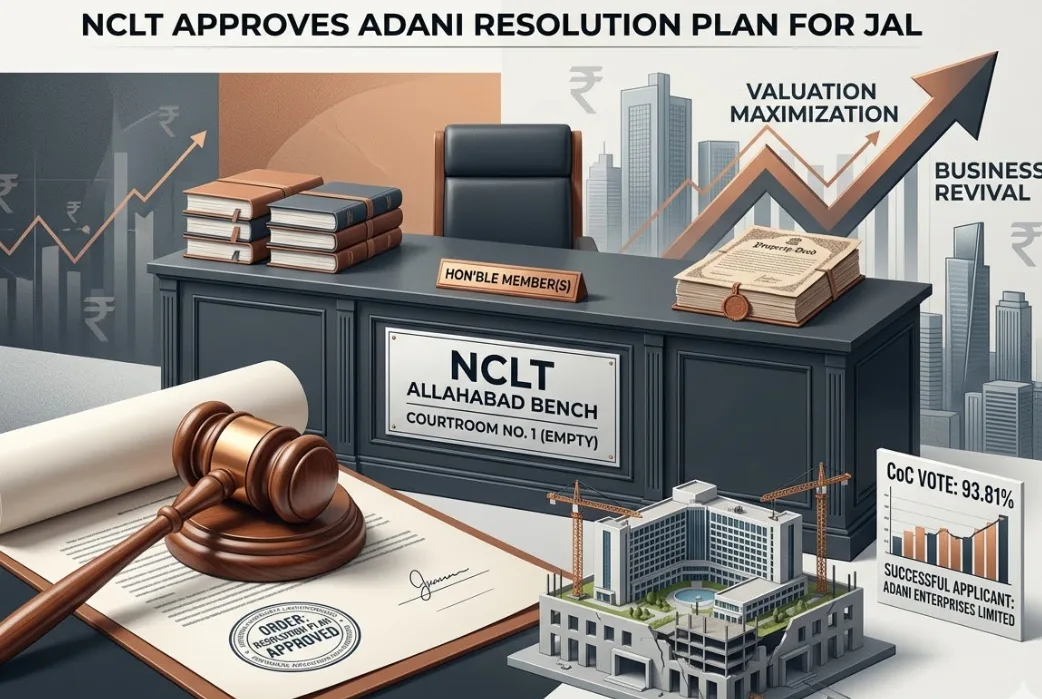
The National Company Law Tribunal (NCLT), Allahabad Bench, approved the resolution plan submitted by Adani Enterprises Limited for Jaiprakash Associates Limited (JAL) under Sections 30(6) and 31(1) of the Insolvency and Bankruptcy Code, 2016. The plan had been approved by the Committee of Creditors (CoC) with a 93.81% voting share. The Corporate Insolvency Resolution Process (CIRP) against JAL was initiated on 3 June 2024 following admission of an application filed by ICICI Bank under Section 7 of the Code. The Resolution Professional conducted the CIRP, including claims verification, constitution and reconstitution of the CoC, and invitation of expressions of interest through Form G.
A total of 25 prospective resolution applicants were shortlisted, out of which six entities submitted resolution plans. After evaluation and elimination of non-compliant bids, five plans were considered. A structured challenge process was conducted to maximise value, involving multiple bidding rounds based on net present value parameters. Following evaluation under the prescribed matrix and detailed deliberations on feasibility and viability, the CoC selected Adani Enterprises Limited as the successful resolution applicant. The plan received the highest score (89.76) among competing bids and was subsequently approved through e-voting.
The Tribunal noted that the resolution plan complied with statutory requirements, including eligibility under Section 29A, as verified through an independent due diligence process. It also recorded that all procedural steps under the CIRP framework—including issuance of the Information Memorandum, Request for Resolution Plan, evaluation process, and CoC deliberations—were duly followed. Financially, the approved plan provides for a total resolution value exceeding ₹1.53 lakh crore, including payments to financial creditors, operational creditors, employees, and other stakeholders, along with capital infusion for business revival. The Tribunal further observed that the CIRP timeline, including extensions and exclusions granted during the process, remained within the permissible statutory framework. Accordingly, the application for approval of the resolution plan was held to be valid and within limitation.
Legal Analysis
The Tribunal reaffirmed the centrality of the “commercial wisdom” of the CoC in approving resolution plans, emphasizing that judicial intervention is limited to ensuring compliance with the provisions of the Code. It noted that the evaluation of feasibility, viability, and distribution mechanism among stakeholders falls within the exclusive domain of the CoC, provided statutory safeguards under Section 30(2) are satisfied. The approval of the plan with an overwhelming majority was treated as a decisive factor.
The order also underscores the legal validity of structured bidding mechanisms such as challenge processes, provided they are conducted transparently and in accordance with the CIRP Regulations. On eligibility, the Tribunal accepted the findings of independent verification under Section 29A, reinforcing that due diligence and disclosure-based compliance are critical in resolution proceedings. Further, the decision highlights that post-submission modifications to resolution plans, particularly after closure of the bidding process, are impermissible where contrary to the process framework approved by the CoC.
Overall, the ruling affirms procedural rigor, creditor primacy, and structured resolution mechanisms as key pillars of the insolvency framework under the IBC.
Full Judgement / Attachment
Full Judgement
Frequently asked questions about Insolvency & Bankruptcy Board
- What is the IBBI?
- The Insolvency and Bankruptcy Board of India, set up on 1 October 2016 under the Insolvency and Bankruptcy Code, 2016 (IBC), regulates insolvency professionals, insolvency professional agencies, information utilities and registered valuers. It also frames the regulations for insolvency processes.
- When can insolvency be started against a company?
- A financial creditor, an operational creditor or the company itself can apply to the National Company Law Tribunal (NCLT) once there is a default of at least ₹1 crore. On admission, a moratorium starts and an interim resolution professional takes charge.
- How long does the corporate insolvency process take?
- The Code provides 180 days for the corporate insolvency resolution process (CIRP), extendable up to an overall limit of 330 days, including time spent in litigation. In practice, many cases take longer. The IBC (Amendment) Act, 2026, largely in force from 26 May 2026, requires the NCLT to decide admission applications within 14 days and to record reasons for any delay.
- Where can an NCLT insolvency order be appealed?
- An appeal lies to the National Company Law Appellate Tribunal (NCLAT) within 30 days, extendable by up to 15 days for sufficient cause. A further appeal lies to the Supreme Court on a question of law.
- How can White Collar Professional help with a insolvency matter?
- Post your requirement on White Collar Professional to receive proposals from verified Insolvency Professionals, Chartered Accountants and Advocates, compare them, and pay securely through the platform. This page also tracks the latest insolvency IBC and IBBI updates as they are reported.