Quashing of Criminal Proceedings Against Teacher for Alleged Corporal Punishment
Court / Authority
Kerala High Court
Update / Judgement Date
09 Oct 2026
Date of Publication
15 Oct 2026
Case No.
CRL.MC NO. 9888 OF 2024
Source
WCP News Bulletin
Author
Pranjal Jha — WCP Legal Desk
Reading Time
3 min read
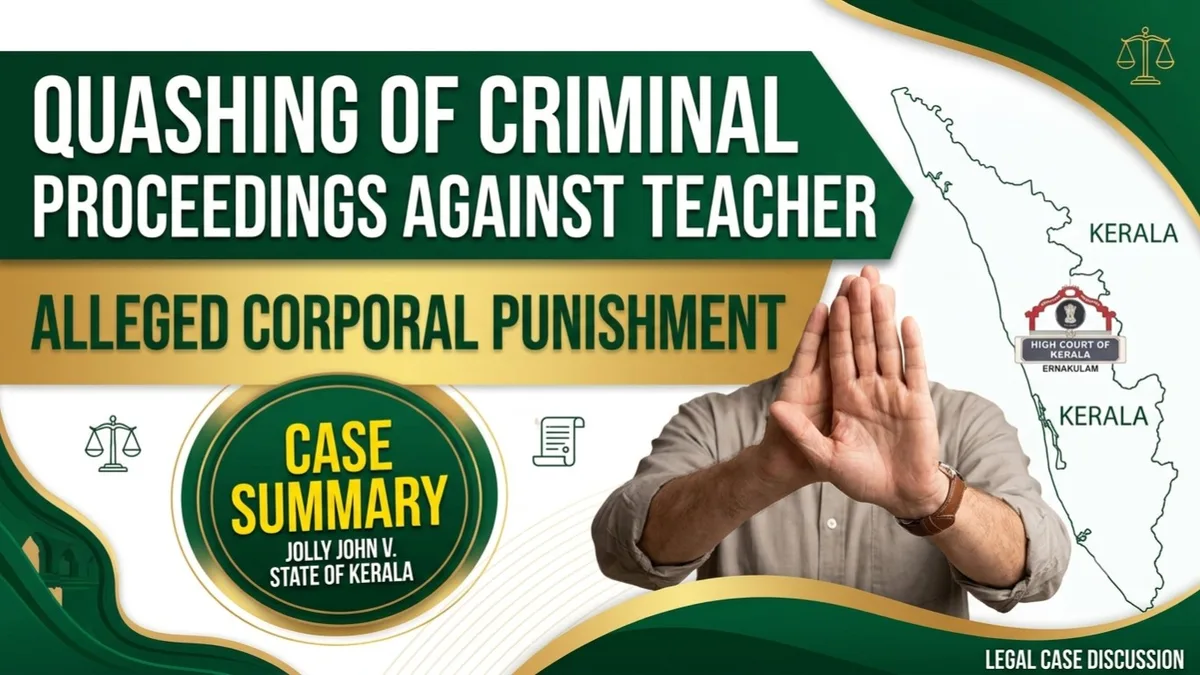
- Case / Party Name: Jolly John v. State of Kerala
- Court Name: High Court of Kerala at Ernakulam
- Case Number(s): CRL.MC NO. 9888 OF 2024
- Citation: 2026:KER:78515
- Coram / Judges: Jobin Sebastian – Single Judge
- Judgment Authored By: Jobin Sebastian
- Date of Decision: 09 October 2026
- Nature of Proceedings: Criminal Miscellaneous Case
- Letters Patent / Appeals (if any): None
- Counsel Appearances: Sri. Gopakumar R. Thaliyat, Sri. R.B. Balachandran, Shri. Sandeep V. for the Petitioner; Sri. Navas V.A., Sr. PP for the Respondent
- Outcome: Allowed
B. Headnote
Key Proposition: A teacher cannot be criminally prosecuted for trivial corporal punishment exercised without malafide intent in a school setting.
Catchwords:
- Juvenile Justice Act – Section 82 – Corporal punishment in schools – Whether trivial punishment amounts to an offence? – Held, no.
- Indian Penal Code – Section 323 – Criminal Intention – Whether malpractice evident? – Held, no.
Headnote: The petitioner, Jolly John, a school teacher, sought to quash proceedings alleging corporal punishment against a student. The court observed that the teacher had acted without any criminal intention while trying to maintain discipline. It held that the allegations did not meet the criteria for prosecution under relevant laws (Paras 11).
C. Background / Synopsis
- Jolly John, a teacher at MGM School, Thiruvalla, was accused of hurting a student.
- The incident occurred on 06 December 2018; the crime was registered on 16 January 2019.
- Allegations pertained to committing offences under the Juvenile Justice Act and IPC.
- The sought relief was to quash the final report and proceedings against her.
D. Issues For Consideration
- Whether the petitioner can be prosecuted for the alleged corporal punishment in maintaining classroom discipline?
- Whether the actions of the petitioner constitute an offence under the Juvenile Justice Act or IPC?
E. Submissions Of Parties
Petitioner / Appellant:
- The petitioner was maintaining discipline and acted without any intention to harm the student.
- Delay in registering the case and minor nature of injuries were highlighted.
Respondent / State:
- The state maintained that the teacher inflicted corporal punishment that caused injury to the student.
F. Court's Observations & Analysis
Re: Issue (i) – Criminal Prosecution of Teachers
- A teacher's role includes discipline; however, it must be exercised without harm.
- Minor corrective actions should not result in criminal prosecution.
- Held: The allegations do not indicate malafide intention (Para 11).
- The materials collected did not substantiate claims of corporal punishment with injury.
- The court found no evidence of criminal intention.
Notable Observations: "If teachers are subjected to criminal prosecution under the Juvenile Justice Act for implementing simple and minimal corrective measures to preserve institutional discipline, the very administration and orderly functioning of educational institutions would be jeopardised." (Para 9)
G. Decision & Directions
- The final report in Crime No. 158/2019 and all further proceedings in S.C. No. 657/2024 are quashed.
H. Legal Provisions Discussed
- Juvenile Justice (Care and Protection of Children) Act, 2015 – Section 82 – Applicable to corporal punishment in educational settings.
- Indian Penal Code – Section 323 – Relates to causing voluntary hurt.
Full Judgement / Attachment
Full Judgement
Frequently asked questions about Kerala High Court
- Where does the Kerala High Court sit and which areas does it cover?
- The Kerala High Court sits at Ernakulam, Kochi. It has jurisdiction over the State of Kerala and the Union Territory of Lakshadweep. It was established on 1 November 1956, when the State of Kerala was formed.
- How do I check Kerala High Court case status and judgements?
- The official website, highcourt.kerala.gov.in, provides case status, cause lists, e-filing and judgements. The court has moved most filing and records to digital form. Orders are also on the eCourts High Court Services portal (hcservices.ecourts.gov.in).
- What kinds of cases does the Kerala High Court hear?
- It hears writs, civil and criminal appeals from Kerala and Lakshadweep, and income-tax appeals arising from the ITAT Cochin Bench on substantial questions of law.
- What is a Writ Appeal in the Kerala High Court?
- Under Section 5 of the Kerala High Court Act, 1958, a judgement of a single judge in certain matters, including writ petitions, can be appealed to a Division Bench. A final judgement can be challenged by a Special Leave Petition under Article 136, ordinarily within 90 days.
- How can White Collar Professional help with a Kerala High Court matter?
- Post your requirement on White Collar Professional to receive proposals from verified Advocates, Chartered Accountants and Company Secretaries, compare them, and pay securely through the platform. This page also tracks the latest Kerala High Court judgements and legal updates as they are reported.