← back
InformativeMadras High Court
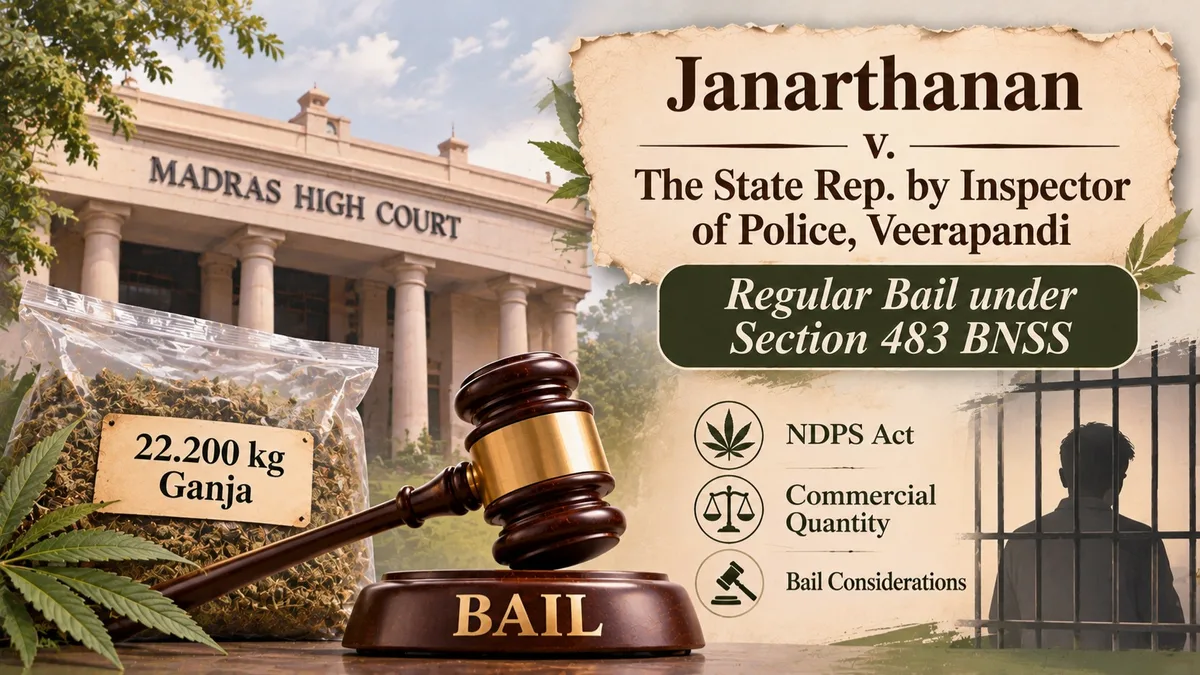
Bail Granted to NDPS Accused A2 and A6 by Applying Supreme Court’s Reasoning on Non-Apportionment of Commercial Quantity and Delayed Trial
Court / Authority
Madras High Court
Update / Judgement Date
10 Nov 2026
Date of Publication
12 Nov 2026
Case No.
CRL OP No. 28632 of 2026
Source
WCP News Bulletin
Author
Dipanshi Bansal — WCP Legal Desk
Reading Time
8 min read
View Count
Criminal Law
Key Proposition: Where the prosecution case involves multiple accused and a large quantity of contraband, but the seized quantity has not been apportioned amongst the individual accused to determine the commercial-quantity threshold qua each accused, and the trial is unlikely to conclude expeditiously, the court may apply the Supreme Court’s corresponding bail reasoning and grant regular bail, subject to appropriate safeguards.
- Narcotic Drugs and Psychotropic Substances Act, 1985 – Sections 8(c), 20(b)(ii)(C), 25 and 29(1) – transportation/possession of ganja, liability and common involvement – Whether regular bail could be granted to A2 and A6 in the circumstances of the case – Held, yes, by applying the Supreme Court’s reasoning in Gupta Charansahu. (Paras 1–4)
- Commercial quantity – 120 kg ganja seized from a case involving ten accused – absence of apportionment of the contraband amongst accused – Whether the absence of individual apportionment was relevant to the bail consideration – Held, yes. (Para 3)
- Length of trial – 15 prosecution witnesses proposed – whether absence of reasonable prospect of early conclusion of trial supported release on bail – Held, yes. (Para 3)
Background / Synopsis :
- The prosecution alleged that on 1 April 2025 at about 9:05 p.m., police personnel received secret information concerning the illegal transportation of narcotic substances.
- The police proceeded to the area near SSS College Junction on the Bangalore–Chennai Highway, where A3 was allegedly found standing suspiciously and was apprehended.
- During the investigation, the police allegedly learnt that A2, A4 and A9 were also coming to the location. The police intercepted the accused along with a Maruti Suzuki Swift car bearing registration No. OR 02 AL 0021 and conducted a seizure in the presence of witnesses.
- A4 and A9 allegedly escaped from the spot, while A1 to A3 were arrested.
- According to the prosecution, A1 and A2 disclosed that they had purchased the contraband in Odisha and were selling it for personal gain.
- Crime No. 171 of 2025 was consequently registered for offences under Sections 8(c) read with 20(b)(ii)(C), 25 and 29(1) of the NDPS Act.
- The present petitioners were A2 and A6 and sought regular bail under Section 483 BNSS.
- The petitioners relied principally upon the Supreme Court's order in Gupta Charansahu v. State of Tamil Nadu, Special Leave Petition (Criminal) No. 16726 of 2026, dated 3 November 2026, in which bail had been granted in circumstances concerning the same broad issue of non-apportionment of seized contraband and the likely delay in trial.
Issues For Consideration :
- Whether the petitioners, A2 and A6, were entitled to regular bail in Crime No. 171 of 2025 despite the offences alleged under the NDPS Act.
- Whether the reasoning adopted by the Supreme Court in Gupta Charansahu v. State of Tamil Nadu regarding non-apportionment of contraband and the likelihood of delay in trial could be applied to the present petitioners.
Submissions Of Parties :
Petitioners:
- The petitioners sought regular bail under Section 483 BNSS.
- They relied upon the Supreme Court's order in Gupta Charansahu v. State of Tamil Nadu, Special Leave Petition (Criminal) No. 16726 of 2026.
- It was specifically brought to the Court's attention that the Supreme Court had released the concerned accused on bail on 3 November 2026.
- The petitioners contended, in substance, that the reasoning adopted by the Supreme Court was applicable to their position as A2 and A6.
Respondent / State:
- The State was represented by the Government Advocate (Criminal Side).
- The judgment records the prosecution's factual case concerning the secret information, interception of the accused, seizure of the vehicle and contraband, the alleged disclosures of A1 and A2, and registration of the NDPS case.
- The order does not record any detailed separate counter-submissions by the State specifically opposing the petitioners' bail request beyond the prosecution case and circumstances referred to in the Supreme Court order.
Court's Observations & Analysis :
Re: Applicability of the Supreme Court's bail reasoning
- The High Court considered the Supreme Court's order in Gupta Charansahu v. State of Tamil Nadu.
- In the Supreme Court matter, there were 10 accused persons and 120 kg of ganja.
- The Supreme Court had noted that the contraband had not been apportioned amongst the accused for determining the commercial-quantity threshold qua each accused, which was stated to be 50 kg of ganja.
- The Supreme Court had also noted that there were 15 prosecution witnesses and consequently no reasonable prospect of an early conclusion of the trial.
- The Madras High Court expressly held that the principle emerging from those circumstances was applicable to the present petitioners, who were arrayed as A2 and A6.
- Held: The circumstances considered in the Supreme Court's order were sufficiently applicable to the present petitioners to justify the grant of regular bail.
Re: Length of custody and prospect of trial
- The Court took into account the prosecution's case involving multiple accused and the substantial quantity of seized ganja.
- The consideration that the trial was not likely to conclude at an early stage was relevant to the bail decision.
- The order therefore treated the absence of an early trial, together with the non-apportionment issue, as material circumstances supporting release on bail.
- Held: The petitioners were entitled to regular bail, subject to conditions designed to ensure their availability during investigation and trial.
Notable Observations: None. The order does not contain a distinct broader obiter observation warranting inclusion as a notable judicial quotation.
Decision & Directions :
- The petitions were allowed and regular bail was granted to the petitioners.
- Each petitioner was directed to execute a bond for ₹25,000 with two sureties for a like sum, to the satisfaction of the Special Judge for EC & NDPS, Salem.
- The sureties were required to affix their photographs and left-thumb impressions in the prescribed surety application, and the Magistrate was directed to obtain identity proof to verify their identity.
- The petitioners were directed to report before the respondent police daily at 10:30 a.m. for 30 days, and thereafter whenever required for interrogation.
- They were prohibited from absconding during investigation or trial.
- They were prohibited from tampering with evidence or witnesses.
- In case of breach of the conditions, the Magistrate/Trial Court could pass appropriate orders in accordance with law, with the order referring to P.K. Shaji v. State of Kerala, [(2005) 13 SCC 283].
- If the accused subsequently absconded, the Court recorded that a fresh FIR could be registered under Section 269 of the Bharatiya Nyaya Sanhita (BNS).
- No separate or dissenting opinion was recorded.
Legal Provisions Discussed & Precedents Cited :
- Bharatiya Nagarik Suraksha Sanhita, 2023 – Section 483: The provision under which the petitioners invoked the High Court's jurisdiction for regular bail.
- Narcotic Drugs and Psychotropic Substances Act, 1985 – Section 8(c): Invoked in relation to the alleged prohibited activity involving narcotic substances.
- NDPS Act – Section 20(b)(ii)(C): Applied in relation to the alleged offence concerning cannabis/ganja involving the commercial-quantity category.
- NDPS Act – Section 25: Included among the offences registered in Crime No. 171 of 2025.
- NDPS Act – Section 29(1): Included in the prosecution's allegations concerning involvement in the offences.
- Bharatiya Nyaya Sanhita, 2023 – Section 269: Referred to in the bail conditions concerning the consequences of subsequent abscondence.
- Gupta Charansahu v. State of Tamil Nadu, SLP (Criminal) No. 16726 of 2026: Relied upon. The High Court applied the Supreme Court's reasoning concerning non-apportionment of 120 kg of ganja among 10 accused and the absence of a reasonable prospect of early trial.
- P.K. Shaji v. State of Kerala, (2005) 13 SCC 283: Referred to for the consequence of breach of bail conditions and the power of the court to take appropriate action.
Case Details :
- Case / Party Name: Sudhir Alberia v. The State Rep. by the Inspector of Police & Relimajhi v. State rep. by the Inspector of Police
- Case Number(s): CRL OP No. 28632 of 2026 and Crl.O.P. No. 28617 of 2026; Crime No. 171 of 2025;
- Coram / Judges: Hon'ble Mr. Justice N. Ramesh – Single Judge. The order is authored by Justice N. Ramesh.
- Counsel Appearances: For Sudhir Alberia: Mr. S. Mohamed Abbas. For Relimajhi: Mr. S. Sudhanthiran. For the State: Mr. M.M.I. Khaleel, Government Advocate (Criminal Side).
Disclaimer: This summary is an editorial aid and does not form part of the judgment. Refer to the original judgment before citing.
Full Judgement / Attachment
Full Judgement
Frequently asked questions about Madras High Court
- Where does the Madras High Court sit and which areas does it cover?
- The Madras High Court has its principal seat in Chennai and a bench at Madurai. It has jurisdiction over Tamil Nadu and the Union Territory of Puducherry. Established in 1862, it is one of India's three oldest High Courts.
- Where can I find Madras High Court judgements and daily orders?
- Judgements and daily orders of both the principal seat at Chennai and the Madurai Bench are searchable on the court's judgements portal, mhc.tn.gov.in/judis. Case status is also on the eCourts High Court Services portal (hcservices.ecourts.gov.in).
- Which cases go to the Madurai Bench of the Madras High Court?
- The Madurai Bench, functioning since 2004, hears cases from the southern districts of Tamil Nadu, and the principal seat in Chennai hears the rest of the state and Puducherry. Chennai also has an Original Side for high-value suits and commercial cases, and hears tax appeals from the ITAT Chennai Bench.
- How is a single-judge order of the Madras High Court appealed?
- Writ orders of a single judge are challenged by a Writ Appeal under Clause 15 of the Letters Patent, and Original Side decisions by an Original Side Appeal (OSA), both before a Division Bench. A final judgement can be challenged by a Special Leave Petition under Article 136, ordinarily within 90 days.
- How can White Collar Professional help with a Madras High Court matter?
- Post your requirement on White Collar Professional to receive proposals from verified Advocates, Chartered Accountants and Company Secretaries, compare them, and pay securely through the platform. This page also tracks the latest Madras High Court judgements and legal updates as they are reported.