Twenty-Four Hours Run From Interception, Not Formal Arrest: Madras High Court Releases NCB Accused Produced 26 Hours After Detention, Applies Sujit Das to Pending Investigations
Court / Authority
Madras High Court
Update / Judgement Date
25 Nov 2026
Date of Publication
27 Nov 2026
Source
WCP News Bulletin
Author
Arshee Saifi — WCP Legal Desk
Reading Time
8 min read
View Count
Key Proposition: The twenty-four hours under Article 22(2) are counted from the moment the person is intercepted and his liberty curtailed, not from the recorded time of arrest; where production before a Magistrate exceeds that limit, the accused must be released on bail even in a commercial-quantity NDPS case, and Sujit Das applies to arrests made before it where the investigation is still pending.
Background / Synopsis :
- On 16.06.2026 the NCB seized 12.35 g of suspected MDMA tablets from a courier parcel at Chennai giving the petitioner's mobile number as the sender's (Para 2).
- On 17.06.2026 it searched his car at Surat (69.67 g of ganja and three suspected LSD blots) and seized 560 mg of suspected LSD powder from a parcel at the Nanpura Head Post Office (Para 2).
- The case is registered under Sections 8(c) r/w 20(b)(ii)(A), 21(c), 22(c), 23(c), 25, 27A, 28 and 29 NDPS; investigation is pending (Para 1).
- His first bail petition (Crl.O.P. No. 27602 of 2026) was dismissed on 07.10.2026 under Section 37(1)(b)(ii) (Para 2).
- At his first production in Surat on 18.06.2026 he complained on affidavit that he had in fact been arrested on 17.06.2026 (Para 10).
Issues For Consideration :
- Whether a successive bail petition lies on the strength of Sujit Das (Para 6).
- Whether Sujit Das applies to an arrest made before it (Paras 7–8).
- Whether the petitioner was produced within twenty-four hours of his detention, and if not, the consequence (Paras 9–12).
Submissions Of Parties :
- Petitioner:
The later arrest of Maheksheet Chawla @ Miku Chhawla (08.10.2026) shows that he sent and received the parcels, misusing the petitioner's number (Para 3(a)).
He was detained from 16.00 hours on 17.06.2026 but produced only at 18.00 hours on 18.06.2026, beyond twenty-four hours (Para 3(b)).
Two people in the car were let go unexplained; the authorisation named his car though nothing had disclosed it; the Magistrate recorded his complaint of ill-treatment; what was found in the car is a small quantity (Para 3(c)–(f)).
- NCB:
Chawla's arrest only shows a syndicate at work; the two others are named in the mahazar and were examined; the petitioner was produced within twenty-four hours (Para 4).
Court's Observations & Analysis :
- Re: Successive petition and Sujit Das
The Article 22(2) plea was not urged before; it rests on a change in the law, which permits a successive petition (Para 6).
Sujit Das held the twenty-four hours run from interception and detention and that Kannan v. State of Tamil Nadu (2026 SCC OnLine Mad 6652) was wrongly decided (Para 6).
It applied the rule to appellants detained in 2025 and contains no prospective limitation; under Devraj URS it applies retrospectively (Para 7).
Richard Yao (23.11.2026), holding that Sujit Das governs arrests after 05.11.2026, stood on different facts – a 2023 arrest with charges framed and witnesses examined – and did not consider Devraj URS; here the investigation is pending and nothing completed is reopened (Para 8).
- Re: Counting the twenty-four hours
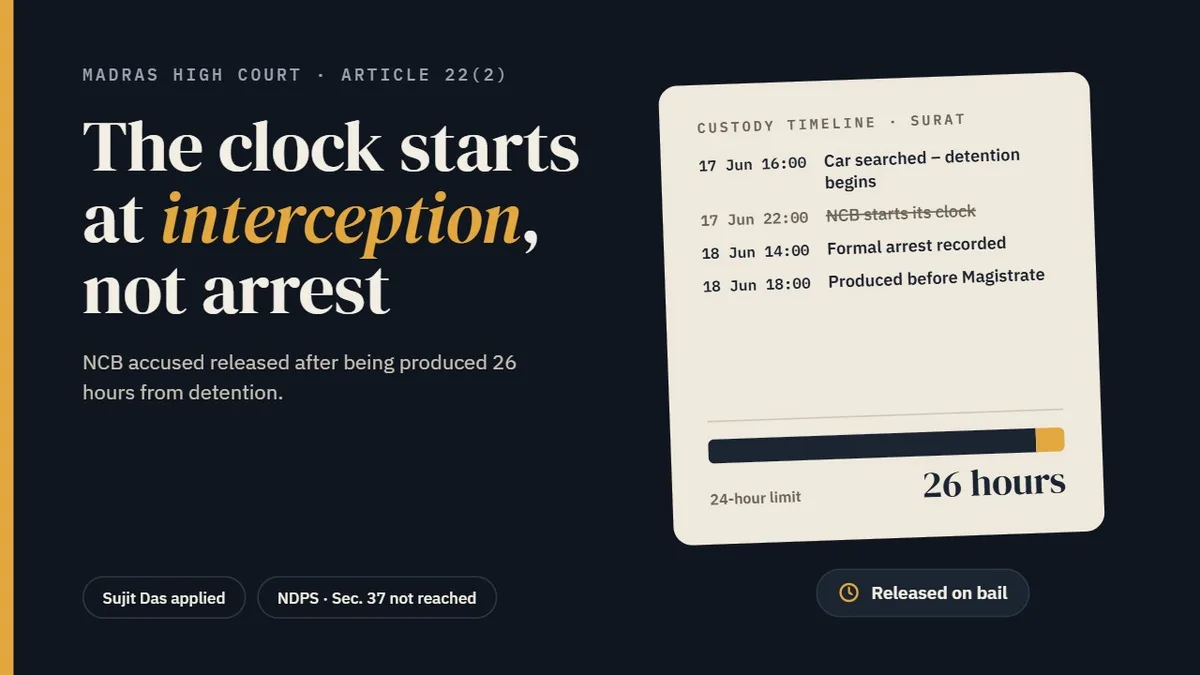
The seizure mahazar shows the officers approached witnesses at about 16.00 hours, searched the car and finished at 19.00 hours; a second mahazar ended at 22.00 hours; he was lodged in safe custody overnight and the arrest memo shows 14.00 hours on 18.06.2026 (Para 9).
From the search of his car he was under the officers' control – that is the detention from which time runs (Para 9).
The Surat Magistrate's order records production at 18.00 hours on 18.06.2026; the NCB counted from 22.00 hours on 17.06.2026, the method Sujit Das rejects; interception cannot be later than 18.00 hours on 17.06.2026, and travel within Surat cannot explain the excess (Para 10).
Held: The twenty-four hours were exceeded by about two hours; the petitioner must be released on that ground alone. (Paras 10–13)
Notable Observations:
"From the time the officers began to search his car he was under their control. That is the detention from which Sujit Das requires the twenty-four hours to be counted." (Para 9)
"I make this order on that ground and not upon any satisfaction recorded on the twin conditions in Section 37 of the Act, which I have not reached and do not reach." (Para 12)
Decision & Directions :
Petition allowed; petitioner released on bail. (Para 13)
1. Bond of Rs. 25,000 with two sureties (one blood relative, one local) to the satisfaction of the Principal Special Judge for EC and NDPS Act Cases, Chennai. (Para 14)
2. Report daily for 15 days (condition (b)), and appear before the NCB Intelligence Officer, Chennai daily for 15 days and then on the first Monday of each month until the final report (condition (h)). (Para 14)
3. Affidavit within a week giving his Surat address, bail address and mobile number; no change without written intimation. (Para 14(g))
4. Not to leave India without the Special Judge's permission; not to abscond or tamper with evidence; P.K. Shaji breach clause; fresh FIR under Section 269 BNS if he absconds. (Para 14)
Observations are prima facie; the earlier findings of 07.10.2026 on the material against the petitioner stand. (Paras 12, 15)
Points to note: the order reads Sujit Das as retrospective for pending investigations while the same judge's Richard Yao order of 23.11.2026 applied it only to later arrests – the two turn on the stage of the case, so watch for an NCB appeal or a larger-bench reference.
Record notes: the date line reads '___.11.2026' – the day was never filled in; two conditions are lettered '[g]'; conditions (b) and (h) both require daily reporting for 15 days (the first to 'the respondent police').
Separate Opinions: None.
Legal Provisions Discussed & Precedents Cited :
- Constitution of India – Article 22(2).
- Narcotic Drugs and Psychotropic Substances Act, 1985 – Sections 8(c), 20(b)(ii)(A), 21(c), 22(c), 23(c), 25, 27A, 28, 29, 37(1)(b)(ii).
- Bharatiya Nagarik Suraksha Sanhita, 2023 – Section 483; Bharatiya Nyaya Sanhita, 2023 – Section 269.
- Sujit Das v. Union of India, 2026 INSC 1195 – Followed.
- Kannan v. State of Tamil Nadu, 2026 SCC OnLine Mad 6652 – Overruled by Sujit Das; noted.
- Kalyan Chandra Sarkar v. Rajesh Ranjan @ Pappu Yadav, (2005) 2 SCC 42 – Followed (successive bail).
- Government of India v. Sri Devraj URS Medical College, 2026 INSC 799 – Followed (retrospectivity).
- Jaskaran Jeet Singh Deol v. State of Punjab, 2026 INSC 1022 – Followed (release despite twin conditions).
- Richard Yao v. Superintendent of Customs, Crl.O.P. No. 26286 of 2026 (Mad., 23.11.2026) – Distinguished.
- P.K. Shaji v. State of Kerala, (2005) 13 SCC 283 – Referred to (bail conditions).
Case Details :
- Case / Party Name: Yash Chhabda v. Union of India (Intelligence Officer, Narcotics Control Bureau, Chennai Zonal Unit)
- Case Number(s): Crl.O.P. No. 32269 of 2026 (CNR HCMA012607822026) – successive petition for regular bail under Section 483 BNSS; R.R. No. 23 of 2026 in NCB F.No. 48/1/17/2026; no neutral citation printed
- Coram / Judges: N. Ramesh, J. – Single Judge
- Counsel Appearances: For the Petitioner: Mr. R.C. Paul Kanagaraj. For the Respondent: Mr. V. Chandrasekaran, Special Public Prosecutor (NCB).
Disclaimer: This summary is an editorial aid and does not form part of the judgment. Refer to the original judgment before citing.
Full Judgement / Attachment
Full Judgement
Frequently asked questions about Madras High Court
- Where does the Madras High Court sit and which areas does it cover?
- The Madras High Court has its principal seat in Chennai and a bench at Madurai. It has jurisdiction over Tamil Nadu and the Union Territory of Puducherry. Established in 1862, it is one of India's three oldest High Courts.
- Where can I find Madras High Court judgements and daily orders?
- Judgements and daily orders of both the principal seat at Chennai and the Madurai Bench are searchable on the court's judgements portal, mhc.tn.gov.in/judis. Case status is also on the eCourts High Court Services portal (hcservices.ecourts.gov.in).
- Which cases go to the Madurai Bench of the Madras High Court?
- The Madurai Bench, functioning since 2004, hears cases from the southern districts of Tamil Nadu, and the principal seat in Chennai hears the rest of the state and Puducherry. Chennai also has an Original Side for high-value suits and commercial cases, and hears tax appeals from the ITAT Chennai Bench.
- How is a single-judge order of the Madras High Court appealed?
- Writ orders of a single judge are challenged by a Writ Appeal under Clause 15 of the Letters Patent, and Original Side decisions by an Original Side Appeal (OSA), both before a Division Bench. A final judgement can be challenged by a Special Leave Petition under Article 136, ordinarily within 90 days.
- How can White Collar Professional help with a Madras High Court matter?
- Post your requirement on White Collar Professional to receive proposals from verified Advocates, Chartered Accountants and Company Secretaries, compare them, and pay securely through the platform. This page also tracks the latest Madras High Court judgements and legal updates as they are reported.