Madras High Court Issues State-Wide Directions to Curb Stray Cattle on Public Roads
Court / Authority
Madras High Court
Update / Judgement Date
17 Nov 2026
Date of Publication
19 Nov 2026
Case No.
W.P. No. 37070 of 2024
Source
WCP News Bulletin
Author
Dipanshi Bansal — WCP Legal Desk
Reading Time
6 min read
View Count
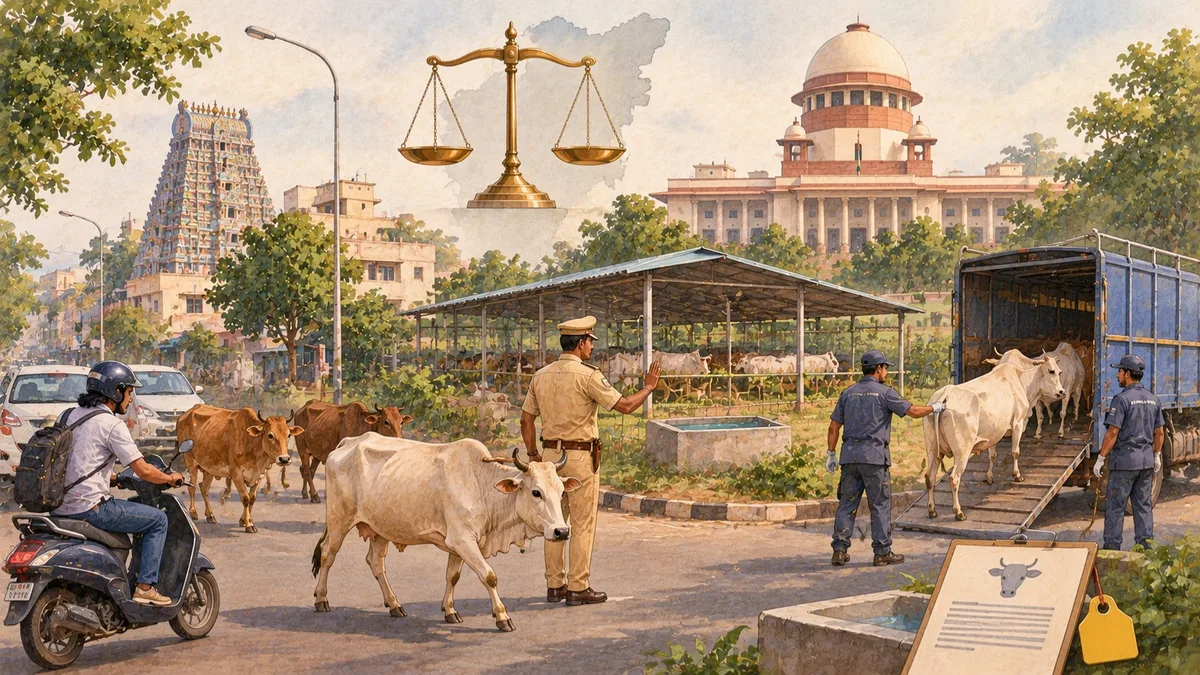
A practising advocate sought directions to control cattle roaming on public roads in Thiruverkadu, alleging traffic disruption, accidents and danger to pedestrians. The Division Bench noted the municipality’s resolution to engage agencies and impose penalties, but held that enforcement of existing licensing, seizure and impounding provisions was necessary. It directed the municipal authority to decide the petitioner’s representation within four weeks and issued broader directions for licensing cattle, inspection of sheds, tagging, regular seizure drives, police assistance, collection of impounding charges, prosecution of repeat offenders and public notices. Except for the direction on the individual representation, the guidelines were extended across Tamil Nadu’s urban and rural local bodies. (Paras 6–10)
Key Proposition: Municipal and police authorities must actively enforce existing statutory controls over cattle in public spaces; the High Court may issue state-wide implementation directions where stray cattle create a recurring public-safety and traffic hazard.
- Tamil Nadu Animals and Birds in Urban Areas (Control and Regulation) Act, 1997 – Sections 3, 9, 10, 11 and 12 – Licensing, inspection, seizure and prosecution of stray / unlicensed cattle – Held, authorities must enforce these provisions. (Paras 7–10)
- Cattle-Trespass Act, 1871 – Section 11 – Police assistance during seizure drives – Held, police must protect municipal workers from obstruction and threats. (Para 9)
- Constitution of India – Article 226 – Public nuisance and road safety – Held, state-wide directions may be issued to secure effective statutory enforcement. (Paras 9–10)
Background / Synopsis :
- The petitioner, a practising advocate, approached the Court concerning cattle roaming on public roads within Thiruverkadu Municipality.
- He stated that busy roads, schools, colleges, hospitals and temples in the area were affected; cattle allegedly blocked traffic, caused accidents, created night-time hazards, attacked pedestrians and damaged shop goods.
- The petitioner had submitted a representation dated 11.11.2024, but alleged that no effective action followed.
- The State relied on existing laws and G.O.(Ms) No.456 dated 20.09.2022, which enhanced daily impounding charges. The municipal council’s Resolution No.809 dated 04.12.2024 proposed engaging private agencies and imposing penalties.
Issues For Consideration :
- Whether the municipal and police authorities were required to take effective action against free-roaming cattle on public roads.
- Whether existing statutory powers and municipal resolutions required further implementation directions.
- Whether the directions should be confined to Thiruverkadu or extended across Tamil Nadu.
Submissions Of Parties :
Petitioner / Appellant:
- Stray cattle on busy public roads endangered commuters, disrupted traffic and caused accidents and other public nuisance.
- Despite the representation dated 11.11.2024, the authorities had not taken concrete steps.
Respondent / State:
- The State submitted that laws governing stray cattle were being enforced, including the Tamil Nadu Urban Local Bodies Act, 1998, the Tamil Nadu Animals and Birds in Urban Areas (Control and Regulation) Act, 1997 and the Cattle-Trespass Act, 1871.
- The Government had enhanced daily pound maintenance charges through G.O.(Ms) No.456 dated 20.09.2022.
- The Municipality had passed Resolution No.809 dated 04.12.2024 proposing private assistance for cattle-catching operations and administrative penalties.
Court's Observations & Analysis :
Re: Statutory framework and municipal responsibility
- Public roads are intended for safe movement; owners cannot allow livestock to roam in a manner that endangers people and disrupts traffic.
- Section 3 of the 1997 Act requires a licence to keep notified animals in urban areas; Section 9 permits inspection of sheds; Section 10 provides for seizure, impounding and disposal of unclaimed animals.
- Section 12 provides penal consequences for contraventions. The Court noted the enhanced daily charges under G.O.(Ms) No.456 dated 20.09.2022.
- The municipal resolution was a positive step, but the Court emphasised that resolutions must be implemented on the ground.
- Held: Authorities were required to enforce the statutory framework rather than leave the municipal resolution unimplemented. (Paras 6–8)
Re: Need for coordinated and state-wide enforcement
- Effective enforcement required regular daytime and night-time drives, police protection for municipal teams, collection of statutory charges and penalties, and prosecution of repeat offenders.
- Because the nuisance affected commuters across the State, the Court extended the directions beyond the individual municipality.
- Held: Except for consideration of the petitioner’s representation, the directions applied to all Municipal Corporations, Municipalities, Town Panchayats and Village Panchayats in Tamil Nadu. (Paras 9–10)
Notable Observations: “resolutions on paper mean little unless they are strictly enforced on the ground.” (Para 6)
Decision & Directions :
- The Municipal Commissioner, Thiruverkadu, shall consider the petitioner’s representation dated 11.11.2024, pass a speaking order and communicate action taken within four weeks of receiving the order.
- Authorities shall enforce Section 3 of the 1997 Act; cattle owners within municipal limits must obtain licences. Sheds shall be inspected under Section 9 and licensed animals tagged for identification.
- Municipal Council Resolution No.809 dated 04.12.2024 shall be implemented immediately through dedicated daytime and night-time cattle seizure teams.
- Police shall provide protection during seizure drives and prevent owners from obstructing or threatening municipal workers, consistently with Section 11 of the Cattle-Trespass Act, 1871.
- Authorities shall collect enhanced daily maintenance / feeding charges under G.O.(Ms) No.456 dated 20.09.2022 and municipal penalties.
- Unclaimed cattle shall be auctioned or handed to recognised Gaushalas as permitted by Section 10(4) of the 1997 Act. Repeat offenders shall face written complaints and prosecution under Sections 11 and 12.
- Public notices shall inform cattle owners of penalties, impounding rules and criminal consequences.
- Directions (ii) to (vii), except the individual representation direction, shall apply throughout Tamil Nadu. The concerned departments and DGP shall issue compliance circulars within four weeks.
Legal Provisions Discussed & Precedents Cited :
- Constitution of India – Article 226 – Writ jurisdiction and public-law directions.
- Tamil Nadu Animals and Birds in Urban Areas (Control and Regulation) Act, 1997 – Sections 3, 9, 10, 11 and 12 – Licensing, inspection, seizure, impounding and prosecution.
- Cattle-Trespass Act, 1871 – Section 11 – Protection / assistance during seizure of cattle.
- Tamil Nadu Urban Local Bodies Act, 1998 – Referred to as part of the State’s statutory framework.
- G.O.(Ms) No.456, Revenue and Disaster Management Department, dated 20.09.2022 – Enhanced daily impounding and maintenance charges.
Case Details :
- Case / Party Name: M. Kamesh v. Municipal Commissioner, Thiruverkadu & Others
- Case Number(s): W.P. No. 37070 of 2024
- Coram / Judges: Sushrut Arvind Dharmadhikari, Chief Justice and G. Arul Murugan, J. – Division Bench
- Counsel Appearances: R.S. Tamilvendan for petitioner; N. Palanivel, Government Advocate (Criminal Side), for respondent 2; C.A. Ramanan, Government Advocate, for respondents 3 and 4; no appearance for respondent 1
Disclaimer: This summary is an editorial aid and does not form part of the judgment. Refer to the original judgment before citing.
Full Judgement / Attachment
Full Judgement
Frequently asked questions about Madras High Court
- Where does the Madras High Court sit and which areas does it cover?
- The Madras High Court has its principal seat in Chennai and a bench at Madurai. It has jurisdiction over Tamil Nadu and the Union Territory of Puducherry. Established in 1862, it is one of India's three oldest High Courts.
- Where can I find Madras High Court judgements and daily orders?
- Judgements and daily orders of both the principal seat at Chennai and the Madurai Bench are searchable on the court's judgements portal, mhc.tn.gov.in/judis. Case status is also on the eCourts High Court Services portal (hcservices.ecourts.gov.in).
- Which cases go to the Madurai Bench of the Madras High Court?
- The Madurai Bench, functioning since 2004, hears cases from the southern districts of Tamil Nadu, and the principal seat in Chennai hears the rest of the state and Puducherry. Chennai also has an Original Side for high-value suits and commercial cases, and hears tax appeals from the ITAT Chennai Bench.
- How is a single-judge order of the Madras High Court appealed?
- Writ orders of a single judge are challenged by a Writ Appeal under Clause 15 of the Letters Patent, and Original Side decisions by an Original Side Appeal (OSA), both before a Division Bench. A final judgement can be challenged by a Special Leave Petition under Article 136, ordinarily within 90 days.
- How can White Collar Professional help with a Madras High Court matter?
- Post your requirement on White Collar Professional to receive proposals from verified Advocates, Chartered Accountants and Company Secretaries, compare them, and pay securely through the platform. This page also tracks the latest Madras High Court judgements and legal updates as they are reported.