Madras High Court Grants Bail After Questioning Whether Gross Ganja Weight Crossed the Commercial-Quantity Threshold
Court / Authority
Madras High Court
Update / Judgement Date
10 Nov 2026
Date of Publication
12 Nov 2026
Case No.
Crl.O.P. No. 29570 of 2026
Source
WCP News Bulletin
Author
Dipanshi Bansal — WCP Legal Desk
Reading Time
12 min read
View Count
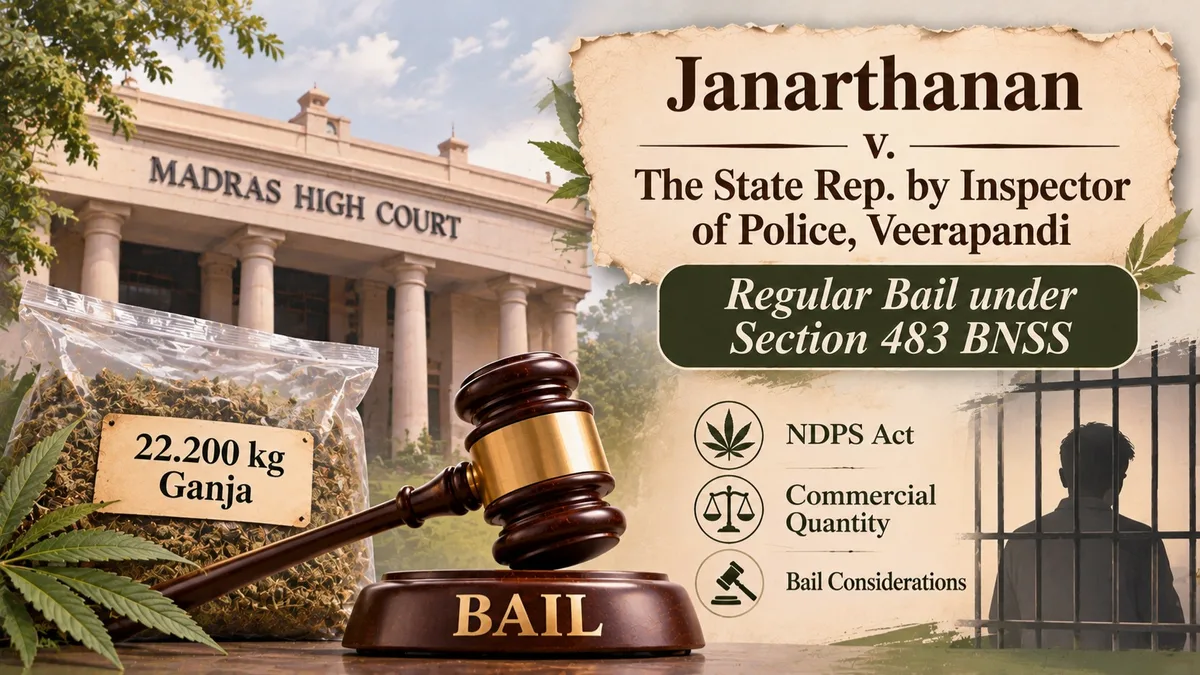
The petitioner, Accused No. 4 in an NDPS prosecution, sought regular bail after nearly nine months in custody in a case involving a stated seizure of 22.200 kg of ganja from a vehicle. The central question was whether the gross weight of a mixed bulk containing flowering or fruiting tops, stalks, stems, loose leaves or seeds, and the carrying sack could, without segregation, establish commercial quantity for the purpose of Section 37 of the Narcotic Drugs and Psychotropic Substances Act, 1985 (NDPS Act). The Madras High Court held that the prosecution record did not establish that the legally defined ganja exceeded the 20 kg threshold, because stalks and stems, certain unaccompanied leaves and seeds, and the sack could not be counted. The Court did not finally determine the quantity or the petitioner's knowledge of the contraband; those matters were left to trial. The second bail petition was allowed subject to conditions.
Key Proposition: Where a ganja seizure is close to the 20 kg commercial-quantity threshold and the prosecution's own description includes stalks or stems, a single gross weighment of the entire bulk and its sack does not by itself establish that the legally defined ganja crosses the threshold; the prosecution must place material showing the weight of the substance falling within Section 2(iii)(b) of the NDPS Act.
- NDPS Act – Section 2(iii)(b) – Definition of ganja – Whether stalks and stems form part of the statutory definition – Held, no; they are excluded. (Paras 8–10)
- NDPS Act – Section 37 – Commercial quantity – Whether gross bulk weight of 22.200 kg, including excluded material and the sack, established the statutory bar – Held, not on the present record. (Paras 7–10)
- NDPS Act – Section 37 – Regular bail – Whether its rigour was shown to apply at the bail stage – Held, no; bail was granted without finally deciding the quantity or the petitioner's knowledge. (Paras 10–12)
Background / Synopsis :
- On 10 February 2026, a police party stopped a car carrying five persons on the road to Ayyampalayam, Tiruppur. The FIR stated that Accused No. 1 was driving, the petitioner was seated in the middle of the rear seat, and Accused No. 1 opened the boot.
- The boot contained a white plastic cattle-feed sack tied with rope, containing dry greenish ganja described as leaves, flowers and stalks. Police weighed the bulk at the spot on an electronic scale and recorded approximately 22 kg 200 g.
- The petitioner was arrested and remanded on 10 February 2026 and had been in custody for a little under nine months by the date of decision.
- The final report was taken on file as C.C. No. 600 of 2026 before the Special Court for Essential Commodities Act Cases, Coimbatore. Charges were framed on 3 November 2026; none of the sixteen cited witnesses had been examined.
- The first bail petition, Crl.O.P. No. 10343 of 2026, was dismissed by a coordinate Bench on 8 July 2026. That order treated 22.200 kg as commercial quantity and found no ground to overcome Section 37, but did not discuss the composition of the bulk or how it was weighed.
- The present matter was the petitioner's second regular-bail petition under Section 483 of the Bharatiya Nagarik Suraksha Sanhita, 2023 (BNSS). He sought release pending trial.
Issues For Consideration :
- Whether the entire 22.200 kg could be treated as ganja for determining commercial quantity despite the prosecution's description of stalks or stems in the bulk and the absence of recorded segregation or net weighment.
- Whether the material available showed that the restrictions on bail under Section 37 of the NDPS Act were attracted.
- Whether the petitioner was entitled to regular bail having regard to the recovery, his alleged connection with the vehicle and contraband, his age and antecedents, and the stage of trial.
Submissions Of Parties :
Petitioner:
- The FIR described the material as leaves, flowers and stalks weighed together. Counsel submitted that stalks were not included in ganja under Section 2(iii)(b); seeds and leaves were excluded when not accompanied by the flowering or fruiting tops.
- It was argued that separating and weighing the tops could result in a quantity below 20 kg. Reliance was placed on Killo Subbarao v. State of Andhra Pradesh, Crl.P. No. 5306 of 2025, dated 23 June 2025.
- The petitioner claimed that he was merely a passenger, did not know of the contraband, and had nothing recovered from him.
- It was submitted that he was eighteen years old, a student and had no previous case.
Respondent / State:
- The State argued that 22.200 kg was commercial quantity and Section 37 applied.
- The counter affidavit alleged that the petitioner drove the car, held its key, opened the boot and hired the car by pledging the third accused's two-wheeler, thereby having conscious possession. This differed from the FIR, which recorded Accused No. 1 as driver and the person who opened the boot.
- The State asserted that no circumstance had changed since the earlier dismissal, disputed the claim of no previous case, and alleged that the petitioner belonged to an inter-State syndicate and might abscond.
- The State relied on Madan Lal v. State of Himachal Pradesh, (2003) 7 SCC 465; State of Kerala v. Rajesh, (2020) 12 SCC 122; Union of India v. Ram Samujh, (1999) 9 SCC 429; and Narcotics Control Bureau v. Mohit Aggarwal, (2022) 18 SCC 374.
Court's Observations & Analysis :
Re: Issue 1 – Statutory meaning of ganja and computation of quantity
- Section 2(iii)(b) defined ganja as the flowering or fruiting tops of the cannabis plant, excluding seeds and leaves when not accompanied by the tops.
- Leaves and seeds accompanying the tops formed part of ganja. The Court relied on Shiv Kumar Mishra v. State of Goa, (2009) 3 SCC 797.
- Stalks and stems were neither flowering or fruiting tops, nor leaves, nor seeds; the statutory definition did not include them.
- A single weighment of dried cannabis in a sack could include the tops, leaves and seeds accompanying them, loose leaves and seeds not accompanied by tops, stalks and stems, and the sack. The gross figure therefore did not disclose the weight of ganja as statutorily defined.
- The distinction mattered because the recorded weight was close to 20 kg. The excess was a little over 2 kg; stalks, excluded leaves and seeds, and the sack could together account for a margin of that order.
- In Anand Dewar v. State of Chhattisgarh, Criminal Appeal No. 3943 of 2026, order dated 19 August 2026, the Supreme Court had observed that a stated weight of 22 kg might include the bag and that the actual contraband could be below 20 kg.
- In Ganesan v. State, Crl.A. (MD) No. 212 of 2020 and batch, dated 15 October 2025, a learned Judge of the Madras High Court held that stalks and stems recovered with tops must be excluded, particularly for recoveries between 21 and 25 kg.
- The prosecution, which invoked the statutory bar, had to place material showing that the threshold had been crossed. The petitioner was not required to prove that the whole excess consisted of excluded parts.
- The FIR recorded stalks in the sack, and the counter affidavit described the contents as 'leaves, flowers, and stems'. Neither stated that the sack had been removed before weighing or that stalks had been separated.
- The Court did not find finally that the quantity was below commercial quantity. It held only that there was a real possibility that the ganja, after excluding stalks, stems, seeds and leaves not accompanied by tops, and the sack, was below 20 kg. The final quantity was left to the Special Court on evidence.
- Held: On the existing record, the prosecution had not shown that the rigour of Section 37 was attracted. (Paras 7–10)
Re: Issue 2 – Treatment of cited authorities
- Killo Subbarao was a decision of another High Court and was persuasive only. The Court declined to rely on it insofar as it excluded leaves without asking whether they accompanied the tops.
- That approach was inconsistent with Shiv Kumar Mishra, which treated leaves and seeds accompanying the tops as part of ganja.
- Held: The Court applied the statutory definition as interpreted by the Supreme Court; it did not adopt a blanket exclusion of leaves. (Paras 8 and 11)
Re: Issue 3 – Petitioner's alleged knowledge and entitlement to bail
- Whether the petitioner knew what was in the boot was a question for trial; the Court did not decide conscious possession at the bail stage.
- The Court noted that the petitioner was eighteen years old when arrested and that no previous case was shown.
- Charges had been framed, but none of the sixteen prosecution witnesses had been examined, and the petitioner had remained in custody for a little under nine months.
- Held: The second regular-bail petition was allowed without a final finding on the actual quantity or the petitioner's knowledge of the contraband. (Paras 10–12)
Notable Observations:
- “The petitioner does not have to show that the whole of the excess consists of excluded parts.” (Para 9)
- “I do not hold that the quantity is below the commercial quantity. That is a matter on which evidence will be led, and I leave it entirely to the Special Court.” (Para 10)
Decision & Directions :
- The Criminal Original Petition was allowed. The petitioner was ordered to be released on bail on executing a bond of ₹25,000 with two sureties for a like sum each, one of whom must be a blood surety, to the satisfaction of the Special Court, Coimbatore.
- Each surety must affix a photograph and Left Thumb Impression on the surety application in Judicial Form No. 46 annexed to the Criminal Rules of Practice, 2019. The court must obtain a copy of any one identity proof to verify identity.
- The petitioner must appear before the trial court on every working day at 10:30 a.m., until further orders.
- Within one week of release, the petitioner must file an affidavit before the Special Court stating the mobile number and address at which he will reside while on bail, with proof. He must not change these details without prior written intimation to the Special Court and respondent.
- The petitioner must not abscond during investigation or trial.
- The petitioner must not tamper with evidence or witnesses, and must not contact occurrence witnesses, officials dealing with the case, or any other person connected with the occurrence.
- On breach of any condition, the Magistrate/Trial Court may pass appropriate orders in accordance with law as if it had itself imposed the conditions and granted bail, as stated in P.K. Shaji v. State of Kerala, (2005) 13 SCC 283.
- If the accused thereafter absconds, a fresh FIR may be registered under Section 269 of the Bharatiya Nyaya Sanhita, 2023 (BNS).
- No separate order on costs was stated.
Legal Provisions Discussed & Precedents Cited :
- NDPS Act – Section 2(iii)(b): Defines ganja as flowering or fruiting tops; leaves and seeds are included only when accompanied by the tops. Stalks and stems are not included.
- NDPS Act – Section 8(c): Prohibits specified dealings in narcotic drugs and psychotropic substances except as permitted by the Act.
- NDPS Act – Section 20(b)(ii)(C): Prescribes punishment for contraventions involving commercial quantity of cannabis-related substances.
- NDPS Act – Section 25: Concerns knowingly permitting premises, conveyance or other place to be used for commission of an offence under the Act.
- NDPS Act – Section 29(1): Addresses abetment and criminal conspiracy in relation to offences under the Act.
- NDPS Act – Section 37: Restricts bail for specified offences, including those involving commercial quantity.
- BNSS, 2023 – Section 483: Special powers of the High Court and Court of Session regarding bail; the present petition was filed under this provision.
- BNS, 2023 – Section 269: Referred to in the direction concerning a fresh FIR if the accused absconds.
- Criminal Rules of Practice, 2019 – Judicial Form No. 46: Surety application form requiring photographs and Left Thumb Impression.
- Anand Dewar v. State of Chhattisgarh, Criminal Appeal No. 3943 of 2026, order dated 19 August 2026 – Relied on for the possibility that a bag may have been included in the stated weight and actual contraband may fall below commercial quantity.
- Ganesan v. State, Crl.A. (MD) No. 212 of 2020 and batch, dated 15 October 2025 – Relied on for excluding stalks and stems, particularly in recoveries in the 21–25 kg range.
- Shiv Kumar Mishra v. State of Goa, (2009) 3 SCC 797 – Relied on for the proposition that leaves and seeds accompanying the tops form part of ganja.
- Killo Subbarao v. State of Andhra Pradesh, Crl.P. No. 5306 of 2025, dated 23 June 2025 – Cited by petitioner; persuasive only and not relied on insofar as it excluded leaves without considering whether they accompanied the tops.
- P.K. Shaji v. State of Kerala, (2005) 13 SCC 283 – Relied on for the trial court's authority to act upon breach of bail conditions.
- Madan Lal v. State of Himachal Pradesh, (2003) 7 SCC 465; State of Kerala v. Rajesh, (2020) 12 SCC 122; Union of India v. Ram Samujh, (1999) 9 SCC 429; Narcotics Control Bureau v. Mohit Aggarwal, (2022) 18 SCC 374 – Cited by the State in opposition to bail; not separately analysed in the order.
Case Details :
- Case / Party Name: Janarthanan v. The State Rep. by the Inspector of Police, Veerapandi Police Station, Tiruppur City.
- Case Number(s): Crl.O.P. No. 29570 of 2026; CNR: HCMA012428302026; Crime No. 61 of 2026; C.C. No. 600 of 2026.
- Coram / Judges: The Hon'ble Mr. Justice N. Ramesh – Single Judge.
- Counsel Appearances: Mr. G. Saravanan for the petitioner; Mr. M.M.I. Khaleel, Government Advocate (Criminal Side), for the respondent.
Disclaimer: This summary is an editorial aid and does not form part of the judgment. Refer to the original judgment before citing.
Full Judgement / Attachment
Full Judgement
Frequently asked questions about Madras High Court
- Where does the Madras High Court sit and which areas does it cover?
- The Madras High Court has its principal seat in Chennai and a bench at Madurai. It has jurisdiction over Tamil Nadu and the Union Territory of Puducherry. Established in 1862, it is one of India's three oldest High Courts.
- Where can I find Madras High Court judgements and daily orders?
- Judgements and daily orders of both the principal seat at Chennai and the Madurai Bench are searchable on the court's judgements portal, mhc.tn.gov.in/judis. Case status is also on the eCourts High Court Services portal (hcservices.ecourts.gov.in).
- Which cases go to the Madurai Bench of the Madras High Court?
- The Madurai Bench, functioning since 2004, hears cases from the southern districts of Tamil Nadu, and the principal seat in Chennai hears the rest of the state and Puducherry. Chennai also has an Original Side for high-value suits and commercial cases, and hears tax appeals from the ITAT Chennai Bench.
- How is a single-judge order of the Madras High Court appealed?
- Writ orders of a single judge are challenged by a Writ Appeal under Clause 15 of the Letters Patent, and Original Side decisions by an Original Side Appeal (OSA), both before a Division Bench. A final judgement can be challenged by a Special Leave Petition under Article 136, ordinarily within 90 days.
- How can White Collar Professional help with a Madras High Court matter?
- Post your requirement on White Collar Professional to receive proposals from verified Advocates, Chartered Accountants and Company Secretaries, compare them, and pay securely through the platform. This page also tracks the latest Madras High Court judgements and legal updates as they are reported.