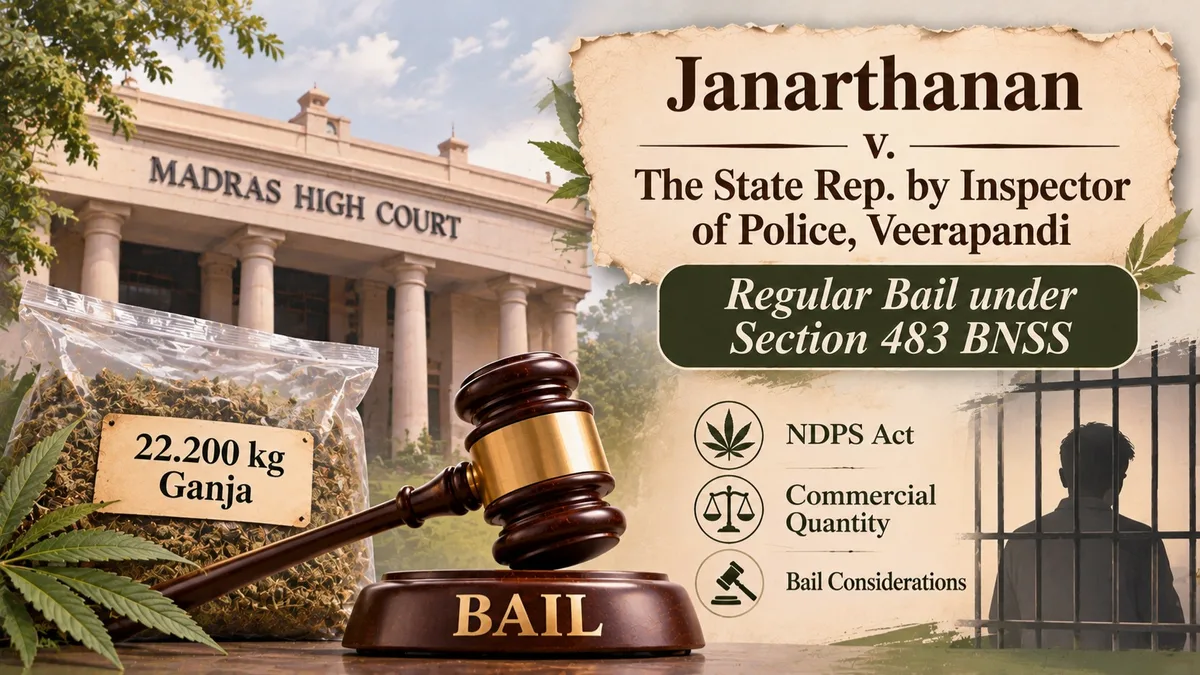
Separate 10-Kg NDPS Recoveries Cannot Be Aggregated Without Evidence of Conspiracy or Joint Possession
Court / Authority
Madras High Court
Update / Judgement Date
23 Nov 2026
Date of Publication
26 Nov 2026
Case No.
CRL.O.P. Nos. 27496, 27515 & 27517 of 2026
Source
WCP News Bulletin
Author
Dipanshi Bansal — WCP Legal Desk
Reading Time
6 min read
View Count
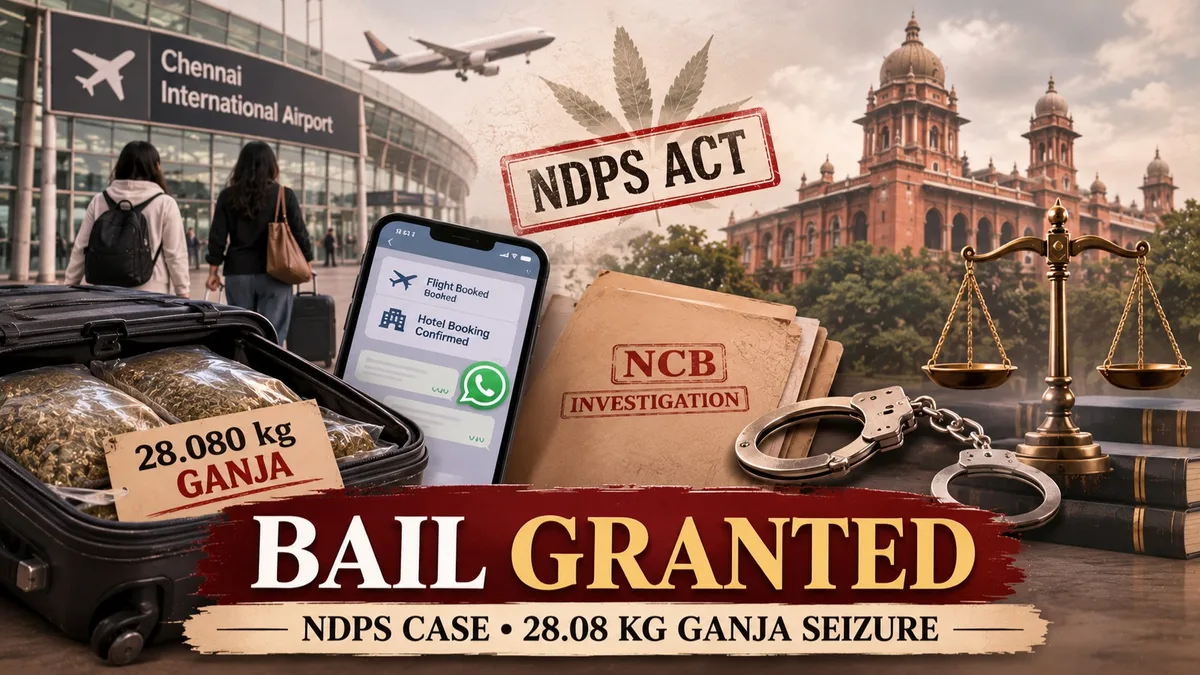
In a common bail order arising from one prosecution, the Madras High Court held that separate recoveries of 10 kg of ganja from each accused could not, at the bail stage, be aggregated to 30 kg where there was no common stock, common container, money trail or independent evidence of conspiracy or joint possession. Treating each recovery independently as intermediate quantity, the Court held that the commercial-quantity rigours of Section 37 did not arise and granted bail. (Paras 6–8)
Key Proposition: Separate recoveries from co-accused cannot be aggregated to invoke the commercial-quantity restrictions under the NDPS Act merely on the basis of inadmissible police statements where independent evidence of conspiracy, abetment or joint possession is absent.
- Narcotic Drugs and Psychotropic Substances Act, 1985 – Sections 29 and 37 – separate recoveries – whether quantities could be aggregated – Held, not on the material available where no independent evidence linked the recoveries. (Paras 6–7)
- Section 37 NDPS Act – commercial quantity – whether its twin rigours applied – Held, no, because each 10-kg recovery was prima facie an intermediate quantity. (Para 7
- Bail – completed investigation and prolonged custody – whether release was justified – Held, yes, subject to stringent conditions. (Paras 7–8)
Background / Synopsis :
- The three petitioners were arrested and remanded to custody on 6 February 2026 in Crime No. 56/2026.
- The prosecution alleged that police intercepted the three petitioners and separately seized 10 kg of ganja from each, totalling 30 kg.
- The accused argued that the recoveries were separate, with no common stock, common container or money trail and no independent material establishing conspiracy or joint possession.
- Investigation had concluded and the final report had been taken on file as C.C. No. 1131 of 2026; the case was posted for questioning.
Issues For Consideration :
- Whether the three separate 10-kg recoveries could be aggregated as a commercial quantity for purposes of Section 37 of the NDPS Act.
- Whether the material disclosed conspiracy, abetment or joint possession sufficient to invoke Section 29 and connect one accused with the recovery from another.
- Whether the petitioners satisfied the applicable bail standard after completion of investigation and prolonged incarceration.
Submissions Of Parties :
Petitioners:
- Each petitioner separately carried 10 kg and each recovery was documented through a separate seizure mahazar.
- There was no common stock, common container, money trail or independent evidence of conspiracy/joint possession.
- The petitioners argued that police confessions could not independently justify aggregation and relied on earlier High Court orders.
State:
- The State contended that the total seizure was 30 kg and therefore commercial quantity.
- It also pointed out that two petitioners had previously raised the separate-recovery argument in an earlier bail application that had been dismissed.
Court's Observations & Analysis :
Re: Aggregation of separate recoverie
- The Court found that each petitioner was carrying 10 kg separately and that each seizure was documented independently.
- There was no common stock, common container or money trail on record.
- The Court relied on Supreme Court authority holding that, absent independent evidence of abetment, conspiracy or joint possession, one accused’s quantity cannot simply be put to the account of another.
- Held: Prima facie, each recovery was separate and distinct and had to be treated independently as an intermediate quantity. (Paras 6–7)
Re: Section 37 and bail
- The Court noted that the prosecution’s material beyond the police-recorded statements did not justify treating the case as one involving commercial quantity.
- Investigation was complete, the final report was filed and the accused had undergone prolonged incarceration.
- The Court was satisfied that the statutory threshold for commercial-quantity bail did not arise on the prima facie view.
- Held: The petitioners were entitled to bail, subject to conditions. (Paras 7–8)
Decision & Directions :
- All three criminal original petitions were allowed and the petitioners were ordered to be released on bail.
- Each petitioner was required to execute a Rs.25,000 bond with two sureties for a like sum.
- The petitioners were required to report before the trial court on all working days at 10:30 a.m. until further orders.
- They were prohibited from absconding and tampering with evidence or witnesses.
- The order specified consequences for breach and referred to Section 269 of the Bharatiya Nyaya Sanhita, 2023 for a fresh FIR if an accused thereafter absconded.
Legal Provisions Discussed & Precedents Cited :
- Narcotic Drugs and Psychotropic Substances Act, 1985 – Section 8(c) – prohibition concerning narcotic drugs.
- NDPS Act – Section 20(b)(ii)(C) – offence relating to cannabis/ganja and quantity classification.
- NDPS Act – Section 29(1) – abetment and criminal conspiracy.
- NDPS Act – Section 37 – stringent bail conditions for offences involving commercial quantity.
- Bharatiya Nyaya Sanhita, 2023 (BNS) – Section 269, referred to regarding absconding after release.
- Amarsingh Ramjibhai Barot v. State of Gujarat, (2005) 7 SCC 550 – Relied on regarding separate recoveries and absence of joint possession/conspiracy.
- B. Saroj Kumar Patra v. State, Crl.O.P. No. 11720 of 2026, order dated 29 July 2026 – Relied on regarding separate recovery and aggregation.
- Crl.O.P. No. 24777 of 2026, order dated 18 September 2026 – Relied on and followed on the same aggregation issue.
- Tofan Singh v. State of Tamil Nadu, (2021) 4 SCC 1 – Relied on concerning police confessions under the NDPS Act.
- State by (NCB) Bengaluru v. Pallulabid Ahmad Arimutta, 2022 INSC 26 – Relied on concerning Section 37 and bail.
- Union of India v. Mohd. Nawaz Khan, (2021) 10 SCC 100 – Relied on for scrutiny under Section 37.
- P.K. Shaji v. State of Kerala, (2005) 13 SCC 283 – Relied on regarding consequences of breach of bail conditions.
Case Details :
- Case / Party Name: Makut Singha v. State; Tapan Chakma v. State; Rabi Chandra Jamatia v. State
- Case Number(s): CRL.O.P. Nos. 27496, 27515 & 27517 of 2026; CNR Nos. HCMA012261832026, HCMA012262152026 and HCMA012262342026
- Coram / Judges: Hon’ble Mr. Justice N. Ramesh – Single Judge
- Counsel Appearances: Mr. Ma. Gouthaman for Mr. J. William Shakesphere for all petitioners; Mr. M.M.I. Khaleel, Government Advocate (Criminal Side) for the State.
Disclaimer: This summary is an editorial aid and does not form part of the judgment. Refer to the original judgment before citing.
Full Judgement / Attachment
Full Judgement
Frequently asked questions about Madras High Court
- Where does the Madras High Court sit and which areas does it cover?
- The Madras High Court has its principal seat in Chennai and a bench at Madurai. It has jurisdiction over Tamil Nadu and the Union Territory of Puducherry. Established in 1862, it is one of India's three oldest High Courts.
- Where can I find Madras High Court judgements and daily orders?
- Judgements and daily orders of both the principal seat at Chennai and the Madurai Bench are searchable on the court's judgements portal, mhc.tn.gov.in/judis. Case status is also on the eCourts High Court Services portal (hcservices.ecourts.gov.in).
- Which cases go to the Madurai Bench of the Madras High Court?
- The Madurai Bench, functioning since 2004, hears cases from the southern districts of Tamil Nadu, and the principal seat in Chennai hears the rest of the state and Puducherry. Chennai also has an Original Side for high-value suits and commercial cases, and hears tax appeals from the ITAT Chennai Bench.
- How is a single-judge order of the Madras High Court appealed?
- Writ orders of a single judge are challenged by a Writ Appeal under Clause 15 of the Letters Patent, and Original Side decisions by an Original Side Appeal (OSA), both before a Division Bench. A final judgement can be challenged by a Special Leave Petition under Article 136, ordinarily within 90 days.
- How can White Collar Professional help with a Madras High Court matter?
- Post your requirement on White Collar Professional to receive proposals from verified Advocates, Chartered Accountants and Company Secretaries, compare them, and pay securely through the platform. This page also tracks the latest Madras High Court judgements and legal updates as they are reported.