ECGC Payout to the Lender Is Not the Debtor's Asset: NCLAT Lets Karnataka Bank Keep ₹45.9 Lakh Export-Credit Settlement Received During Moratorium, Holds Cover a Performance Guarantee Outside 'Security Interest'
Court / Authority
NCLT & NCLAT
Update / Judgement Date
27 Nov 2026
Source
WCP News Bulletin
Author
Arshee Saifi — WCP Legal Desk
Reading Time
7 min read
View Count
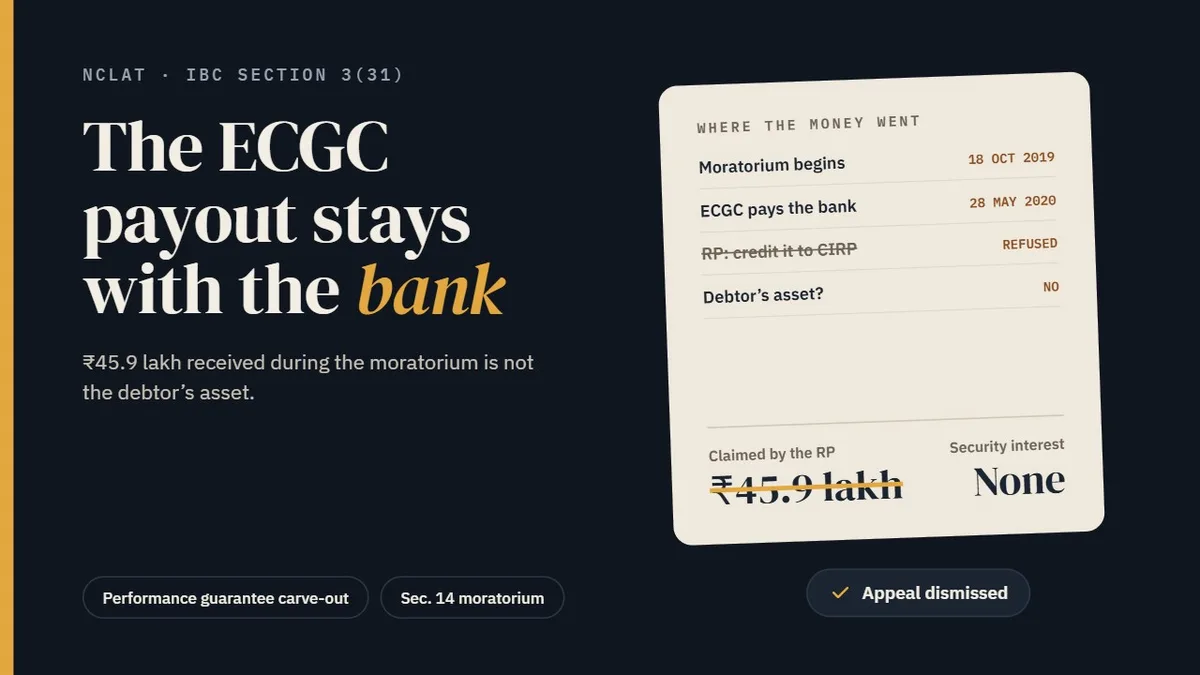
Key Proposition: A payment made by ECGC to a lender under export-credit cover is the proceeds of a separate third-party contract, excluded from 'security interest' as a performance guarantee by the proviso to Section 3(31) IBC; it is not an asset of the corporate debtor and the lender may retain it notwithstanding the moratorium under Section 14.
Background / Synopsis :
- CIRP was initiated on 18.10.2019 on a Section 9 petition by Carbon Resources Pvt. Ltd.; the appellant was appointed RP on 23.01.2020 (Paras 4–5, 8).
- Karnataka Bank claimed ₹14,57,18,571 on 01.11.2019, revised on 09.12.2019 to ₹44,54,74,153, listing the ECGC Credit Cover (ECIB) for pre-shipment credit among 'Collateral Securities' (Para 7).
- On 28.05.2020, during the moratorium, ECGC paid the bank ₹45,90,206 by cheque, on condition that the amount not be credited to the exporter's account until its dues were fully recovered or written off with ECGC's approval (Para 9).
- The RP's request of 25.11.2020 for release was met by the bank's letter of 01.12.2020 offering to reduce its claim by ₹45,90,206 (Para 13).
- The RP's I.A. No. 52/KB/2021 also sought release of fixed deposits of ₹11,75,521 (from the bank) and ₹3,01,500 (from a second respondent) (Para 3).
Issues For Consideration :
- Whether the amount received by the bank from ECGC under the export-credit cover is a 'security interest' or an asset of the corporate debtor that must be credited to the CIRP account (Paras 14, 20–22).
Submissions Of Parties :
- Appellant (Erstwhile RP):
The cover was a pre- and post-shipment insurance taken by the exporter, recorded as collateral security in the sanction letter of 24.04.2017 – a 'letter of comfort or security interest', not a third-party guarantee (Paras 10–11, 16).
The bank's claim had been admitted before the receipt; realising and retaining the amount during moratorium violated Section 14 (Paras 12, 18).
- Respondent (Karnataka Bank):
The ECGC cover is a separate and independent contract between the bank and ECGC – a third-party guarantee; default was reported to ECGC before the CIRP and the amount was not realised from the debtor's assets (Paras 15, 17).
The receipt was an invocation of a performance guarantee for non-payment of packing credit (Para 17).
Court's Observations & Analysis :
- Re: The proviso to Section 3(31)
Though a proviso usually qualifies the main provision, this one is an exception 'causing an exclusion', taking performance guarantees outside 'security interest' (Para 20).
Security interest covers rights securing payment or performance, but excludes performance-based guarantees (Para 21).
- Re: Character of the ECGC payment
The ECGC cover is a third-party guarantee outside the loan documents; what ECGC pays is not a debt under Section 3(11) but is obtained for non-performance of the obligation under the guarantee (Para 20).
A bank guarantee is payable on demand; the surety's assets are separate from the debtor's, and the guarantee can be invoked during moratorium given Section 14(3)(b) (BALCO v. J.P. Engineers) (Para 21).
Held: The debtor never deposited the sum, no security interest was created over it, and it is not an asset of the corporate debtor; the NCLT rightly refused to direct its transfer. (Para 22)
Notable Observations:
"The guarantee that was obtained from the ECGC is not a debt as per Section 3(11) of the Code." (Para 20)
"… the Corporate Debtor had never deposited the said sum obtained by the Bank from ECGC, hence it cannot be said to be assets of the Corporate Debtor …" (Para 22)
Decision & Directions :
- Appeal dismissed; NCLT order of 24.04.2023 upheld; interlocutory applications closed. (Paras 22–23)
- Points to note: ECIB/WTPC cover is export-credit insurance bought by the bank against borrower default; the judgment equates it with a 'performance guarantee' (adopting the bank's description) and relies on Section 14(3)(b), which speaks of a surety in a contract of guarantee. The reasoning that the cover is outside the debtor's estate is the operative ratio; the 'performance guarantee' label is open to debate.
- Points to note: the bank had itself offered (01.12.2020) to reduce its admitted claim by ₹45,90,206 – the judgment does not direct that reduction expressly, but the RP should ensure the claim is not double-counted. The NCLT's liberty as to the other fixed deposits is not disturbed.
- Record notes: the cause title describes the impugned order as passed by the 'NCLT, Ahmedabad Bench', but the body and case numbers (KB) show the Kolkata Bench. The BALCO v. J.P. Engineers extract carries no citation. The respondent is styled 'Respondent No. 1' throughout though it is the sole respondent here.
- Separate Opinions: None.
Legal Provisions Discussed & Precedents Cited :
- Insolvency and Bankruptcy Code, 2016 – Sections 3(11), 3(31) and proviso, 9, 14, 14(3)(b), 15, 17(1)(d), 60(5).
- IBBI (Insolvency Resolution Process for Corporate Persons) Regulations, 2016 – Regulation 6.
- Bharat Aluminium Co. Ltd. v. J.P. Engineers Pvt. Ltd. (citation not given) – Followed (guarantee invocable during moratorium).
Case Details :
- Case / Party Name: Bijay Murmuria (Erstwhile Resolution Professional of Dimension Steel & Alloys Pvt. Ltd.) v. Karnataka Bank Limited
- Case Number(s): Company Appeal (AT) (Insolvency) No. 1002 of 2023 with I.A. No. 3427 of 2023 – arising out of order dated 24.04.2023 of NCLT, Kolkata Bench in I.A. No. 52/KB/2021 in C.P.(IB) No. 832/KB/2019
- Coram / Judges: Justice Sharad Kumar Sharma, Member (Judicial); Arun Baroka, Member (Technical); Indevar Pandey, Member (Technical) – Judgment by Justice Sharad Kumar Sharma
- Counsel Appearances: For the Appellant: Mr. Gaurav H. Sethi, Mr. Rahul Pawar, Mr. Rahul Kapoor, Mr. Parikshit Poddar and Mr. Kartik Nagpal, Advocates. For the Respondent: Mr. Gautam Singhal, Ms. Anjali Maurya, Ms. Kirti Agrawal and Mr. Rajat Chaudhary, Advocates.
Disclaimer: This summary is an editorial aid and does not form part of the judgment. Refer to the original judgment before citing.
Full Judgement / Attachment
Full Judgement
Frequently asked questions about NCLT & NCLAT
- What are the NCLT and NCLAT?
- The National Company Law Tribunal (NCLT) and the National Company Law Appellate Tribunal (NCLAT) were constituted on 1 June 2016 under the Companies Act, 2013. The NCLT sits in benches across India, and the NCLAT hears appeals from it, with its principal bench in New Delhi and a bench in Chennai.
- What cases does the NCLT hear?
- The NCLT is the Adjudicating Authority for corporate insolvency under the IBC. It also hears company law matters, including oppression and mismanagement petitions, schemes of merger and demerger, reduction of capital, and class action suits.
- What is the time limit to appeal an NCLT order to the NCLAT?
- Under the Companies Act, the appeal is due within 45 days, extendable by up to 45 days. Under the IBC, it is due within 30 days, extendable by up to 15 days. These outer limits are strictly applied.
- How can I check NCLT case status or orders?
- Case status, cause lists and orders are available on the NCLT website (nclt.gov.in) and the NCLAT website (nclat.nic.in), searchable by case number, party name or bench.
- How can White Collar Professional help with a NCLT or NCLAT matter?
- Post your requirement on White Collar Professional to receive proposals from verified Company Secretaries, Insolvency Professionals and Advocates, compare them, and pay securely through the platform. This page also tracks the latest NCLT or NCLAT NCLT and NCLAT judgements as they are reported.