±10% Variation Must Be Allowed Before Penalising Excess Mining: Orissa High Court Quashes ₹40 Crore Demand on Iron Ore Miner, Orders Recalculation on Annual Basis
Court / Authority
Orissa High Court
Update / Judgement Date
11 Nov 2026
Date of Publication
13 Nov 2026
Source
WCP News Bulletin
Author
Arshee Saifi — WCP Legal Desk
Reading Time
6 min read
View Count
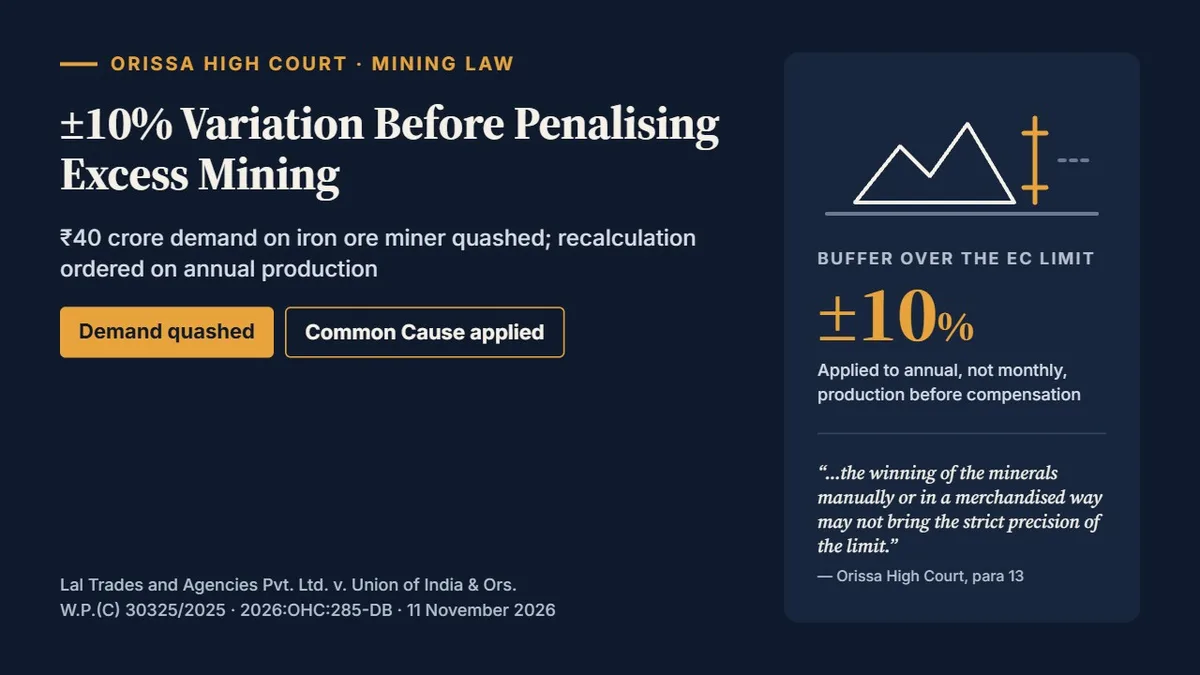
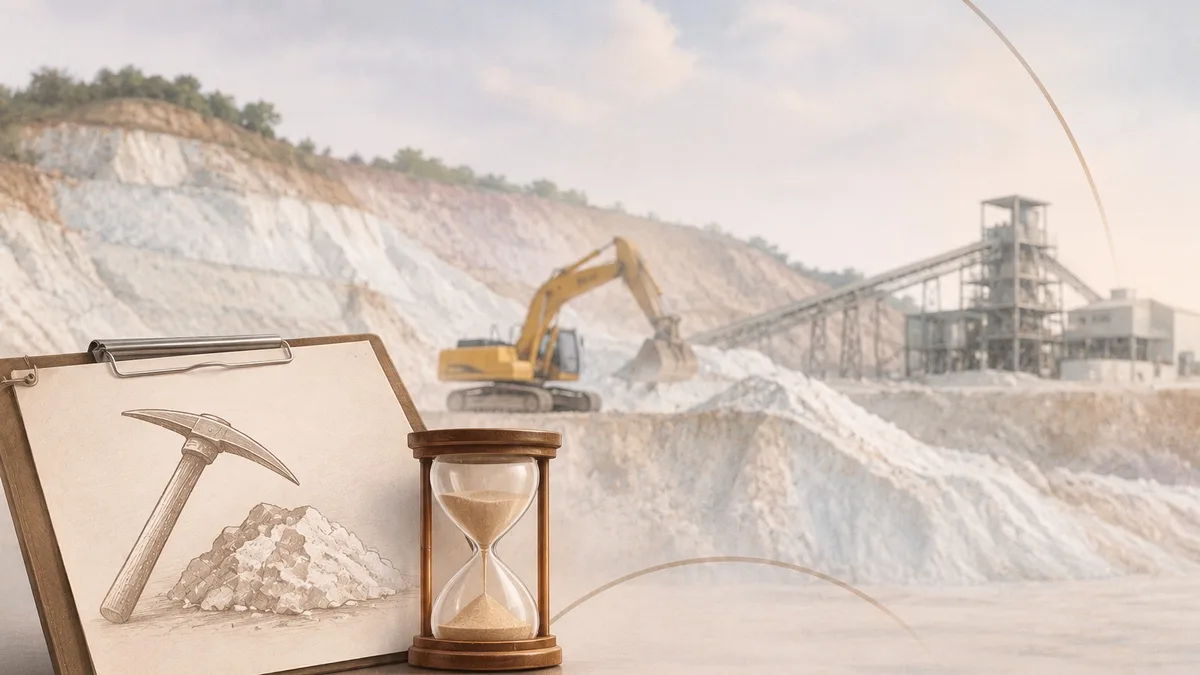
Key Proposition: In computing compensation under Section 21(5) of the MMDR Act for extraction beyond the limit in an Environmental Clearance, the authorities must first allow the ±10% variation accepted by the Supreme Court in Common Cause v. Union of India, applied to annual and not monthly production; only extraction beyond that buffer attracts compensation under the CEC formula.
A. Background / Synopsis :
- The petitioner received EC on 09.04.2010 for 0.72 MTPA; IBM approved a scheme enhancing production to 1.5 MTPA in 2015, a supplementary lease ran till 26.05.2020, and EC for 1.5 MTPA followed the Expert Appraisal Committee's recommendation of January 2019. (Para 3)
- Production for April 2019–March 2020 was accepted by the Deputy Director of Mines, Baripada, and royalty was paid. (Para 3)
- A show cause notice dated 31.05.2023 demanded over ₹50 crore; a fresh notice of 07.05.2024 reduced it to over ₹40 crore, and a demand notice issued on 26.07.2024 despite the petitioner's plea of a 20% variation approved by IBM. (Para 4)
- The Revisional Authority dismissed the revision on 01.10.2025 without dealing with the variation issue; renewal of the trading licence was meanwhile refused for want of a Mining Dues Clearance Certificate. (Paras 2, 5–6)
Whether a permissible variation of ±20% (or any variation) in production can be read harmoniously with Common Cause v. Union of India in relation to production beyond the EC limit. (Para 7)
C. Submissions Of Parties :
- Petitioner:
Production targets are fixed annually, not monthly, and once the annual target is enhanced in the EC, production within it is lawful. (Para 4)
IBM had approved a variation of up to 20% of tentative annual production, so the alleged excess was within permissible limits. (Para 4)
- State:
The ore was extracted within the mining plan limit but beyond the EC limit for 2019-20, which under Common Cause is unlawful extraction attracting Section 21(5); reliance on para 151 of Common Cause. (Paras 7, 14)
D. Court's Observations & Analysis :
- Statutory scheme
Sections 4, 5, 18 and 21(5) of the MMDR Act, the MCR and MCDR, and the EIA Notifications require mining to conform to both the mining plan and the EC; Common Cause held the mining plan subordinate to the EC. (Paras 8–10)
What Common Cause decided on variation
The Hoda Committee noted that IBM allows a grace of ±10% for market fluctuation and process complexity and suggested the same cushion in EC; the Supreme Court found no clarity why the Ministry of Mines shifted to ±20%. (Paras 10–11)
Common Cause permitted at most a 20% variation in a year, subject to the five-year mining plan limit, and held mining beyond permissible limits under the mining plan, EC or FC to be unlawful. (Paras 12–13)
Read as a whole, the Supreme Court accepted the ±10% variation; IBM's assessment covers both yearly extraction and environmental impact, and extraction cannot achieve exact precision. (Para 13)
- Application
Para 151 of Common Cause relates to calculating compensation and does not mean extraction within the ±10% variation attracts compensation or penalty under Section 21(5). (Para 14)
Held: the authorities ought to have allowed the ±10% buffer on annual production while applying the CEC formula in para 155 of Common Cause. (Paras 15–16)
Notable Observations: “…the winning of the minerals manually or in a merchandised way may not bring the strict precision of the limit.” (Para 13)
E. Decision & Directions :
1. Order of the Revisional Authority dated 01.10.2025 and the demand quashed. (Para 16)
2. Authorities directed to recalculate allowing ±10% variation over the EC limit on annual production; if extraction exceeds that limit, compensation is to be calculated under Common Cause with reasonable time to pay. (Para 16)
3. Writ petition disposed of. (Para 17)
Costs: Not stated in judgment.
Separate Opinions: None; judgment by Harish Tandon, CJ, with Chittaranjan Dash, J. agreeing.
F. Legal Provisions Discussed & Precedents Cited :
- Mines and Minerals (Development and Regulation) Act, 1957 – Sections 3(d), 4(1)–(2), 5, 18 and 21(5).
- Mineral Concession Rules, 1960 (Rule 22(5), mining plan) and Mineral Conservation and Development Rules, 1988.
- EIA Notifications dated 27.01.1994 and 2006; Ministry of Mines letter dated 12.12.2011 (20% variation).
- Common Cause v. Union of India, (2017) 9 SCC 499 – Explained and applied.
- W.P.(C) No. 14602 of 2025 (Orissa HC, 20.05.2025) – earlier order on renewal of trading licence, noted.
G. Case Details :
- Case / Party Name: M/s. Lal Trades and Agencies Pvt. Ltd., Mayurbhanj (Petitioner) v. Union of India and others (Opposite Parties)
- Case Number(s): W.P.(C) No. 30325 of 2025; CNR ODHC010749892025; Neutral Citation 2026:OHC:285-DB
- Coram / Judges: Hon'ble the Chief Justice Harish Tandon and Hon'ble Mr. Justice Chittaranjan Dash – Division Bench
- Counsel Appearances: For the Petitioner: Mr. Durga Prasad Nanda, Senior Advocate, assisted by Mr. Subhankar Rout. For the Opposite Parties: Mr. P.K. Parhi, Deputy Solicitor General of India, with Mr. S.S. Kashyap, Central Government Counsel; Mr. D. Tripathy, Additional Government Advocate.
Disclaimer: This summary is an editorial aid and does not form part of the judgment. Refer to the original judgment before citing.
Full Judgement / Attachment
Full Judgement
Frequently asked questions about Orissa High Court
- Where does the Orissa High Court sit and which areas does it cover?
- The Orissa High Court sits in Cuttack. It has jurisdiction over the State of Odisha. It was established in 1948 and retains its historical name, Orissa High Court.
- How do I check Orissa High Court case status and judgements?
- The official website, orissahighcourt.nic.in, provides case status, cause lists and judgements. The court has digitised a large part of its records, and many hearings are held in hybrid mode. Orders are also on the eCourts High Court Services portal (hcservices.ecourts.gov.in).
- What kinds of cases does the Orissa High Court hear?
- It hears writs on service, mining and land matters, civil and criminal appeals from across Odisha, and income-tax appeals arising from the ITAT Cuttack Bench.
- How is a single-judge order of the Orissa High Court appealed?
- Certain single-judge orders, particularly in writ petitions, can be challenged by a Writ Appeal before a Division Bench. A final judgement can be challenged by a Special Leave Petition under Article 136, ordinarily within 90 days.
- How can White Collar Professional help with a Orissa High Court matter?
- Post your requirement on White Collar Professional to receive proposals from verified Advocates, Chartered Accountants and Company Secretaries, compare them, and pay securely through the platform. This page also tracks the latest Orissa High Court judgements and legal updates as they are reported.