
The Supreme Court dismissed the husband’s appeals and upheld the enhancement of interim maintenance payable to his wife from ₹75,000 to ₹1,50,000 per month. The Court found the…
Family Law
Court / Authority
Insurance (IRDAI)
Update / Judgement Date
10 Nov 2026
Date of Publication
12 Nov 2026
Source
WCP News Bulletin
Author
Arshee Saifi — WCP Legal Desk
Reading Time
6 min read
View Count
3
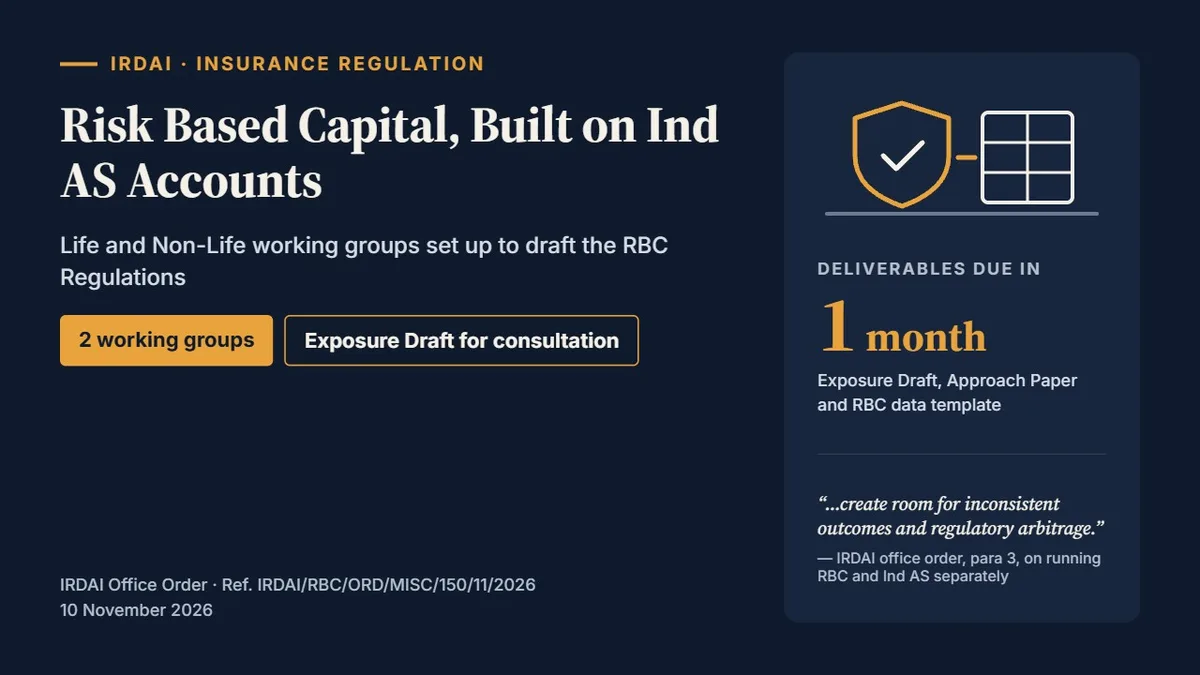
Key Proposition: IRDAI proposes that insurers' Ind AS financial statements form the starting point and basis for the Risk Based Capital framework, with clearly defined adjustments only where RBC's prudential objectives require them, and has tasked two industry working groups with drafting the RBC Regulations on that converged basis within one month.
A. Background :
IRDAI is in the process of transitioning the Indian insurance sector from the existing factor-based solvency regime to an RBC framework. (Para 1)
The IRDAI (Actuarial, Finance and Investment Functions of Insurers) (Amendment) Regulations, 2026, notified on 30.03.2026, require financial statements to be prepared under applicable Ind AS. (Para 2)
Running the two frameworks on unconnected bases would impose duplicative cost on insurers and create room for inconsistent outcomes and regulatory arbitrage. (Para 3)
B. Purpose of the Order :
To give effect to an approach in which Ind AS financial statements form the starting point and basis for RBC, and to develop the regulatory instruments needed for it. (Paras 4–5)
C. Key Provisions of the Order :
A coherent convergence in which a single set of data, models and assumptions serves both Ind AS and RBC as far as possible; the resulting framework must be transparent, comparable, resistant to arbitrage, proportionate and implementable on a realistic transition path.
Full Judgement / Attachment
Full Judgement
© 2026 White Collar Professional Technologies Pvt. Ltd. All rights reserved. CIN: U74999MH2024PTC000001
Preparation of the Exposure Draft of the RBC Regulations and an associated Approach Paper.
Convergence must neither dilute RBC's prudential purpose (policyholder protection at a defined confidence level) nor distort Ind AS objectives (faithful representation).
The groups should examine narrowing the choices Ind AS allows insurers, based on data and outcomes, without curtailing reasoned flexibility.
A standard industry approach should be adopted; where divergence is possible, governance and monitoring of the divergence should be defined.
Every recommendation must be backed by analysis, data and quantified impact, including sensitivity testing.
Valuation of assets and liabilities starting from Ind AS carrying values, with an exhaustive list of permitted and mandatory adjustments; Available Capital and its tiers; Required Capital, risk modules, calibration and diversification.
Treatment of key Ind AS components such as debt securities and ECL, contract boundary, discounting, Contractual Service Margin, risk adjustment, loss component, acquisition cash flows and reinsurance held.
Solvency ratio, supervisory intervention levels and ladder of action under Section 64VA; governance and Board responsibilities; reporting and disclosure; transitional provisions; and consequential amendments.
Approach Paper on alternatives and consequences, covering sensitivity testing, acceptable ranges, materiality, construction of the risk-free yield curve, flooring of negative liabilities or CSM, alignment of risk margin with Ind AS risk adjustment, and the illiquidity premium.
Draft data-submission template, including an Ind AS-to-RBC reconciliation; recommendations on actuarial valuation under Sections 13 and 49 of the Insurance Act, 1938; recalibration and stress factors; and treatment of foreign business.
Ms. Jamuna Choudhary (Life) and Mr. Parmeshwar Shelke (Non-Life), both DGMs (RBC), IRDAI, are Member Conveners.
Quorum is at least 50% of each group's members (separately for joint sittings); meetings may be physical, virtual or hybrid, and video participation counts towards quorum.
Valuation Actuaries or Deputy CFOs may attend in place of or in addition to Appointed Actuaries or CFOs; the groups may co-opt experts; all deliberations, data and drafts are strictly confidential.
Notable Observations: “Running the two frameworks on separate, unconnected bases would impose duplicative cost on insurers, introduce reconciliation complexity, and create room for inconsistent outcomes and regulatory arbitrage.” (Para 3)
D. Deliverables & Timeline :
1. Two Working Groups constituted – Life (Annexure 1) and Non-Life (Annexure 2). (Para 5)
2. Deliverables: Exposure Draft of the RBC Regulations suitable for public consultation, an Approach Paper and a draft RBC data template, with related recommendations. (Paras 14, 16)
3. All work to be completed and deliverables submitted within one month from the date of the order (10.11.2026). (Para 17)
Issued with the approval of the Competent Authority; signed by C. Srinivasa Kumar, CGM (Actuarial & RBC). (Para 18)
E. Statutory Provisions & Instruments Referred :
F. Order Details :
Disclaimer: This summary is an editorial aid and does not form part of the office order. Refer to the original IRDAI order before relying on it.
The Supreme Court dismissed the husband’s appeals and upheld the enhancement of interim maintenance payable to his wife from ₹75,000 to ₹1,50,000 per month. The Court found the…

The Supreme Court allowed the appeal of a woman who suffered severe electrocution injuries, resulting in amputation of her right hand and permanent disability. It set aside the…

The Supreme Court dismissed the Delhi Development Authority’s appeals and upheld directions requiring release of gratuity to two retired employees who had been honourably…

The Supreme Court dismissed the challenge by candidates to the recruitment process for Excise Constables in Nagaland. It held that the recruitment was governed by the Nagaland…

The Supreme Court dismissed the State of Kerala’s appeal against a finding that 12 acres of land in Edakkara Village, Malappuram District, did not constitute private forest and…

The Supreme Court allowed the Union of India’s transfer petitions and directed that two cases registered in Jammu and Kashmir and Haryana be transferred to the NIA Special Court…

The Supreme Court examined the termination of an Associate Professor during probation at the Indian Institute of Science, Bengaluru. The central question was whether a termination…
The Supreme Court considered a batch of appeals arising from the insolvency resolution processes of Videocon Industries Limited VIL , twelve other Videocon group companies and…

A joint venture formed by two companies was a partnership on the substance of its agreement, including the project business, profit-sharing and mutual agency; because the…
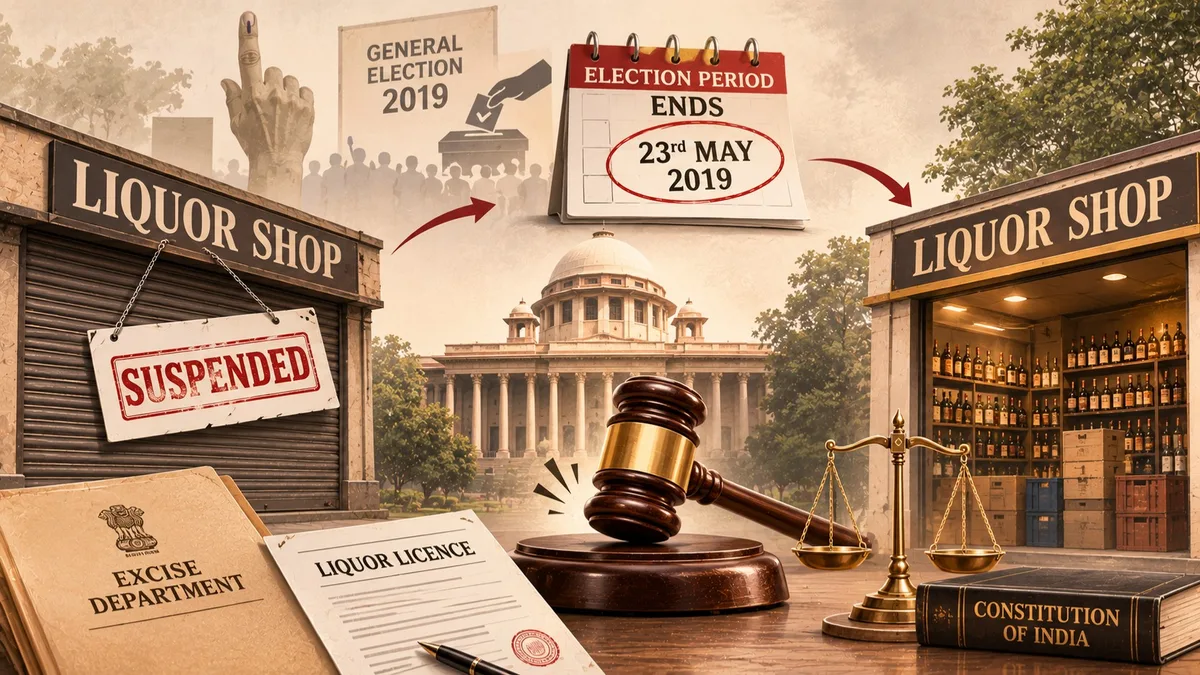
Although no fundamental right exists to carry on the liquor trade, the State cannot keep temporary licences suspended beyond the election period without disclosing cogent reasons…