
The Supreme Court dismissed the husband’s appeals and upheld the enhancement of interim maintenance payable to his wife from ₹75,000 to ₹1,50,000 per month. The Court found the…
Family Law
Court / Authority
Madras High Court
Update / Judgement Date
12 Nov 2026
Date of Publication
16 Nov 2026
Case No.
Case Number W.A. No. 3112 of 2026
Source
WCP News Bulletin
Author
Soumya Gupta — WCP Legal Desk
Reading Time
7 min read
View Count
Background / Synopsis :
● The appellant was employed as a Staff Nurse at the Government Headquarters Hospital, Thirukalukundram, Kancheepuram District. She initially entered service on a contract basis in 2007 and her services were regularised with effect from 30 July 2009.
● A complaint was made by V. Sujatha, wife of Vijayavelu. The appellant’s service record named Ranganathan as her husband, while the birth certificate of the appellant’s daughter identified Vijayavelu as the child’s father. The appellant admitted the relationship and the child’s birth through Vijayavelu, but denied having married him.
● Disciplinary proceedings were initiated for alleged misconduct under Rule 19(2) of the Tamil Nadu Government Servants’ Conduct Rules, 1973. Following the enquiry and consultation with the Tamil Nadu Public Service Commission (TNPSC), the appellant was removed/dismissed from service by order dated 26 February 2018. Her departmental appeal was rejected on 15 October 2018.
● The appellant challenged the appellate order in W.P. No. 426 of 2019. The writ petition was dismissed on 10 April 2026. The present writ appeal was filed under Clause 15 of the Letters Patent.
● In the criminal case, C.C. No. 592 of 2012, the trial court convicted the appellant and Vijayavelu. The appellant’s appeal, Criminal Appeal No. 265 of 2023, was disposed of on 27 June 2024 after the parties compounded the offence with the court’s permission.
● The appellant sought to set aside the disciplinary action and, alternatively, sought reinstatement without continuity of service or monetary benefits.
Issues For Consideration :
Full Judgement / Attachment
Full Judgement
● Whether the appellant’s conduct attracted Rule 19(2) of the Tamil Nadu Government Servants’ Conduct Rules, 1973, even though she disputed having contracted a marriage with Vijayavelu.
● Whether non-supply of the TNPSC’s advice before imposition of the penalty vitiated the disciplinary action.
● Whether the acquittal following compounding of the criminal case removed the basis for disciplinary action.
● Whether dismissal from service was disproportionate in light of the subsequent compromise and other mitigating circumstances.
Submissions Of Parties :
Appellant:
● There was no proof of a bigamous marriage; the appellant admitted her relationship with Vijayavelu but denied marrying him.
● The expression “moral turpitude” was vague and, according to the appellant, did not extend to her personal life or a relationship outside marriage.
● The criminal appeal had ended in acquittal after the complainant and the accused settled the dispute and the offence was compounded.
● The TNPSC’s opinion on the gravity of the punishment had not been supplied to the appellant, allegedly preventing her from effectively contesting the disciplinary action.
● In view of the compromise and dissolution of the complainant’s marriage with Vijayavelu, dismissal was said to be excessive; the appellant sought reinstatement without past service or monetary benefits.
Respondents / State:
● The appellant’s service record recorded Ranganathan as her husband, whereas the child’s birth certificate named Vijayavelu as the father.
● The appellant had availed medical leave around the period of childbirth rather than maternity leave, which the respondents relied upon as part of the alleged concealment of misconduct.
● The appellant’s conduct had led to a criminal complaint and trial, causing embarrassment and discredit to the Government; the disciplinary enquiry and TNPSC consultation had been completed before the penalty was imposed.
Court's Observations & Analysis :
Re: Applicability of Rule 19(2) and moral turpitude
● Rule 19(1) prohibited a Government servant from contracting a marriage with a person who had a living spouse, subject to the stated Government-permission proviso. Rule 19(2) separately prohibited involvement in an act involving moral turpitude, including an unlawful act, that could cause embarrassment or bring discredit to the Government.
● The Court noted that the appellant’s service record named Ranganathan as her husband and that the child’s birth certificate named Vijayavelu as the father. It also recorded that the appellant had declined to provide further details about Ranganathan during the domestic enquiry.
● The Court relied on the criminal proceedings: the trial court had found the appellant guilty and convicted her for the offence under Section 494 IPC read with Section 109 IPC. The appellate acquittal followed compounding of the offence with the court’s permission under Section 320 CrPC.
● The Court held that the acquittal resulting from compounding enabled the appellant to avoid undergoing the sentence but did not wipe out the moral turpitude that had caused embarrassment to the Government. The criminal case and its outcome were treated as sufficient, on the facts, to establish conduct bringing discredit to the Government.
Re: Supply of TNPSC advice
● The Court read the proviso to Rule 17(b) of the Tamil Nadu Civil Services (Discipline and Appeal) Rules, 1955 as requiring consultation with the TNPSC and consideration of its advice before imposing the penalty. It found that the Rule did not mandate supplying a copy of the advice to the delinquent employee. The appellant’s objection on this ground was rejected. (Para 11)
Re: Proportionality and subsequent mitigating circumstances
● The Court stated that a writ court in service matters need not revisit the evidence except to consider the proportionality of the punishment in relation to the delinquency.
● On the facts and law as they stood on the date of the charge memo, the punishment of dismissal was held not to be disproportionate.
● Nevertheless, taking account of the mitigating circumstances placed by the appellant, the Court modified the operative penalty from “dismissal from service” to “removal from service”. It observed that, if the appellant made an application, the respondents could consider reinstatement without past service benefits or a fresh appointment if she was otherwise eligible, as a special case. This was expressly stated to be a suggestion, not a direction.
Notable Observations: The Court referred to “the sweeping changes in the Societal behavior with respect to marital relationships and childbirth” (Para 15).
Decision & Directions :
● The writ appeal was disposed of with modifications and observations; there was no order as to costs.
● The order of dismissal from service was modified to removal from service.
● The respondents were not directed to reinstate the appellant. The Court only observed that, if she made a request, the respondents could consider reinstatement without past service benefits or a fresh appointment, provided she was otherwise eligible, as a special case.
● The Court clarified that the above observation was a suggestion and not a binding direction.
© 2026 White Collar Professional Technologies Pvt. Ltd. All rights reserved. CIN: U74999MH2024PTC000001
The Supreme Court dismissed the husband’s appeals and upheld the enhancement of interim maintenance payable to his wife from ₹75,000 to ₹1,50,000 per month. The Court found the…
The Supreme Court allowed the appeal of a woman who suffered severe electrocution injuries, resulting in amputation of her right hand and permanent disability. It set aside the…

The Supreme Court dismissed the Delhi Development Authority’s appeals and upheld directions requiring release of gratuity to two retired employees who had been honourably…

The Supreme Court dismissed the challenge by candidates to the recruitment process for Excise Constables in Nagaland. It held that the recruitment was governed by the Nagaland…

The Supreme Court dismissed the State of Kerala’s appeal against a finding that 12 acres of land in Edakkara Village, Malappuram District, did not constitute private forest and…

The Supreme Court allowed the Union of India’s transfer petitions and directed that two cases registered in Jammu and Kashmir and Haryana be transferred to the NIA Special Court…

The Supreme Court examined the termination of an Associate Professor during probation at the Indian Institute of Science, Bengaluru. The central question was whether a termination…
The Supreme Court considered a batch of appeals arising from the insolvency resolution processes of Videocon Industries Limited VIL , twelve other Videocon group companies and…
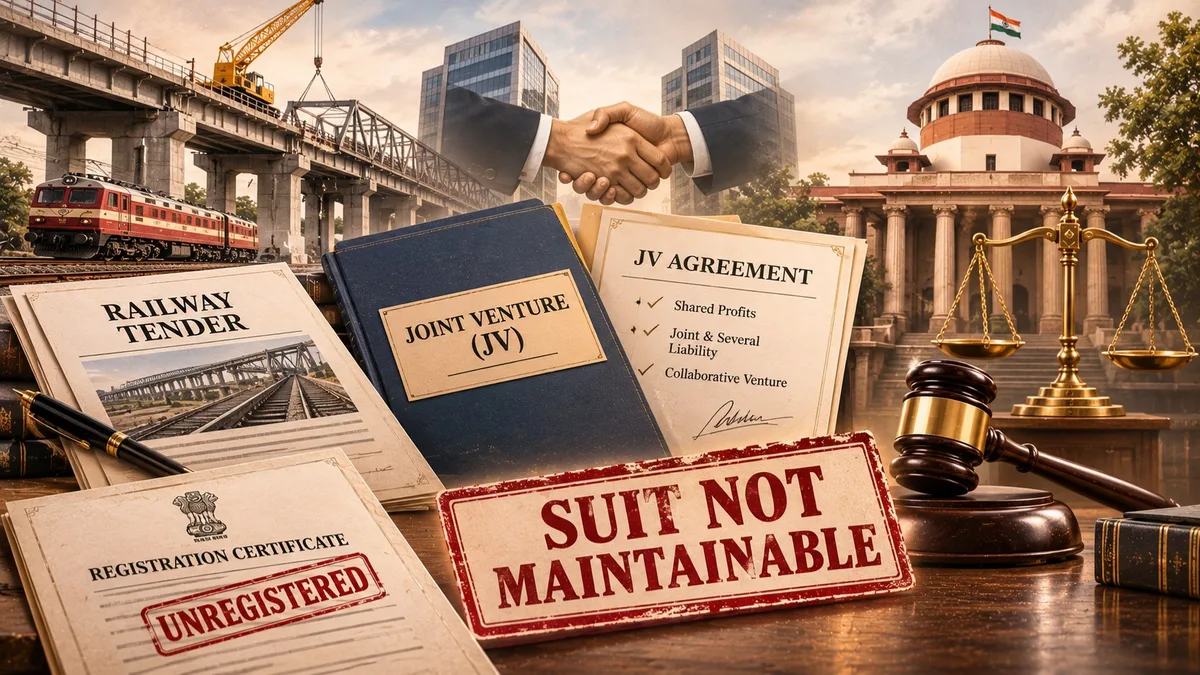
A joint venture formed by two companies was a partnership on the substance of its agreement, including the project business, profit-sharing and mutual agency; because the…
Although no fundamental right exists to carry on the liquor trade, the State cannot keep temporary licences suspended beyond the election period without disclosing cogent reasons…