
The Supreme Court dismissed the husband’s appeals and upheld the enhancement of interim maintenance payable to his wife from ₹75,000 to ₹1,50,000 per month. The Court found the…
Family Law
Court / Authority
Orissa High Court
Update / Judgement Date
09 Nov 2026
Date of Publication
13 Nov 2026
Case No.
W.A. No. 909 of 2026
Source
WCP News Bulletin
Author
Pranjal Jha — WCP Legal Desk
Reading Time
8 min read
View Count
1
Summary
Background and facts
Court's observations and reasoning
A. The statutory requirement of independent application of mind under Section 26(1)
The Court emphasised that Section 26(1) vests the CCI with the power to form a prima facie opinion and direct the Director General to investigate an alleged contravention of the Competition Act.
Although the direction under Section 26(1) is administrative and preliminary in nature, it is not an automatic consequence of receiving a complaint. The CCI must independently examine the material placed before it and arrive at its own satisfaction that a prima facie case exists.
Relying on Competition Commission of India v. Steel Authority of India Ltd., (2010) 10 SCC 744, the Court clarified that the CCI is not required to pass an elaborate speaking order at this stage. However, it must record at least some reasons demonstrating that it applied its mind and formed the requisite prima facie opinion.
In the present case, the minutes dated 23 August 2021 merely recorded that detailed deliberations had taken place and that the CCI had decided to register a suo motu case. The direction to the Director General was to investigate the matter in terms of the directions contained in the Madras High Court's order.
The minutes did not record any prima facie opinion regarding the allegations of cartelisation or disclose even briefly the basis on which the CCI considered an investigation necessary.
The Court therefore held that the minutes failed to demonstrate the independent statutory satisfaction required under Section 26(1).
B. A judicial direction cannot replace a statutory requirement
The CCI argued that the investigation had been initiated pursuant to the Madras High Court's order dated 29 July 2021, which had attained finality.
The Division Bench rejected this argument. It held that the Madras High Court had merely directed the authorities to take appropriate action in accordance with law. That direction did not dispense with the statutory requirements of the Competition Act.
The Court further clarified the distinction between the respective functions of the CCI and the Director General. The power to form a prima facie opinion and direct an investigation belongs to the CCI, whereas the Director General conducts the investigation pursuant to that direction.
A judicial direction to act in accordance with law cannot transfer the CCI's statutory power to the Director General or authorise an investigation without satisfying the statutory precondition.
C. The Director General's power to investigate enterprises not named in the original complaint
An important aspect of the judgment concerns the scope of the Director General's investigative powers.
The Court relied on Excel Crop Care Ltd. v. Competition Commission of India, (2017) 8 SCC 47, and recognised that an investigation need not remain restricted to the enterprises specifically named in the original complaint.
If evidence emerging during a valid investigation reveals the involvement of additional enterprises in anti-competitive conduct, the Director General may investigate them as well. A separate Section 26(1) direction against every additional enterprise is not necessarily required.
However, the Court placed an important qualification on this principle: the additional enterprise must have a demonstrable connection with the subject matter of the original inquiry. The expression in rem does not grant the Director General unrestricted authority to investigate every enterprise operating in a particular industry.
Most importantly, the power to expand an investigation presupposes that the investigation was validly initiated in the first place. It cannot cure the absence of the statutory foundation under Section 26(1).
D. Procedural fairness in formally including an enterprise as an Opposite Party
The Court distinguished between two separate situations:
An enterprise does not have a right to prior notice or hearing merely because the CCI is forming its preliminary opinion under Section 26(1).
However, where an enterprise is formally brought into the proceedings and treated as an Opposite Party, the authority must follow the applicable statutory procedure.
The Court noted that the Director General had obtained the CCI's permission through an order dated 1 July 2025 to investigate certain associations that were not named in the original complaint. No corresponding order or procedure was shown to have been followed in respect of Rungta Mines.
The Court therefore found procedural infirmity in the manner in which Rungta Mines had been brought into the proceedings, particularly in light of Regulation 24 of the CCI (General) Regulations, 2009.
Final decision
Legal significance
Central principle: The CCI's investigative powers are broad, but they must be exercised within the statutory framework. An investigation cannot be sustained merely because the subject matter concerns public interest or competition in the market; the statutory foundation for initiating it must first exist.
© 2026 White Collar Professional Technologies Pvt. Ltd. All rights reserved. CIN: U74999MH2024PTC000001
The Supreme Court dismissed the husband’s appeals and upheld the enhancement of interim maintenance payable to his wife from ₹75,000 to ₹1,50,000 per month. The Court found the…

The Supreme Court allowed the appeal of a woman who suffered severe electrocution injuries, resulting in amputation of her right hand and permanent disability. It set aside the…

The Supreme Court dismissed the Delhi Development Authority’s appeals and upheld directions requiring release of gratuity to two retired employees who had been honourably…

The Supreme Court dismissed the challenge by candidates to the recruitment process for Excise Constables in Nagaland. It held that the recruitment was governed by the Nagaland…

The Supreme Court dismissed the State of Kerala’s appeal against a finding that 12 acres of land in Edakkara Village, Malappuram District, did not constitute private forest and…

The Supreme Court allowed the Union of India’s transfer petitions and directed that two cases registered in Jammu and Kashmir and Haryana be transferred to the NIA Special Court…

The Supreme Court examined the termination of an Associate Professor during probation at the Indian Institute of Science, Bengaluru. The central question was whether a termination…
The Supreme Court considered a batch of appeals arising from the insolvency resolution processes of Videocon Industries Limited VIL , twelve other Videocon group companies and…

A joint venture formed by two companies was a partnership on the substance of its agreement, including the project business, profit-sharing and mutual agency; because the…
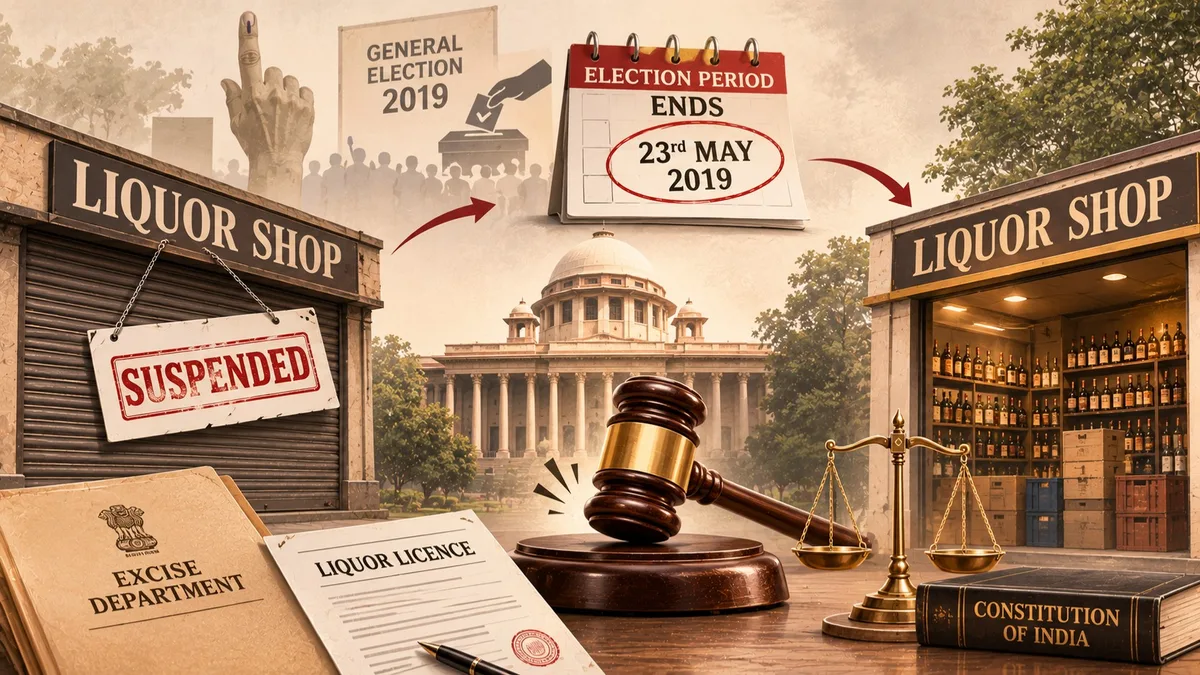
Although no fundamental right exists to carry on the liquor trade, the State cannot keep temporary licences suspended beyond the election period without disclosing cogent reasons…