No Fixed Term, No Right to Stay: Kerala High Court Upholds Withdrawal of Government Nominees from Sree Narayana Guru Open University Syndicate, Says 'Eminent Persons' Should Accept It with Grace
Court / Authority
Kerala High Court
Update / Judgement Date
12 Nov 2026
Source
WCP News Bulletin
Author
Arshee Saifi — WCP Legal Desk
Reading Time
7 min read
View Count
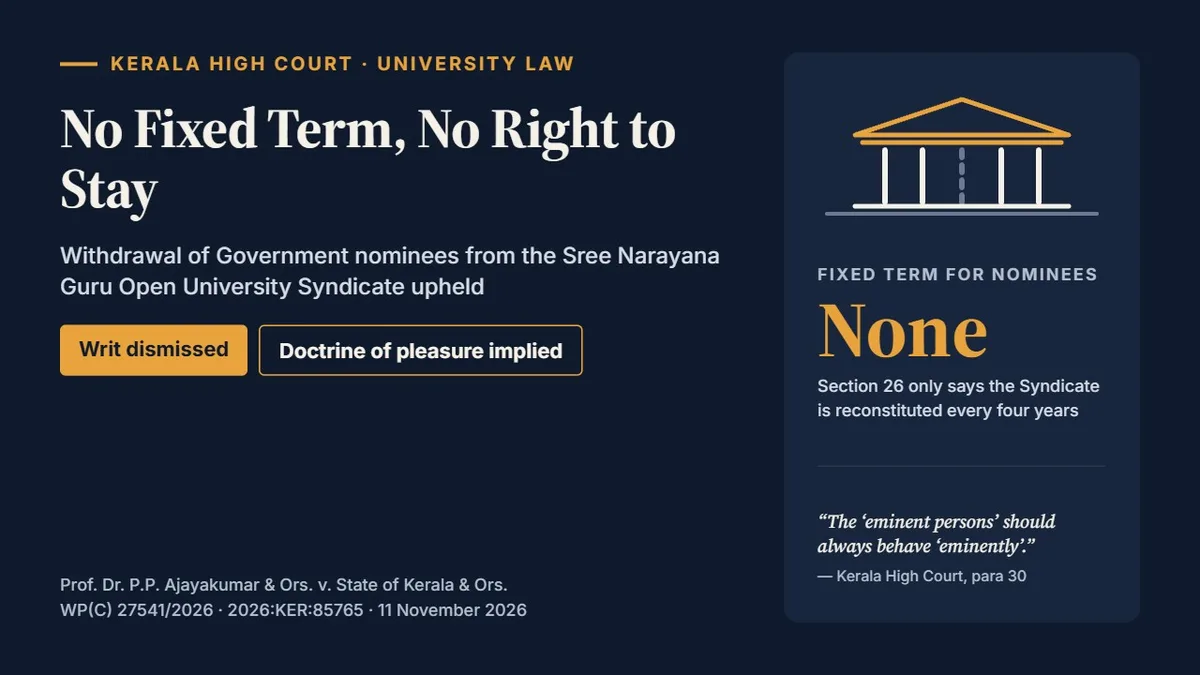
Key Proposition: Where a university statute fixes no term of office for members nominated by the Government to its Syndicate, and only provides that the Syndicate shall be reconstituted every four years, the nominees have no statutory right to continue for four years, and the Government may withdraw their nominations without assigning reasons when the withdrawal casts no stigma.
A. Background / Synopsis :
- The University was established under the Sree Narayana Guru Open University Act, 2021 (Act 1 of 2021); Section 25 provides for eight 'eminent persons' nominated by the Government to its Syndicate. (Paras 1, 10–11)
- By Government Order dated 14.03.2025 (Ext.P1) and the University's notification dated 16.04.2025 (Ext.P2), the petitioners were nominated to the Syndicate; the first petitioner is a former Pro-Vice-Chancellor of Kerala University. (Para 1; Appendix)
- By G.O.(P) No. 30/2026/HEDN dated 01.08.2026 (Ext.P4) and the University's order of the same date (Ext.P5), the Government withdrew the nominations of the petitioners and other members and nominated respondents 5 to 13 in their place. (Paras 3, 9; Appendix)
- Ext.P4 stated no reason; it only recorded that the Government had decided to review the nominations under Section 25. (Para 9)
B. Issues For Consideration :
- Whether a nominated member of the Syndicate is entitled to continue for four years under the 2021 Act. (Para 9)
- Whether the Government can substitute nominated members before such a term ends without assigning any reason. (Para 9)
C. Submissions Of Parties :
- Petitioners:
Read together, Sections 25 and 26 fix a four-year term, which would run till 13.03.2029; unlike other university Acts, the 2021 Act gives no power to recall nominees or invoke the doctrine of pleasure. (Paras 1–2)
Even where that doctrine is expressly provided, it cannot be used arbitrarily (Deepak S.P. v. Chancellor, University of Kerala); the withdrawal without reasons or misconduct violates Article 14, and universities must be kept free of political control. (Paras 2–3, 5)
State and University:
The power to appoint includes the power to dismiss (Section 16, General Clauses Act; State of Maharashtra v. Shaikh Mahemud). (Para 6)
Nomination differs from appointment; the power to nominate includes the power to rescind (Section 21, General Clauses Act), and judicial review of such decisions is limited absent mala fides. (Para 7)
- Respondents 5 to 13:
Section 26 only sets an outer limit for reconstituting the Syndicate; every other Kerala university Act expressly fixes a term for members, which the 2021 Act does not. (Para 8)
D. Court's Observations & Analysis :
- Re: Issue (i): No fixed term
Section 26 fixes no term for the Syndicate or its nominated members and only requires reconstitution every four years; the Kerala University Act, 1974 and other statutes, by contrast, give members a four-year term. (Paras 13–15)
Whether to fix a term is a matter of legislative wisdom, and the Court cannot read one in where the provision is not ambiguous. Ext.P1 and Ext.P2 also mention no term. (Para 15)
Being nominated as an 'eminent person' gives no right to continue in office without statutory backing, and withdrawing a nomination does not withdraw recognition of eminence. (Para 12)
- Re: Issue (ii): Power to withdraw
Section 16 of the General Clauses Act deals with 'appointment', not 'nomination', so it has little application here; Shaikh Mahemud only reiterates Section 16 and was not discussed further. (Paras 16–18)
Thiruvanchoor Radhakrishnan (fixed four-year term under the CUSAT Act), Saji D. Anand (express removal provision) and Cheviti Venkanna Yadav (fixed term) were distinguished; the 2021 Act has neither a fixed term nor a removal provision. (Paras 19–25)
Withdrawing a nomination that the Act empowers the Government to make is not Government domination of the University (All Kerala Pvt. College Teachers' Assn.). (Para 24)
Agreeing with the Karnataka High Court, the doctrine of pleasure can be implied, and once it applies, neither natural justice nor an opportunity before removal arises. (Paras 26–28)
Held: no legal or statutory right of the petitioners is violated; there is nothing to interfere with in the withdrawal orders. (Paras 29–30)
Notable Observations: ““Eminence” alone cannot confer an indefeasible right to continue in office unless there is statutory backing.” (Para 12); “The “eminent persons” should always behave “eminently”.” (Para 30)
E. Decision & Directions :
1. Writ petition dismissed; the withdrawal of the petitioners' nominations (Exts.P4 and P5) upheld. (Para 30)
2. The Court observed that the withdrawal does not mean the petitioners are not 'eminent persons', and that a graceful acceptance would only enhance their eminence. (Paras 12, 30)
Costs: Not stated in judgment.
Separate Opinions: None (Single Judge).
F. Legal Provisions Discussed & Precedents Cited :
- Sree Narayana Guru Open University Act, 2021 – Sections 20, 25 and 26 – authorities of the University, constitution and reconstitution of the Syndicate.
- General Clauses Act, 1897 – Section 16 (power to appoint includes power to dismiss) – held of little application; Section 21 (power to rescind notifications) – noted.
- Constitution of India – Articles 14 and 226.
- Comparable provisions noted: Kerala University Act, 1974 (s.22); CUSAT Act, 1986 (s.17); Mahatma Gandhi University Act, 1985 (s.22); Calicut University Act, 1975 (s.22); Kannur University Act, 1996 (s.24); and other Kerala university statutes. (Para 14)
- Doctrine applied: doctrine of pleasure (implied).
- State of Kerala v. Thiruvanchoor Radhakrishnan, 1997 KHC 155 – Distinguished.
- Saji D. Anand (Single Judge), affirmed in State of Kerala v. Saji D. Anand, 2018 KHC 28 – Distinguished.
- Cheviti Venkanna Yadav v. State of Telangana, (2017) 1 SCC 283 – Distinguished.
- All Kerala Pvt. College Teachers' Assn. v. Nair Service Society, 1994 (5) SCC 479 – Distinguished.
- State of Maharashtra v. Shaikh Mahemud, 2022 (3) KHC 310 – Not applied.
- Karnataka High Court, WA No. 632/2024 (judgment dated 23.01.2025) and WP No. 10851/2023 (judgment dated 28.10.2025) – Relied on / agreed with.
G. Case Details :
- Case / Party Name: Prof. Dr. P.P. Ajayakumar, Adv. G. Sugunan and P. Haridas v. State of Kerala, Sree Narayana Guru Open University, its Vice-Chancellor and Registrar, and the newly nominated members (respondents 5 to 13)
- Case Number(s): WP(C) No. 27541 of 2026; Neutral Citation 2026:KER:85765
- Coram / Judges: Hon'ble Mr. Justice P.V. Kunhikrishnan – Single Judge
- Counsel Appearances: For the Petitioners: Mr. Elvin Peter P.J., Senior Advocate, instructed by Mr. K.R. Ganesh. For the State: Mr. Anoop V. Nair, State Attorney. For the University (R2–R4): Smt. Girija K. Gopal, Standing Counsel. For Respondents 5 to 13: Mr. George Poonthottam, Senior Advocate, instructed by Smt. Nisha George.
Disclaimer: This summary is an editorial aid and does not form part of the judgment. Refer to the original judgment before citing.
Full Judgement / Attachment
Full Judgement
Frequently asked questions about Kerala High Court
- Where does the Kerala High Court sit and which areas does it cover?
- The Kerala High Court sits at Ernakulam, Kochi. It has jurisdiction over the State of Kerala and the Union Territory of Lakshadweep. It was established on 1 November 1956, when the State of Kerala was formed.
- How do I check Kerala High Court case status and judgements?
- The official website, highcourt.kerala.gov.in, provides case status, cause lists, e-filing and judgements. The court has moved most filing and records to digital form. Orders are also on the eCourts High Court Services portal (hcservices.ecourts.gov.in).
- What kinds of cases does the Kerala High Court hear?
- It hears writs, civil and criminal appeals from Kerala and Lakshadweep, and income-tax appeals arising from the ITAT Cochin Bench on substantial questions of law.
- What is a Writ Appeal in the Kerala High Court?
- Under Section 5 of the Kerala High Court Act, 1958, a judgement of a single judge in certain matters, including writ petitions, can be appealed to a Division Bench. A final judgement can be challenged by a Special Leave Petition under Article 136, ordinarily within 90 days.
- How can White Collar Professional help with a Kerala High Court matter?
- Post your requirement on White Collar Professional to receive proposals from verified Advocates, Chartered Accountants and Company Secretaries, compare them, and pay securely through the platform. This page also tracks the latest Kerala High Court judgements and legal updates as they are reported.