Investigation Directions Upheld: No General Pre-Investigation Hearing Right
Court / Authority
Madras High Court
Update / Judgement Date
26 Oct 2026
Date of Publication
27 Oct 2026
Case No.
Cont.P.No.872 of 2026
Source
WCP News Bulletin
Author
Dipanshi Bansal — WCP Legal Desk
Reading Time
8 min read
View Count
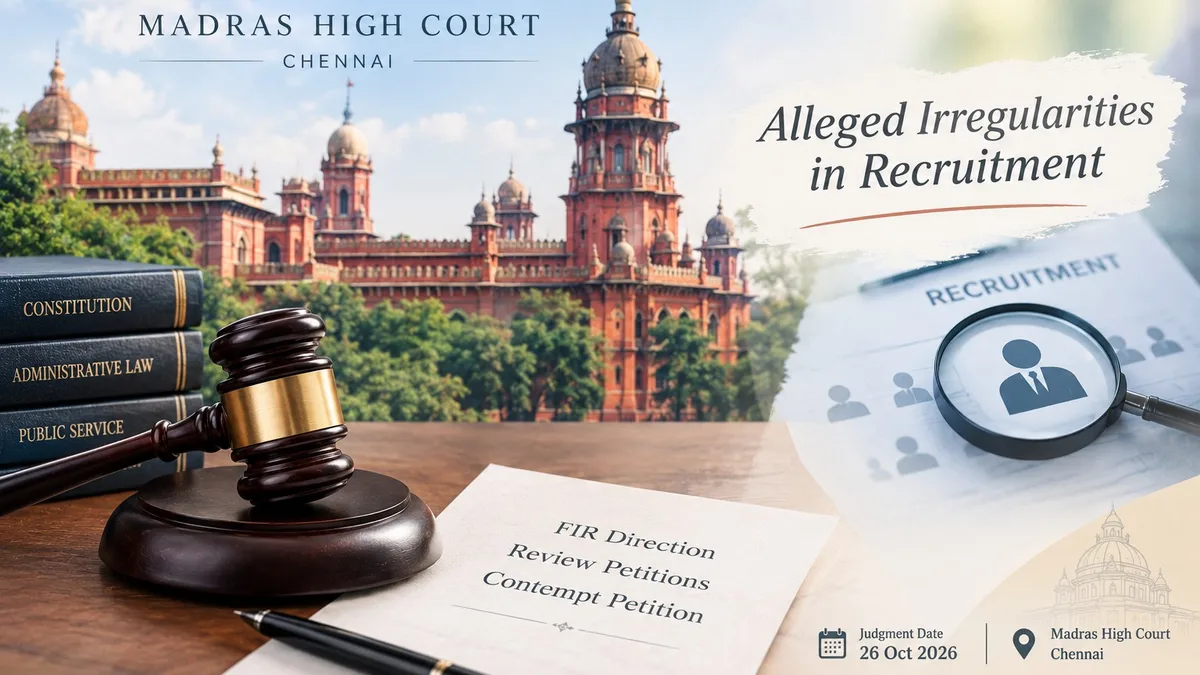
The Madras High Court dismissed the Minister's review application challenging a prior direction to register a case and investigate alleged recruitment irregularities, holding that a person named in the material had no general right to a pre-decisional hearing before an investigation direction. The State's review was dismissed as withdrawn after it stated that an FIR had been registered, and the related contempt petition was closed on an assurance that investigation would proceed. (Paras 12–18, 38–43)
Key Proposition: A direction to register a case and investigate is preliminary and does not ordinarily require a prior hearing for every person who may be investigated; Section 175(4) BNSS is a specific procedural safeguard for Magistrates and does not create a general pre-decisional hearing right in writ proceedings.
- PMLA – Section 66(2) – information forwarded to State authorities – whether it could form the basis for investigation – considered in the earlier order. (Paras 5–8)
- BNSS – Section 175(4) – pre-decisional hearing – whether applicable to a writ court directing registration and investigation – Held, no general right arises. (Paras 38–40)
- Constitution – Article 226 – investigation direction – whether named person must first be heard – Held, no, because the direction is preliminary. (Paras 38–40
- Contempt of Courts Act – Section 11 – compliance with prior direction – petition closed after assurance that investigation would continue. (Paras 42–43)
Background / Synopsis :
- Applications were invited for 2,538 posts in the Tamil Nadu Municipal Administration and Water Supply Department, with appointments made around July 2025.
- During an investigation into an unrelated bank-fraud matter, the Enforcement Directorate reported material allegedly suggesting recruitment irregularities and forwarded approximately 232 pages to the Director General of Police on 27 October 2025 under Section 66(2) of the Prevention of Money Laundering Act (PMLA).
- After no action was perceived, Rajya Sabha Member of Parliament I.S. Inbadurai made a representation to the Directorate of Vigilance and Anti-Corruption (DVAC) on 13 December 2025 and filed W.P.(Crl.) No.74 of 2026.
- On 20 February 2026, the Division Bench directed DVAC to register a case and conduct a detailed, expeditious investigation. The present common order dealt with the State's review application, Minister K.N. Nehru's review application, and the contempt petition alleging non-compliance.
- The State later stated that it did not wish to press its review application and that an FIR had been registered. The Minister's review challenged the absence of a meaningful hearing and the direction to register an FIR.
Issues For Consideration :
- Whether the State could withdraw its review application after changing its position, despite an objection that the State should not take inconsistent positions merely because the Government changed.
- Whether a person named in material prompting a direction to register an FIR was entitled to a pre-decisional hearing in the writ proceedings.
- Whether Section 175(4) of the Bharatiya Nagarik Suraksha Sanhita, 2023 (BNSS) required the Minister to be heard before the High Court directed registration of a case and investigation.
- Whether the contempt petition should continue once the State confirmed that an FIR had been registered and gave an assurance that the investigation would proceed.
Submissions Of Parties :
State of Tamil Nadu (Review Application No.2)
- Initially argued that Section 66(2) PMLA permits information-sharing but does not itself compel FIR registration; that a Magistrate remedy under Section 175(3) BNSS was available; and that a preliminary enquiry under Section 17-A of the Prevention of Corruption Act was already underway.
- The Advocate General later stated that the State no longer wished to press the review and that an FIR had been registered.
K.N. Nehru (Review Application No.3)
- Argued that he had not received a meaningful opportunity to respond before the original order was reserved and that the adverse direction should be reviewed or recalled.
- Contended that the Enforcement Directorate's material could not validly trigger action after related proceedings were quashed and material returned; that a preliminary enquiry was permissible in corruption cases; and that Section 175(4) BNSS required the public servant's version to be considered.
- Also argued that the writ petitioner lacked standing, that the ordinary remedy lay before the Magistrate, and relied on authorities concerning FIR registration, investigation, review and procedural fairness.
I.S. Inbadurai / opposing parties
- The contempt petitioner alleged that DVAC had failed to comply with the 20 February 2026 direction despite receipt of the representation and sought action for wilful disobedience.
- Counsel opposing withdrawal of the State's review argued that the State should not reverse its position solely because a different Government had taken office, invoking the principle against approbation and reprobation.
Court's Observations & Analysis :
Re: State's request to withdraw Review Application No.2
- The Court accepted the Advocate General's statement that the State did not wish to pursue the review and treated the request as a withdrawal of a proceeding instituted by the State itself.
- The Court distinguished impermissible inconsistent positions from a litigant's decision to abandon an objection it no longer wished to press. The doctrine against approbation and reprobation did not prevent the State from withdrawing its own review in these circumstances.
Re: Whether the Minister had a right to be heard before the investigation direction
- The Court relied on the principle that an accused person ordinarily has no right to be heard at the investigation stage before a case is registered or investigation directed.
- It held that an order directing registration of a case and investigation is preliminary and does not determine guilt; the person concerned can present his version during the investigation and subsequent proceedings.
- The Court considered Union of India v. W.N. Chadha and E. Sivakumar v. Union of India, and held that the principle applies whether the direction arises under ordinary criminal law or in proceedings under Article 226 of the Constitution.
Re: Section 175(4) BNSS
- The Court held that Section 175(4) BNSS prescribes a specific safeguard for a Magistrate considering a complaint under Section 175(3), including seeking a superior officer's report and considering the public servant's version.
- It rejected the argument that this statutory procedure creates a general right to a pre-decisional hearing in every proceeding that may lead to investigation, including a writ petition acting on information already forwarded by a statutory agency.
Re: Contempt petition
- Following withdrawal of the State's review, the Advocate General gave a clear assurance that the concerned authority would carry the investigation forward on the basis of the registered FIR.
- The Court held that the grievance underlying the contempt petition had thereby been met and that there was no purpose in keeping it pending.
Decision & Directions :
- Review Application No.2 of 2026, filed by the State of Tamil Nadu, was dismissed as withdrawn.
- Review Application No.3 of 2026, filed by K.N. Nehru, was dismissed.
- Contempt Petition No.872 of 2026 was closed in view of the assurance that investigation would proceed on the basis of the registered FIR.
- No order as to costs; connected miscellaneous petitions were closed.
Legal Provisions Discussed & Precedents Cited :
- PMLA, 2002 – Section 66(2): transmission of information by the Enforcement Directorate to the State authorities.
- Constitution of India – Article 226: writ jurisdiction under which the original direction for registration and investigation had been issued.
- Code of Civil Procedure, 1908 – Section 114 and Order XLVII Rules 1–2: review jurisdiction invoked by the applicants.
- BNSS, 2023 – Sections 175(3) and 175(4): Magistrate-directed investigation and the specific procedure where a public servant is concerned.
- Prevention of Corruption Act, 1988 – Section 17-A: prior approval relied upon in relation to the preliminary enquiry.
- Contempt of Courts Act, 1971 – Section 11: invoked in the contempt petition.
- Lalita Kumari v. Government of U.P., (2014) 2 SCC 1 – referred to on preliminary enquiries in specified categories, including corruption cases.
- Union of India v. W.N. Chadha – relied on for the principle that an accused has no right to be heard at the investigation stage.
- E. Sivakumar v. Union of India, (2018) 7 SCC 365 – relied on regarding absence of a right to be heard before a direction for investigation.
- A.P. Dairy Development Corpn. Federation v. B. Narasimha Reddy, (2011) 9 SCC 286, and State of T.N. v. K. Shyam Sunder, (2011) 8 SCC 737 – considered on continuity of the State's position and the limits of that principle.
Full Judgement / Attachment
Full Judgement
Frequently asked questions about Madras High Court
- Where does the Madras High Court sit and which areas does it cover?
- The Madras High Court has its principal seat in Chennai and a bench at Madurai. It has jurisdiction over Tamil Nadu and the Union Territory of Puducherry. Established in 1862, it is one of India's three oldest High Courts.
- Where can I find Madras High Court judgements and daily orders?
- Judgements and daily orders of both the principal seat at Chennai and the Madurai Bench are searchable on the court's judgements portal, mhc.tn.gov.in/judis. Case status is also on the eCourts High Court Services portal (hcservices.ecourts.gov.in).
- Which cases go to the Madurai Bench of the Madras High Court?
- The Madurai Bench, functioning since 2004, hears cases from the southern districts of Tamil Nadu, and the principal seat in Chennai hears the rest of the state and Puducherry. Chennai also has an Original Side for high-value suits and commercial cases, and hears tax appeals from the ITAT Chennai Bench.
- How is a single-judge order of the Madras High Court appealed?
- Writ orders of a single judge are challenged by a Writ Appeal under Clause 15 of the Letters Patent, and Original Side decisions by an Original Side Appeal (OSA), both before a Division Bench. A final judgement can be challenged by a Special Leave Petition under Article 136, ordinarily within 90 days.
- How can White Collar Professional help with a Madras High Court matter?
- Post your requirement on White Collar Professional to receive proposals from verified Advocates, Chartered Accountants and Company Secretaries, compare them, and pay securely through the platform. This page also tracks the latest Madras High Court judgements and legal updates as they are reported.