Madras High Court Directs Expedited Tribunal Hearing in Waqf Dispute, Preferably Within 12 Weeks
Court / Authority
Madras High Court
Update / Judgement Date
27 Oct 2026
Date of Publication
30 Oct 2026
Case No.
CMA No. 3551 of 2026, connected with CMP No. 28969 of 2026
Source
WCP News Bulletin
Author
Pranjal Jha — WCP Legal Desk
Reading Time
8 min read
View Count
Field Details
- Case/Party Name- Abdul Wahab v. The Tamil Nadu Waqf Board & Ors.
- Court Name- High Court of Judicature at Madras
- Case Number(s)- CMA No. 3551 of 2026, connected with CMP No. 28969 of 2026
- Coram / Judges- The Hon’ble Mrs Justice N. Mala, Single Judge
- Judgment Authored By- Justice N. Mala
- Date of Decision- 27 October 2026
- Nature of Proceedings- Civil Miscellaneous Appeal under Section 83(9) of the Waqf Act, 1995
- Letters Patent / Appeals- No Letters Patent Appeal. The present appeal challenges the docket order dated 10 September 2026 in IA No. 452 of 2026 in OA No. 122 of 2026 before the Tamil Nadu Waqf Tribunal.
- Counsel Appearances- Appellant: Y. Kajanavas. Respondents 1–2: Mrs Rajeswari Karthikeyan, Standing Counsel for the Tamil Nadu Waqf Board. Respondents 3–9: Senior Advocate N. Nissar Ahmed, instructed by I. Abdul Basith, counsel for the caveators.
- Outcome- Disposed of at the admission stage, with a direction to the Waqf Tribunal to dispose of the interim application as expeditiously as possible, preferably within 12 weeks. No costs.
B. HEADNOTE
Key Proposition: Where the appellant elects to pursue an interim application before the competent Waqf Tribunal rather than have the High Court consider the matter on merits, the High Court may dispose of the appeal by directing expeditious consideration of that application without adjudicating the underlying dispute.
Catchwords
- Waqf Act, 1995 – Section 83(9) – Civil Miscellaneous Appeal – Interim application – Tribunal proceedings – Held, the appeal was disposed of with a direction for expeditious disposal of the interim application, preferably within 12 weeks. (Paras 5–10)
- Waqf Act, 1995 – Section 83(2) – Challenge to Waqf Board resolution and appointment of Muthawalli – Interim stay – Held, the High Court did not decide the merits after the appellant opted to pursue the application before the Tribunal. (Paras 4–7)
- Civil procedure – Interim relief – Expeditious adjudication – Held, the Tribunal was directed to dispose of the pending interim application as expeditiously as possible, preferably within the specified period. (Paras 7–10)
Headnote
The appellant claimed to be the elected Muthawalli/Administrator of Nawab Abdul Nabi Khan Mosque Waqf at Chidambaram. He challenged a Waqf Board resolution dated 17 April 2025 and consequential proceedings dated 22 May 2025 appointing another person as hereditary Muthawalli and constituting a seven-member committee. After earlier writ proceedings, the appellant approached the Waqf Tribunal and sought interim protection. The Tribunal issued notice to the respondents rather than granting the requested interim stay at that stage. The appellant challenged that docket order before the High Court. When the High Court indicated that a merits hearing might prejudice the pending interim application, the appellant elected to pursue the matter before the Tribunal. The High Court consequently refrained from examining the merits and directed the Tribunal to dispose of the interim application preferably within 12 weeks of receiving a copy of the judgment. The appeal was disposed of without costs.
C. BACKGROUND / SYNOPSIS
Key facts
- The appellant, Abdul Wahab, claimed to be the elected Muthawalli/Administrator of Nawab Abdul Nabi Khan Mosque Waqf, Chidambaram.
- He stated that he had managed the day-to-day affairs of the Jamath for over four decades.
- He claimed that he had been unanimously elected by the Jamath through a resolution dated 27 April 2024.
- The Tamil Nadu Waqf Board passed a resolution under Item No. 42/25 dated 17 April 2025.
- A consequential order dated 22 May 2025 appointed the third respondent as hereditary Muthawalli and constituted a seven-member committee.
- The appellant challenged these actions and sought an interim stay of their operation pending disposal of his original application before the Waqf Tribunal. These are the appellant’s stated claims, not findings finally determined by the High Court.
Procedural history
- 17 April 2025: The Waqf Board passed the challenged resolution.
- 22 May 2025: Consequential proceedings were issued appointing the third respondent as hereditary Muthawalli and constituting a seven-member committee.
- 2025: The appellant filed W.P. No. 44468 of 2025. It was dismissed on 1 June 2026.
- 2026: In W.A. No. 1494 of 2026, the appellant was granted liberty to approach the Waqf Tribunal to decide the issues raised in the writ petition.
- 2026: The appellant filed OA No. 122 of 2026 before the Tamil Nadu Waqf Tribunal and IA No. 452 of 2026 seeking interim protection.
- 10 September 2026: The Tribunal issued notice to the respondents in the interim application.
- 27 October 2026: The High Court disposed of CMA No. 3551 of 2026 and directed expedited disposal of the interim application, preferably within 12 weeks from receipt of a copy of the judgment.
Impugned order and relief sought
- The appeal challenged the Tribunal’s docket order dated 10 September 2026, which directed issuance of notice in IA No. 452 of 2026. The appellant sought to set aside that order and obtain an ad-interim stay against implementation of the Waqf Board resolution and consequential proceedings pending disposal of OA No. 122 of 2026.
- The High Court did not grant the requested stay or determine whether the challenged appointments were lawful. Instead, it directed the Tribunal to expedite the interim application.
D. ISSUES FOR CONSIDERATION
The judgment does not formally frame issues. The following emerge from the proceedings:
- Whether the High Court should examine the merits of the appeal against the Tribunal’s order issuing notice in the interim application, or leave the interim dispute to be considered by the Tribunal.
- Whether a time-bound direction should be issued for disposal of IA No. 452 of 2026 in OA No. 122 of 2026.
- Whether the High Court should determine the merits of the underlying dispute concerning the Waqf Board’s resolution and appointment of the Muthawalli at this stage.
E. SUBMISSIONS OF PARTIES
Petitioner / Appellant
- The appellant claimed to have managed the mosque Waqf’s affairs for more than four decades.
- He asserted that the Jamath had unanimously elected him on 27 April 2024.
- He challenged the Waqf Board’s resolution and the consequential proceedings appointing the third respondent as hereditary Muthawalli and constituting a committee.
- He claimed that the respondents were taking urgent steps to implement the challenged orders, creating a need for interim protection.
- When the High Court offered him the option of contesting the merits before it or pursuing the interim application before the Tribunal, his counsel opted for the Tribunal route and requested that a timeframe be fixed for disposal of the application.
Respondents
- The Standing Counsel accepted notice on behalf of respondents 1 and 2.
- Counsel for respondents 3–9 also accepted notice.
- The respondents’ counsel submitted that the parties would cooperate in the expeditious disposal of IA No. 452 of 2026.
F. COURT'S OBSERVATIONS & ANALYSIS
Re: Issue (i) – Whether the High Court should examine the merits
- The appeal arose from a docket order directing issuance of notice to the respondents in the interim application.
- The Court informed the appellant’s counsel that a merits hearing before the High Court could prejudice the appellant’s rights in the pending interim application.
- The appellant was given the option of contesting the matter before the High Court or before the Tribunal.
- The appellant chose to pursue the matter before the Tribunal.
- In light of that choice, the Court considered it unnecessary to enter into the merits of the case.
Held: The High Court did not adjudicate the substantive dispute over the Waqf Board’s resolution or the appointment of the Muthawalli.
Re: Issue (ii) – Whether to prescribe a timeframe for the interim application
- The appellant expressly requested that a timeframe be fixed for disposal of the interim application.
- Counsel for the respondents stated that the parties would cooperate with an expeditious hearing.
- The Court directed the Tribunal to dispose of IA No. 452 of 2026 in OA No. 122 of 2026 as expeditiously as possible.
- It specified that disposal should preferably occur within 12 weeks from the date the Tribunal received a copy of the judgment.
Held: The Tribunal was directed to expedite the interim application, preferably within 12 weeks. The timeframe is expressed as a preference, rather than an unconditional mandatory deadline.
Re: Issue (iii) – Merits of the Waqf Board’s actions
- The Court deliberately refrained from entering into the merits because the appellant elected to proceed before the Tribunal.
- No final finding was made on the validity of the resolution, the appointment of the hereditary Muthawalli, the constitution of the committee or the appellant’s entitlement to interim protection.
Held: The underlying merits remained for consideration in the proceedings before the Tribunal.
G. DECISION & DIRECTIONS
The Civil Miscellaneous Appeal was disposed of at the admission stage, with no order as to costs.
The Court issued the following direction:
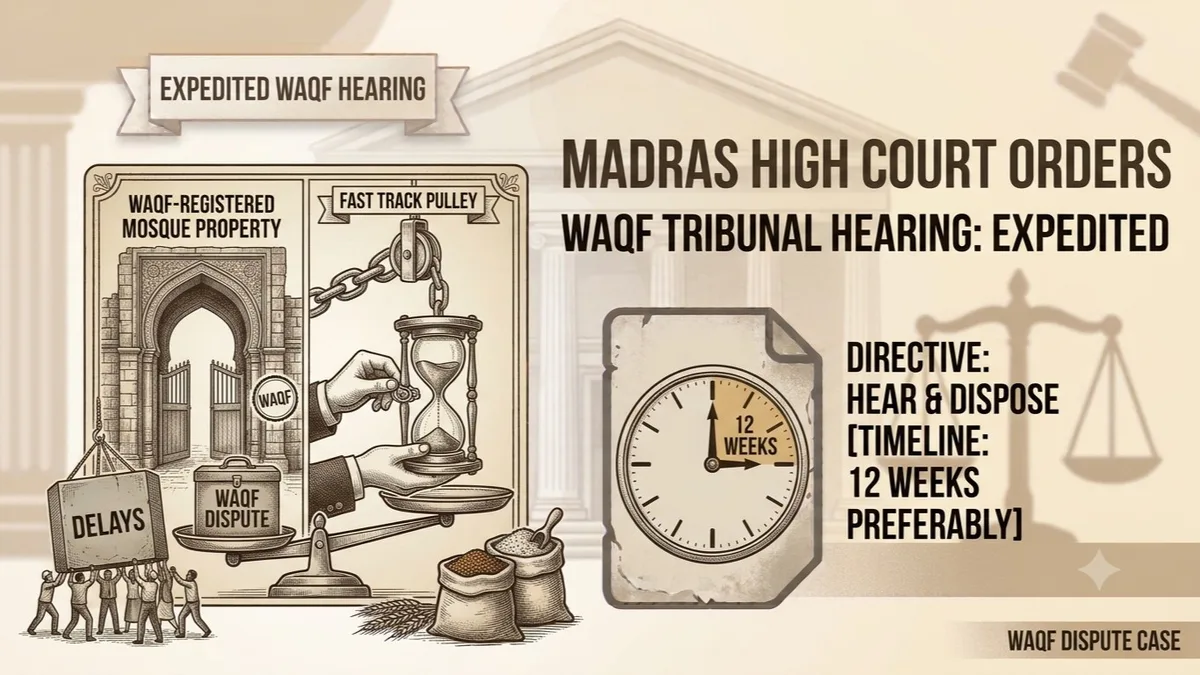
- The Tamil Nadu Waqf Tribunal must dispose of IA No. 452 of 2026 in OA No. 122 of 2026 as expeditiously as possible, preferably within 12 weeks from the date of receipt of a copy of the judgment.
- The respondents’ counsel undertook that the parties would cooperate in expeditious disposal.
- CMP No. 28969 of 2026, the connected miscellaneous petition, was closed.
H. LEGAL PROVISIONS DISCUSSED
Provision Relevance
- Waqf Act, 1995 – Section 83(9) Invoked as the provision under which the Civil Miscellaneous Appeal was filed.
- Waqf Act, 1995 – Section 83(2) Invoked in the original application before the Waqf Tribunal.
- Code of Civil Procedure, 1908 – Order VII Rule 1 Cited in connection with the original application before the Tribunal.
I. PRECEDENTS CITED
None discussed.
Full Judgement / Attachment
Full Judgement
Frequently asked questions about Madras High Court
- Where does the Madras High Court sit and which areas does it cover?
- The Madras High Court has its principal seat in Chennai and a bench at Madurai. It has jurisdiction over Tamil Nadu and the Union Territory of Puducherry. Established in 1862, it is one of India's three oldest High Courts.
- Where can I find Madras High Court judgements and daily orders?
- Judgements and daily orders of both the principal seat at Chennai and the Madurai Bench are searchable on the court's judgements portal, mhc.tn.gov.in/judis. Case status is also on the eCourts High Court Services portal (hcservices.ecourts.gov.in).
- Which cases go to the Madurai Bench of the Madras High Court?
- The Madurai Bench, functioning since 2004, hears cases from the southern districts of Tamil Nadu, and the principal seat in Chennai hears the rest of the state and Puducherry. Chennai also has an Original Side for high-value suits and commercial cases, and hears tax appeals from the ITAT Chennai Bench.
- How is a single-judge order of the Madras High Court appealed?
- Writ orders of a single judge are challenged by a Writ Appeal under Clause 15 of the Letters Patent, and Original Side decisions by an Original Side Appeal (OSA), both before a Division Bench. A final judgement can be challenged by a Special Leave Petition under Article 136, ordinarily within 90 days.
- How can White Collar Professional help with a Madras High Court matter?
- Post your requirement on White Collar Professional to receive proposals from verified Advocates, Chartered Accountants and Company Secretaries, compare them, and pay securely through the platform. This page also tracks the latest Madras High Court judgements and legal updates as they are reported.