Denial of Reasonable Adjournment Violated Natural Justice in Odisha Sales-Tax Appeals
Court / Authority
Orissa High Court
Update / Judgement Date
18 Nov 2026
Date of Publication
21 Nov 2026
Case No.
W.P.(C) Nos. 16677, 16800 and 17164 of 2026
Source
WCP News Bulletin
Author
Dipanshi Bansal — WCP Legal Desk
Reading Time
4 min read
View Count
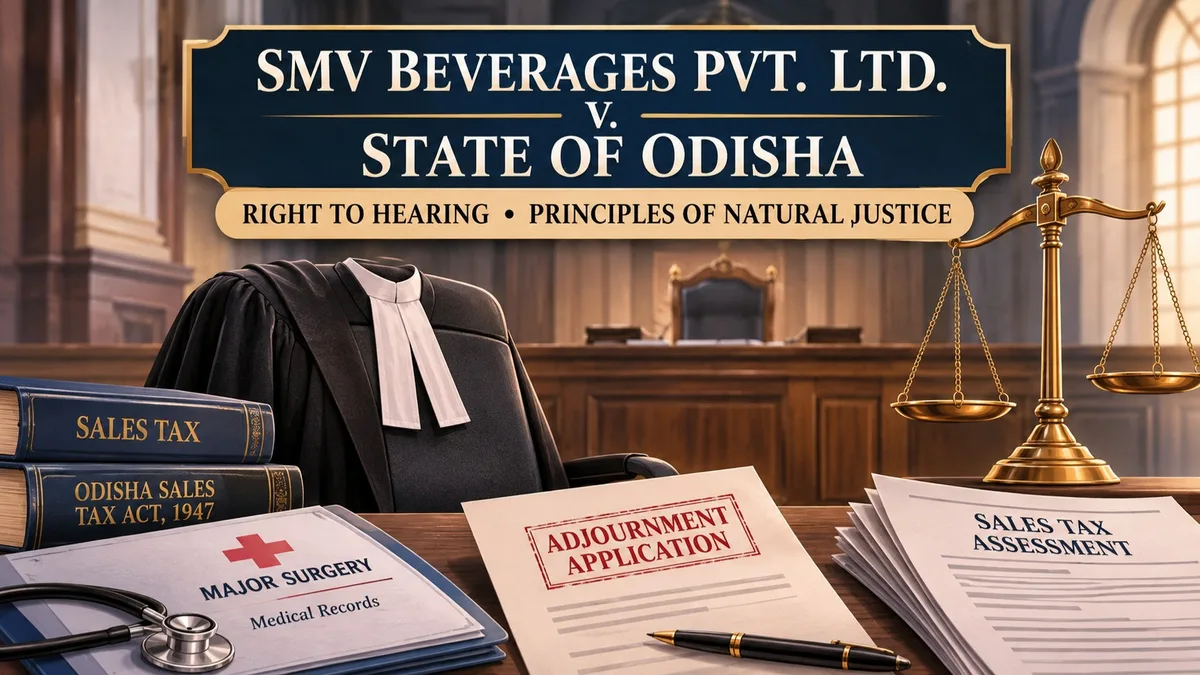
The Division Bench held that the petitioner had been deprived of a reasonable opportunity to present its case before the Commissioner of Sales Tax. An adjournment request must be assessed independently on its own facts, and earlier adjournments do not justify mechanically rejecting a later request where sufficient cause is shown. The orders dismissing the statutory appeals were set aside and the appeals restored for fresh hearing (Paras 7–9).
Key Proposition: A statutory appellate authority must independently assess each adjournment request and cannot deny a party a reasonable opportunity of hearing merely by relying on the fact that earlier adjournments were granted.
- Odisha Sales Tax Act, 1947 – Section 23(4)(c) – Statutory appeal – Whether refusal of a reasonable adjournment deprived the taxpayer of natural justice? – Held, yes. (Paras 7–9)
Background / Synopsis :
- M/s. SMV Beverages Private Ltd. filed three appeals under Section 23(4)(c) of the Odisha Sales Tax Act, 1947.
- The Commissioner of Sales Tax, Odisha, passed a common order dated 7 January 2026 in Appeal Nos. CU-II-58, 59 and 60/OST/2023-24.
- The petitioner challenged the order on the ground that it had not been afforded a fair and reasonable opportunity to present its case, including in relation to its request for adjournment.
Issues For Consideration :
- Whether the Commissioner’s refusal to grant an adjournment, in the circumstances recorded in the judgment, violated the principles of natural justice.
- Whether the appellate orders should be set aside and the appeals restored for fresh consideration.
Submissions Of Parties :
Petitioner / Appellant:
The petitioner contended that sufficient and reasonable cause prevented its appearance on the date fixed for hearing and that the appeals had been decided without a fair opportunity of being heard.
Respondent / State:
The State defended the impugned appellate order. The judgment considered the circumstances surrounding the adjournment request and the authorities on fair hearing.
Court's Observations & Analysis :
Re: Reasonable opportunity and adjournment
- The Court considered the facts explaining the petitioner’s inability to appear on the hearing date and the principles governing adjournment requests.
- Each adjournment application must be considered independently and on its own merits, uninfluenced merely by the reasons for which earlier adjournments had been granted.
- The Court found sufficient and reasonable cause preventing the petitioner from appearing before the Commissioner.
- The refusal deprived the petitioner of a fair opportunity to present its case, violating a facet of natural justice.
- Held: The appellate order could not stand because the petitioner was denied reasonable opportunity of hearing. (Paras 7.11–9)
Re: Appropriate relief
- The Court set aside the common order and restored the statutory appeals to their original file.
- The Commissioner was directed to hear the appeals afresh after granting reasonable opportunity and to pass appropriate orders in accordance with law.
- Held: Writ petitions disposed of with restoration and fresh hearing directions. (Para 9)
Notable Observations: The Court stated that each adjournment petition must be independently considered, uninfluenced by the reasons for which earlier adjournments were granted. (Para 7.11).
Decision & Directions :
- The order dated 7 January 2026 in Appeal Nos. CU-II-58, 59 and 60/OST/2023-24 was set aside.
- The three statutory appeals were restored to their original file before the Commissioner of Sales Tax, who was directed to grant reasonable opportunity of hearing and decide them afresh in accordance with law.
- Pending interlocutory applications, if any, stood disposed of. No separate opinion.
Legal Provisions Discussed & Precedents Cited :
- Odisha Sales Tax Act, 1947 – Section 23(4)(c) – Appellate jurisdiction under which the impugned appeals had been filed.
- Principles of natural justice – Right to fair hearing and reasonable opportunity to present one’s case.
- The judgment refers to judicial authorities on adjournment requests and the requirement of reasonable opportunity; the discussion includes the principle that an adjournment request must be assessed on its own facts.
Case Details :
- Case / Party Name: M/s. SMV Beverages Private Ltd. v. State of Odisha & Ors.
- Case Number(s): W.P.(C) Nos. 16677, 16800 and 17164 of 2026
- Coram / Judges: Dr. Sanjeeb K. Panigrahi and M.S. Raman, JJ. – Division Bench
- Counsel Appearances: For petitioner: Mr. Rudra Prasad Kar, Senior Advocate, assisted by Mr. Santosh Kumar Mishra, Advocate. For State: Mr. Sunil Mishra, Standing Counsel.
Disclaimer: This summary is an editorial aid and does not form part of the judgment. Refer to the original judgment before citing.
Full Judgement / Attachment
Full Judgement
Frequently asked questions about Orissa High Court
- Where does the Orissa High Court sit and which areas does it cover?
- The Orissa High Court sits in Cuttack. It has jurisdiction over the State of Odisha. It was established in 1948 and retains its historical name, Orissa High Court.
- How do I check Orissa High Court case status and judgements?
- The official website, orissahighcourt.nic.in, provides case status, cause lists and judgements. The court has digitised a large part of its records, and many hearings are held in hybrid mode. Orders are also on the eCourts High Court Services portal (hcservices.ecourts.gov.in).
- What kinds of cases does the Orissa High Court hear?
- It hears writs on service, mining and land matters, civil and criminal appeals from across Odisha, and income-tax appeals arising from the ITAT Cuttack Bench.
- How is a single-judge order of the Orissa High Court appealed?
- Certain single-judge orders, particularly in writ petitions, can be challenged by a Writ Appeal before a Division Bench. A final judgement can be challenged by a Special Leave Petition under Article 136, ordinarily within 90 days.
- How can White Collar Professional help with a Orissa High Court matter?
- Post your requirement on White Collar Professional to receive proposals from verified Advocates, Chartered Accountants and Company Secretaries, compare them, and pay securely through the platform. This page also tracks the latest Orissa High Court judgements and legal updates as they are reported.