Mere Recovery of Tainted Money Cannot Sustain Bribery Conviction Without Proof of Demand: Supreme Court
Court / Authority
Supreme Court of India
Update / Judgement Date
17 Nov 2026
Source
WCP News Bulletin
Author
Dipanshi Bansal — WCP Legal Desk
Reading Time
2 min read
View Count

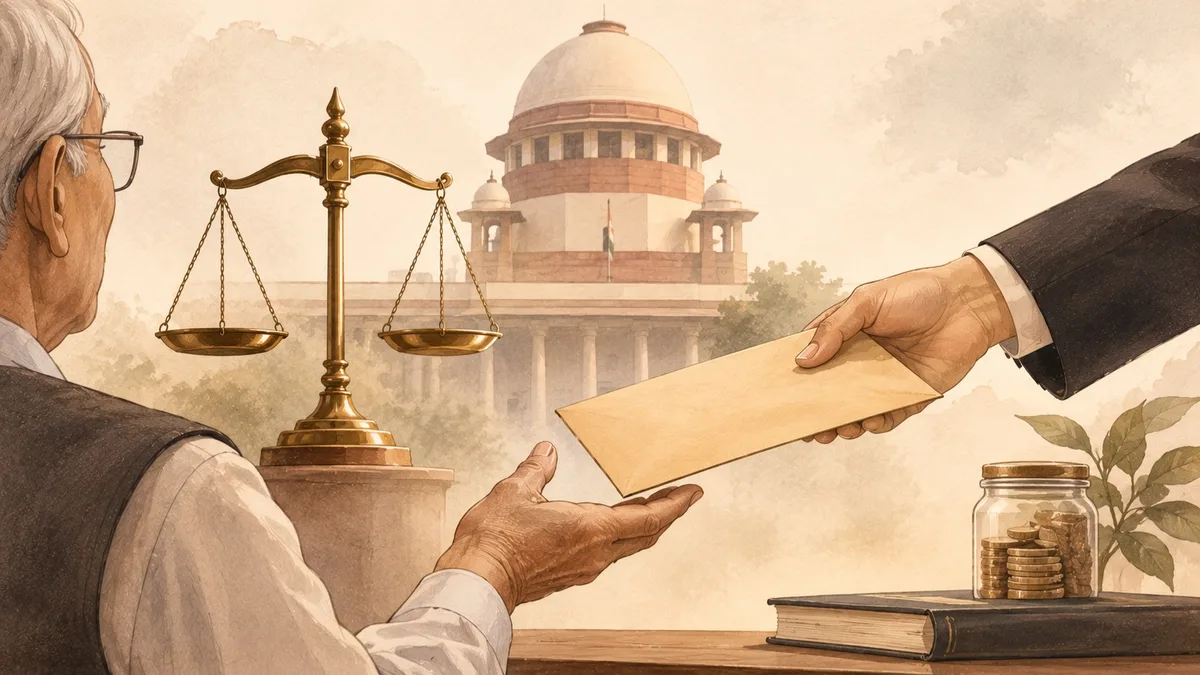
The appellant, a public servant, had been convicted under Sections 7 and 13(1)(d), punishable under Section 13(2), of the Prevention of Corruption Act, 1988, on allegations that he demanded and accepted a bribe of ₹1,000 to forward two recovery cheques to the Labour Department. The prosecution relied substantially on recovery of tainted currency notes and positive hand/pocket wash results. The Supreme Court examined whether the essential element of demand and conscious acceptance had been proved.
Key Legal Issues
Whether recovery of tainted currency and positive chemical wash results, without reliable proof of demand and conscious acceptance, could sustain a corruption conviction; and whether the official record supported the prosecution’s allegation that the public servant had withheld the cheques to extract a bribe.
Analysis and Findings
The Court reiterated that mere recovery of tainted money is not enough where the prosecution fails to establish the demand for illegal gratification. Contemporaneous official records showed that the two cheques had already been dispatched by the appellant’s office on 28 December 2002 and were received by the Labour Department on 1 January 2003. The complainant collected them on 7 January 2003. Therefore, no related official work remained pending with the appellant on the alleged date of demand, 6 January 2003. This materially undermined the prosecution version. The appellant’s explanation that the complainant had attempted to thrust the money into his coat pocket while expressing gratitude was considered plausible. The defence needed to establish its version only on a preponderance of probabilities to rebut the statutory presumption under Section 20; the prosecution, by contrast, had to prove guilt beyond reasonable doubt.
Final Outcome
The appeal was allowed. The Supreme Court set aside the High Court and Special Judge judgments, acquitted Har Parsad Gaur of the charges under the Prevention of Corruption Act, and directed that his bail bonds stand discharged.
Relevant Law and Precedents
Sections 7, 13(1)(d), 13(2) and 20 of the Prevention of Corruption Act, 1988. The decision underscores that demand and conscious acceptance are foundational elements of a bribery prosecution. Section 20’s presumption cannot be invoked unless the foundational facts are established; the accused may rebut the presumption on a preponderance of probabilities.
This summary is based on the uploaded judgment/order. It is an editorial summary and should be read with the original source for the complete record and operative directions.
Full Judgement / Attachment
Full Judgement
Frequently asked questions about Supreme Court of India
- What is the role of the Supreme Court of India?
- The Supreme Court, established on 28 January 1950, is the highest court of appeal in India. Under Article 141 of the Constitution, the law it declares is binding on all courts in India. It also hears writ petitions for enforcement of fundamental rights under Article 32.
- How can I check Supreme Court case status or download a judgement?
- Case status, cause lists, daily orders and judgements are published on the official website, sci.gov.in. Reported judgements are also available free through the Digital SCR (Supreme Court Reports) on the same website.
- What is a Special Leave Petition (SLP) and what is the time limit?
- An SLP under Article 136 asks the Supreme Court for permission to appeal against a judgement or order of any court or tribunal in India. Against a High Court judgement it is ordinarily filed within 90 days. Leave is discretionary, and most SLPs are decided at the admission stage.
- Who can file a case in the Supreme Court?
- Only an Advocate-on-Record, a lawyer who has passed the Supreme Court's AOR examination, can file pleadings in the Supreme Court. A party may appear in person with the Court's permission, but most litigants engage an Advocate-on-Record along with arguing counsel.
- How can White Collar Professional help with a Supreme Court matter?
- Post your requirement on White Collar Professional to receive proposals from verified Advocates, Chartered Accountants and Company Secretaries, compare them, and pay securely through the platform. This page also tracks the latest Supreme Court judgements and legal updates as they are reported.