Supreme Court Restores Compensation to Woman Permanently Disabled by Electrocution
Court / Authority
Supreme Court of India
Update / Judgement Date
16 Nov 2026
Case No.
Civil Appeal arising out of SLP (C) Diary No. 42323 of 2025
Source
WCP News Bulletin
Author
Dipanshi Bansal — WCP Legal Desk
Reading Time
4 min read
View Count
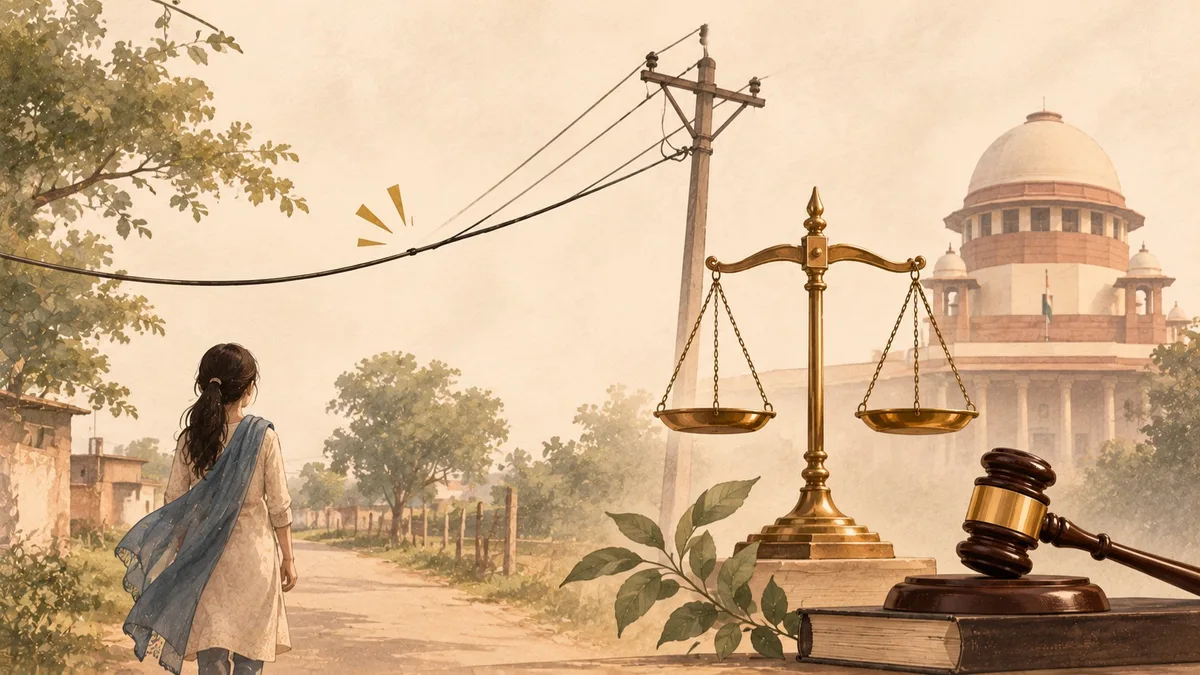
The Supreme Court allowed the appeal of a woman who suffered severe electrocution injuries, resulting in amputation of her right hand and permanent disability. It set aside the Rajasthan High Court’s decision rejecting her compensation claim on grounds of suspicion and restored the trial court’s decree awarding ₹8.70 lakh with 6% interest. The Court held that a civil court must assess evidence on the balance of probabilities and cannot reject a claim merely because the incident appears suspicious without properly evaluating witness credibility.
Key Highlights
- The appellant was a minor when she was injured on 15 July 2011 by a low-hanging live electricity wire.
- She alleged that the electricity distribution authorities had failed to maintain the transmission lines, which had sagged close to the ground.
- The trial court awarded ₹8,70,000 with 6% interest. The Rajasthan High Court reversed the decree, describing the incident as unbelievable and suspicious.
- The Supreme Court found that the appellant’s evidence and supporting witnesses remained materially unshaken, while the utility’s witness had no personal knowledge of the incident.
- The Court held that appellate courts cannot substitute suspicion for a proper assessment of evidence and restored the trial court’s decree.
Background and Procedural History
The appellant stated that she came into contact with a live wire hanging approximately three to four feet above the ground in a village in Rajasthan. She was taken for treatment and later to Agra, where her right hand was amputated. Her case was that the distribution company had failed to maintain its lines despite complaints about their dangerous condition. The company denied negligence and suggested that she had received the shock at home. The trial court accepted her evidence and awarded compensation. The High Court reversed that decision.
Issues for Determination
- Whether the High Court was justified in rejecting the appellant’s case on suspicion rather than a proper evaluation of oral and documentary evidence.
- Whether the evidence established electrocution and negligence by the electricity distribution authorities on the civil standard of proof.
- Whether the principle of strict liability applied once the incident and the utility’s responsibility were established.
Court’s Analysis and Findings
- The Supreme Court held that the standard in a civil case is preponderance of probabilities, not proof beyond reasonable doubt. The evidence must show a fair degree of probability, not merely a theoretical possibility.
- The appellant’s testimony was detailed and consistent on material aspects. Her witnesses supported her account and stated that complaints had been made about the dangerous condition of the lines.
- The utility’s employee admitted that maintenance of the transmission lines was the respondents’ responsibility, but he was not an eyewitness and was not on duty on the date of the incident. His alternative account was hearsay.
- The High Court placed undue weight on perceived improbabilities, delay and alleged inconsistencies without finding that the witnesses were unreliable. The Supreme Court held that a court cannot assume facts unsupported by evidence or disbelieve an incident merely because it appears unusual.
- The appellate court may interfere where the trial judgment suffers from material irregularity, relies on inadmissible evidence or misreads evidence. It cannot undertake a fault-finding exercise based on suspicion alone.
- The Court concluded that the facts attracted strict liability of the electricity distribution authorities.
Final Decision / Outcome
The appeal was allowed. The Rajasthan High Court order dated 10 May 2024 was set aside, and the trial court’s decree in Civil Case No. 02 of 2015 awarding ₹8,70,000 with 6% interest was restored.
Relevant Statutes and Precedents
The judgment discusses Sections 3 and 4 of the Indian Evidence Act, 1872, concerning proof and presumptions, and the civil standard of preponderance of probabilities. It applies the principle of strict liability in relation to hazardous electricity infrastructure. The judgment emphasises the distinction between civil proof and the criminal standard of proof beyond reasonable doubt.
Supreme Court of India judgment/order dated 16 November 2026. This summary is an editorial aid and should be read with the original judgment for authoritative text.
Full Judgement / Attachment
Full Judgement
Frequently asked questions about Supreme Court of India
- What is the role of the Supreme Court of India?
- The Supreme Court, established on 28 January 1950, is the highest court of appeal in India. Under Article 141 of the Constitution, the law it declares is binding on all courts in India. It also hears writ petitions for enforcement of fundamental rights under Article 32.
- How can I check Supreme Court case status or download a judgement?
- Case status, cause lists, daily orders and judgements are published on the official website, sci.gov.in. Reported judgements are also available free through the Digital SCR (Supreme Court Reports) on the same website.
- What is a Special Leave Petition (SLP) and what is the time limit?
- An SLP under Article 136 asks the Supreme Court for permission to appeal against a judgement or order of any court or tribunal in India. Against a High Court judgement it is ordinarily filed within 90 days. Leave is discretionary, and most SLPs are decided at the admission stage.
- Who can file a case in the Supreme Court?
- Only an Advocate-on-Record, a lawyer who has passed the Supreme Court's AOR examination, can file pleadings in the Supreme Court. A party may appear in person with the Court's permission, but most litigants engage an Advocate-on-Record along with arguing counsel.
- How can White Collar Professional help with a Supreme Court matter?
- Post your requirement on White Collar Professional to receive proposals from verified Advocates, Chartered Accountants and Company Secretaries, compare them, and pay securely through the platform. This page also tracks the latest Supreme Court judgements and legal updates as they are reported.