Supreme Court Applies OBC Creamy-Layer Ruling to Pending CSE 2025 Allocations
Court / Authority
Supreme Court of India
Update / Judgement Date
06 Nov 2026
Source
WCP News Bulletin
Author
Dipanshi Bansal — WCP Legal Desk
Reading Time
5 min read
View Count
5
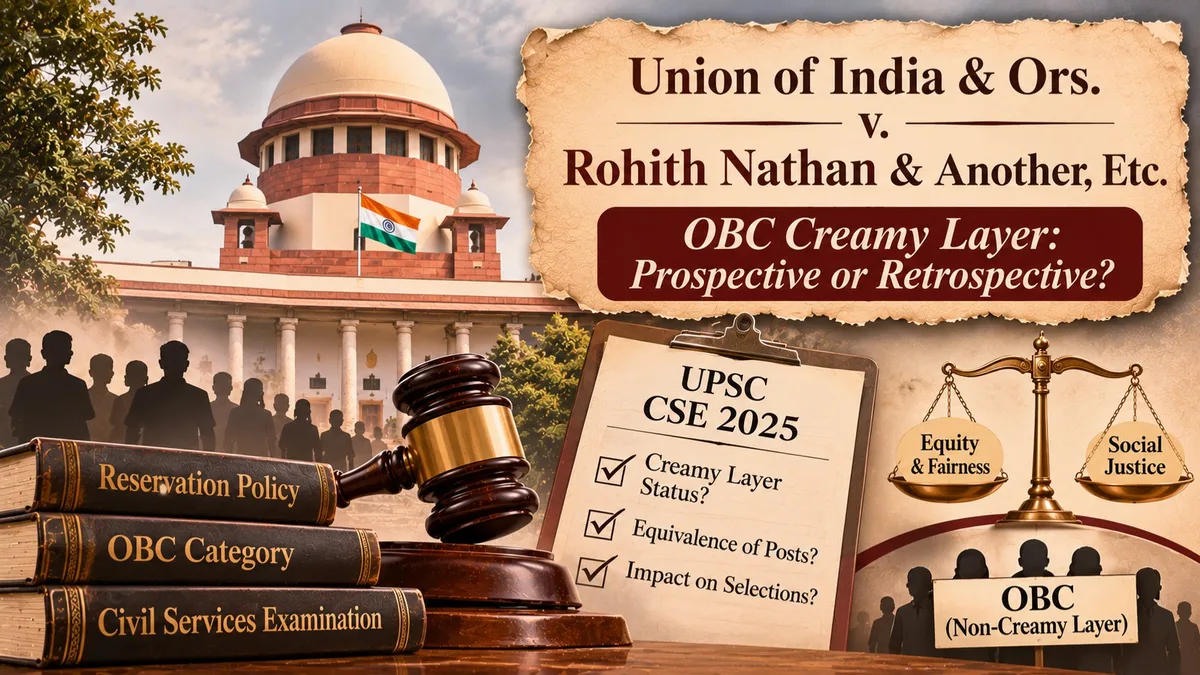
The Supreme Court clarified the temporal operation of its 11 March 2026 judgment on OBC creamy-layer status. It declined to reopen selections, appointments or seniority already concluded, but directed that the interpretation of the 1993 Office Memorandum, as explained in the earlier judgment, must govern service allocation for OBC candidates selected through Civil Services Examination 2025 because that allocation had not yet been finalised.
Key Highlights :
- The Union of India sought clarification of the Supreme Court’s judgment dated 11 March 2026 in Civil Appeal Nos. 2827–2829 of 2018 and connected matters.
- The earlier judgment interpreted the 1993 Office Memorandum and the 2004 Department of Personnel and Training letter concerning determination of OBC creamy-layer status, including the treatment of salary income.
- The Union sought protection for completed selections and appointments, a two-year period to establish equivalence between posts, and transitional treatment for ongoing recruitment and admissions.
- The Court held that the earlier judgment determined the rights of the parties and intervenors before it; it did not direct a general retrospective reopening of completed selections, appointments, service allocations or seniority.
- Claims of similarly placed persons pending before a court, tribunal or competent authority may be considered on their own merits, applying the legal interpretation laid down in the 11 March 2026 judgment.
- Since CSE 2025 service allocation had not been finalised, the creamy-layer principle in the 11 March 2026 judgment must govern that allocation.
- The time for compliance with the earlier judgment was extended by two months from 06 November 2026; the Court did not prescribe a two-year timeline for post equivalence or policy formulation.
Background :
- The 11 March 2026 judgment dismissed the Union’s appeals and directed consideration of the respondent candidates and intervenors under the clarified OBC non-creamy-layer principles within six months.
- The Union argued that retrospective implementation could unsettle recruitment, cadre allocation, seniority and admissions, and referred to the number of reserved vacancies filled over the preceding decade.
- Respondents and intervenors opposed dilution of the earlier ruling and argued that their claims and pending service allocations should be decided under the 1993 Office Memorandum as interpreted by the Court.
What Has Changed :
- Issue: Whether the 11 March 2026 judgment required retrospective revision of concluded selections and appointments, and how it applied to recruitment and service allocation processes still pending.
- Finding: The earlier judgment’s operative relief was confined to the parties and intervenors before the Court. The binding legal principle under Article 141 is distinct from the relief granted to those parties.
- Finding: The earlier judgment does not, by itself, justify reopening selections or appointments already concluded before 11 March 2026, revising another person’s seniority or disturbing completed service allocations.
- Finding: Claims of similarly placed persons pending before a court, tribunal or competent authority may be decided on their own merits, taking the interpretation of the 1993 Office Memorandum and 2004 letter into account.
- Direction: Selections, appointments and roster-point allotments made after 11 March 2026, insofar as they concern reservation and creamy-layer exclusion, must follow the 1993 Office Memorandum as interpreted in the earlier judgment.
- Direction: The Government remains free to formulate a reservation and creamy-layer policy consistent with the Constitution and the Court’s principles. The Court declined to prescribe a timeline for equivalence of posts or stakeholder consultation.
- Direction: The creamy-layer principle clarified in the 11 March 2026 judgment applies to OBC candidates selected through CSE 2025 because service allocation remained pending.
- Outcome: The miscellaneous applications were disposed of and the time for compliance with the earlier judgment was extended by two months.
Compliance Action Points :
- DoPT and relevant service-allocation authorities: apply the 1993 Office Memorandum as interpreted in the Supreme Court’s judgment dated 11 March 2026 to OBC candidates selected through CSE 2025, whose allocation remained pending.
- Authorities making selections, appointments or roster-point allotments after 11 March 2026: apply the same clarified interpretation for reservation and creamy-layer exclusion.
- Authorities need not reopen completed selections, appointments or seniority solely because of the 11 March 2026 ruling.
- Compliance period under the earlier judgment: extended by two months from 06 November 2026. The order does not state a two-year deadline for equivalence of posts.
References :
- Constitution of India – Article 141: law declared by the Supreme Court is binding on all courts; the order distinguishes the binding legal principle from inter partes relief.
- Constitution of India – Articles 32 and 142: referred to in submissions concerning the Court’s power to mould relief.
- Office Memorandum dated 08 September 1993: central instrument governing OBC creamy-layer exclusion, interpreted in the judgment dated 11 March 2026.
- Department of Personnel and Training letter dated 14 October 2004: subsequent clarification considered with the 1993 Office Memorandum in the earlier judgment.
- Indra Sawhney v. Union of India, 1992 Supp (3) SCC 217: cited in submissions concerning prospective operation and reservation principles.
- Supreme Court judgment dated 11 March 2026 in C.A. Nos. 2827–2829 of 2018 and connected matters: principal judgment whose temporal operation is clarified.
Source & Attribution :
Primary source: Supreme Court of India order, 2026 INSC 1201, Miscellaneous Applications Nos. 3313–3315 of 2026 and connected applications, dated 06 November 2026, supplied as the source PDF.
Disclaimer: This summary is an editorial aid prepared from publicly available information. It is not legal, tax or investment advice. Refer to the original notification, circular, order or report before acting
Full Judgement / Attachment
Full Judgement
Frequently asked questions about Supreme Court of India
- What is the role of the Supreme Court of India?
- The Supreme Court, established on 28 January 1950, is the highest court of appeal in India. Under Article 141 of the Constitution, the law it declares is binding on all courts in India. It also hears writ petitions for enforcement of fundamental rights under Article 32.
- How can I check Supreme Court case status or download a judgement?
- Case status, cause lists, daily orders and judgements are published on the official website, sci.gov.in. Reported judgements are also available free through the Digital SCR (Supreme Court Reports) on the same website.
- What is a Special Leave Petition (SLP) and what is the time limit?
- An SLP under Article 136 asks the Supreme Court for permission to appeal against a judgement or order of any court or tribunal in India. Against a High Court judgement it is ordinarily filed within 90 days. Leave is discretionary, and most SLPs are decided at the admission stage.
- Who can file a case in the Supreme Court?
- Only an Advocate-on-Record, a lawyer who has passed the Supreme Court's AOR examination, can file pleadings in the Supreme Court. A party may appear in person with the Court's permission, but most litigants engage an Advocate-on-Record along with arguing counsel.
- How can White Collar Professional help with a Supreme Court matter?
- Post your requirement on White Collar Professional to receive proposals from verified Advocates, Chartered Accountants and Company Secretaries, compare them, and pay securely through the platform. This page also tracks the latest Supreme Court judgements and legal updates as they are reported.